Рубрика: Literature and criticism

  • The content of the tragedy “Alcestis” by Euripides

    The content of the tragedy “Alcestis” by Euripides

    Author of the text: Friedrich Hohenstaufen
    Written in 2021

    Russian and Ukrainian versions

    Of the surviving tragedies of Euripides, the oldest by chronology was the drama “Alcestis” staged in 438 BC. It was staged together with the now lost plays “Cretans”, “Telephus” and “Alkmeon in Psophida”. In that year at the competition tragedians this tetralogy took second place, and the first was taken by none other than Sophocles himself. Of the undelivered plays potentially interesting could be “Cretans” — the story of the Cretan princess Aeropa, secretly in love with a young warrior. Upon learning of this, the angry father ordered a Greek sailor to drown the princess in the sea, but he took pity on the girl and took her to Greece. Ancient authors tell us that the beautiful arias from this tragedy, in which Aerope poured out her failed love, were sung in Athens long after the poet himself had already died. The theme of romantic love, therefore, already in the earliest work of Euripides, comes to the surface in a very powerful stream, and Euripides was appreciated from the very beginning for his melodramatic nature. But we had better turn to the only surviving tragedy of this cycle, the myth of Alcestis. In a very brief form, the plot of the play is as follows: Alcestis agreed to sacrifice her life in order to save her husband, the king of Feres named Admet. But the hero Heracles, who was visiting Thera at the time, defeated the “demon of death” in battle and brought Alcestis back to the world of the living. The hero Admetus was a character who also appeared in the myths of the Caledonian Hunt, and even in the myths of the Argonauts, i.e. this is a very large figure, equal to the Athenian Theseus. From the backstory, which Euripides tells us, we know that the god Apollo himself served Admetus as a shepherd (he was punished by Zeus for his transgression with this slavery), and it was he who, in order to save the king, obtained from the Moires themselves that in case of the date of his death someone else would go to Hades. It is Alcestis who becomes this “other”.

    Despite the fact that female characters play major roles in most of Euripides’ plays, ancient comic poets (especially conservative ones like Aristophanes) tended to portray Euripides as a complete misogynist. We will return to this theme many times, but it is already worth saying here that on the whole this makes sense. Euripides is often justified by the fact that he wrote the feminist play Medea, which is full of compassion for women, and this is true (although Medea is not a good character). The mere fact that women are constantly cast in the lead roles should tell you something. And lovers of stoic and heroic pathos can even say that Euripides’ women are masculine, i.e. “sublime”, so he is not just not a misogynist, but praises women as equal to men. The image of Alcestis sacrificing herself for her husband is the first in a series of such examples. From this we could conclude that “misogyny” from the critics’ point of view consisted only in the fact that the female characters of Euripides were too “masculine” in their character, and this meant only that the poet did not like to portray “feminine” women (and dislike of femininity is the same as dislike of women as such). But in most cases, women sacrifice themselves for men, women are instructed, unless there is a force majeure case, to stay at home and fulfill all patriarchal norms. And in some plays one can even realize that by showing strong-willed women, Euripides is appealing to men not to be inferior to women. His motivation most often seems dubious and far from feminism and any progressive ideas (often women put the greatness of the state above their lives). And the emphases he places are also typical. Euripides will contrast the right women, who are a minority in society (or even only in his plays), with the “typical woman” from real life, and in this respect he expresses a quite contemptuous attitude towards the opposite sex. Even so, we still cannot say that Euripides was a stranger to sentimentality; for example, he was the first of the playwrights who treated the subject, who brought Alcestis‘ children on stage to bid farewell to their mother. Love for solid characters and stoic virtues does not cancel the fact that Euripides sees humanity in man, and recognizes the legitimacy of many mental weaknesses. However, it is also impossible to “justify” the poet by saying that he was definitely not a misogynist. In “Alcestis” and “Medea” notes of anti-feminism are not yet so noticeable, but in the following plays they will be more and more.


    As a work, “Alcestis” immediately breaks out of the already familiar range of plays, since it is a tragedy with comedic elements, although it is not presented as a “satyr drama”. That is to say, these are the first conscious tragicomic productions in history; and Euripides himself may be regarded as the antique counterpart of the bourgeois “bourgeois drama” which would supposedly emerge only in the Modern Age. This tragedy was staged in the greatest chronological proximity to Sophocles’ Antigone as well. Similarities in these writers, however, are found a little, and only with the three first chronologically Sophocles’ plays. In “The Trachiniae”, “Ajax” and “Antigone” we see Sophocles, who was still in extreme proximity to Pericles and his court, living in an atmosphere of sophistry ideas. In this period of Sophocles’ work, he was interested in the women’s question, the natural equality of people and the conditionality of slavery, the superiority of knowledge over faith, and the erection, on this ideological basis, almost full-fledged “Stoic” ethics. He promotes the theme of humanism and sympathy even towards slaves; he shows that women too are capable of fortitude and prudence, and that love (passion) leads not only Dejanira, but also the courageous Heracles! All these themes have only been hinted at by him, but have not yet been put in all seriousness, nor fully revealed. Just all this will be done by Euripides.

    As usual, we will consider first of all worldview moments, the place of Euripides’ poetry in the history of ideological development, philosophical and political agenda of Greece. In this respect, it is immediately striking that the aristocratic god Apollo is portrayed in the play in slightly negative tones. It is not enough for the god that he has saved a friend by giving the life of his wife in return. Now he goes to take Alcestis with a gun in his hands, risking to violate the divine laws, and all this just to please his friend again:

    (Demon of Death) What have you forgotten? Why are you wandering around
    Wandering, Phebus, and again
    From the underbottom.
    Why, offender, why do you take them away?
    Or is it not enough for you that Admetus
    that you prevented his death, that by art
    of the maidens of fate?
    Why dost thou take up thy bow with thy hand?
    Did not Pelias’ daughter herself
    who was willing to die for her husband?
    (Apollo) Dare: only truth and glory are with me.
    (Demon) Only truth? What’s this bow for?
    (Apollo) It’s a habit, demon.
    (Demon) To help houses like this one,
    At least against the truth, god, isn’t it?

    We are shown here a very dubious god who argues by force, and resorts to tricks to break laws and justice; although to his credit, against the background of the same Hercules, he does not use force. But it is hard to say that the god’s behavior here is morally approved. In the same dialog, Euripides goes further, recalling the political engagement of this deity:

    (Demon) Is your law designed for the rich?
    (Apollo ironically) What a fine mind… Who could have expected it?
    (Demon continuing) Until old age from Death to buy off….
    (Apollo silent) So, Alcestis me you will not give me?
    (Demon) Yes, I will not. You know my character …

    The fact that the play’s protagonist, Alcestis, is an admirable person is told almost head-on in the boldest of strokes; and one of the main reasons for this assessment is that she sacrifices herself to save her husband. The very fact of her self-sacrifice makes her “the best of women,” also because by doing so she demonstrates the highest degree of love and devotion. Therefore, when such an important character dies, Euripides shows us a whole ocean of emotions; the suffering of the husband and wife because of the forced separation, the grief of their children, and even a sense of horror at the premonition of death in Alcestis herself. Unlike other playwrights who tried to emphasize the pathos of the sacrificial scenes by demonstrating the stoic will of the characters, Alcestis (still holding her own) shows weakness and fear of the afterlife. Technically, from a classical perspective, this should have diminished the value of her sacrifice; but in fact Euripides only increases the audience’s compassion, and greatly improves the emotional dynamics of the scene. Alcestis gives her final instructions to her children and husband (including remembering to jealously forbid him to find a new wife, lest she plot against their children) and departs for Hades.
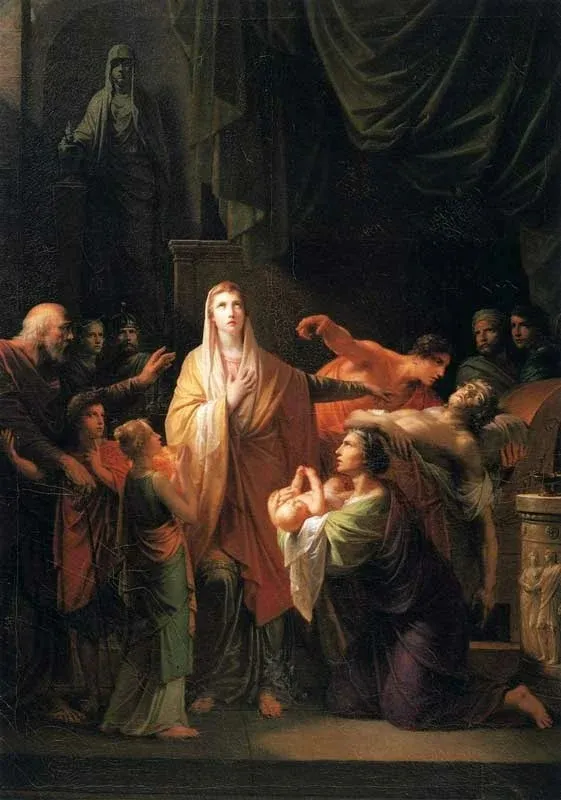
    The Alcestis bids farewell to her family.

    This whole scene is extremely overloaded with emotions. In some places it looks even better than Sophocles‘, but in other places, on the contrary, it is too much, which makes the performance begin to look unrealistic (cf. the stage behavior of 18th- and 19th-century society ladies, with the popular culture of “fainting”). At all times, from antiquity to our time, theorists and practitioners of art say that Euripides was a realist, while Sophocles idealized people, wanting to educate them in new, more “high” qualities. Therefore, Euripides was evaluated a little worse than the same Sophocles. But here even on the example of “Alcestis” we see exactly the same idealization of high and noble qualities of man. It is just that Euripides wished to cultivate somewhat different qualities, less “sublimely stoic” and more sensual-humanistic (we would say “epicurean”). The fact that Euripides was later considered a “lowly” poet is probably due to a perverse association with a number of false dichotomies (reason/feeling, good/evil, older/younger, male/female, white/black, virtue/dissoluteness, Romans/Greeks, Stoics/Epicureans, etc.). If we look at Alcestis, the characters of “exalted” characters are found here even more often than in the idealized works of Sophocles. The only question is the specific forms of this “sublimity”, and it varies.

    Returning to the first scene, to the conversation between Apollo and the demon of death, it is worth reminding that Apollo failed to defeat the demon, but in the best traditions of his image, this god gives a prediction. He says that Heracles will appear in the city and will take the girl to the world of the living. And so, after the scene with Alcestis‘ farewell, in the very next act Heracles arrives in the city. I.e. the motif of divine fate and determinism still penetrates Euripides’ work.

    Father-child conflict

    In the scene of Alcestis‘ funeral, we see another motif that distinguishes Euripides from all the previous plays of Aeschylus and Sophocles. Admetus’ father has come to bid farewell to Alcestis; but the son despises his old father, for the father, who already had little left, was unwilling to sacrifice himself to save his son; or since the role of sacrifice was chosen by Alcestis, the old man could have saved the girl by insisting on a substitute sacrifice. Since the father did not do this even for the sake of his own son, and by doing so he supposedly lost his “virtue”, his presence at the funeral is now perceived by Admetus as an insult to the memory of his wife, and to him personally (it should be understood that Admetus himself could not die, because Apollo arbitrarily decided to rewrite his fate, and someone must necessarily die in his place, but who exactly — it was not precisely prescribed, so there was still room for variation here). Not only the general idea of what is happening on stage, but also the narrative itself changes greatly. Sophocles never, even in moments when the “fathers” were extremely wrong, allowed their “children” such harsh expressions as we see below:

    Over the youth you ruined,
    Do you now come to weep? Condemned
    Before men enough, hardly
    You were even my father, old man.
    […]
    Your age was so short. What feat of sacrifice
    Thou couldst accomplish by thy sacrifice,
    What glory.
    Here
    Thou hast experienced all the happiness of man:
    Thou hast been king from the youngest nails,
    Thou hast had an heir. Behind thee
    All things would not have fallen to ruin. Thou darest not
    Thou darest say, surely, that I have insulted thy old age.
    I have insulted thy old age, that I have not been
    honorable. Oh, for my cares
    You and your mother have paid me handsomely.
    Please hurry up and have more children.
    More children, old man, or else who will be there
    to feed you, and if at last
    You die, who’ll clean up your corpse, who’ll carry it out?
    Who’s gonna take care of your corpse? Not me, not Admet.

    Of course, the society of “elders” from the choir, and the father himself, strongly object to such an impertinent tone. It could not have been otherwise:

    But what a tone, my son! Did you buy yourself a Lydian
    Or did you buy a Phrygian slave?
    I advise you to remember: a Thessalian,
    The free son of a free father.
    before thee. But your childish words
    cannot hurt me. I bore you
    I brought you up to give you your father’s house.
    To give thee, not that I should give thee,
    To buy you back from death with my life.

    The father’s argumentation is simple, the son cannot reproach him for his cowardice before death, because he himself is cowardly and allowed his wife to die in his place (a strong argument, but not really, if Admetus really had no choice because of Apollo, though the father does not know about it). Further reasoning in the dialog concerns whose life is more precious, the old man’s or the young man’s. And the question of “life-love” as such is raised separately here:

    You love life yourself, it seems. In your father
    Why don’t you want to recognize the same love?
    […]
    And you have the spirit to reproach others
    to reproach what you yourself are guilty of.
    Silence, child, we are all of us life-loving.
    I will answer to your scolding with sternness.

    The ideological motive of this dispute is obvious; it is all the more interesting because here the “old man” — the very one who is supposed to embody Sophocles’ “stoic” ideals — rationally justifies his vitality, even when his son demands that he be conventionally virtuous. Euripides generally agrees with the elder, since his son could not challenge any of his assertions, and began simply to press the old morality, the images of valiant death.

    (Admetus) But death will not bring you glory.
    (Feretus) No glory reaches the dead.

    By design, in the eyes of the theater’s conservative audience, the elder is supposed to be “downright” wrong, which in itself is a break in the pattern. And what is more, the chorus of elders chants that the young man should not argue with his father (which is generally “right” in the eyes of the audience); but this formal deference to the elders actually justifies a “lowly” attitude to notions of honor. Even in the very arrangement of roles there is a considerable irony over the “high” poetry of Euripides’ contemporaries. As for Euripides’ own position, it is ambiguous and will eventually lean to the “right”. He cannot dispute the arguments of the elder, but he does not want to fully sign under them either. For Euripides himself, the theme of “glorious death” is of great importance, and he will still try to justify this theme in his later works. Perhaps here, too, he sides with Admetus, but for some reason has made his father’s argument stronger. In that case, it’s a failure.

    Manifesto of Hedonism

    No sooner does the viewer recover from the violation of the “logic of virtue” that he has seen, than we are immediately shown Heracles feasting and visiting Admetus. And again strange things: everyone around knows about the mourning in the house of Admetus, massively dressed in black clothes, but Heracles does not prevent him from feasting! Why does everyone wear mourning? Sure, he even tried to leave, and yes, Admetus himself made his friend stay, out of hospitality, but does that justify such carelessness? Hercules in the story did not know that Alcestis was exactly dead (though he knew, or guessed, that she was near death!), and on this is built the attempt to justify him. But with or without justification, further events do not fit into any picture of the traditional hero’s appearance.

    Even the slave of Admetus (!) grieves, considering Heracles’ behavior inappropriate. And we remind you once again that Heracles in the plays of the previous authors, as well as in the Greek logic of myths in general, is an extremely “stoic” character, the embodiment of warrior virtue. Here, however, he is initially painted in rather negative colors, even against the background of a slave. And so, when Heracles finds that the slave serves him with obvious discontent; what does the hero decide to say about it? Does he try to find out what the cause is? No! “The embodiment of the virtues” Heracles lays out a little manifesto of hedonism to the slave!

    You! Why lookest thou sullenly, why art thou.
    What cares thee, slave? When thou hast served thy guests,
    Thou shalt not make them uncomfortable with a sad face,
    Be cheerful. Thou hast before thee a companion
    and thou hast puffed up thy face,
    and you frown, for the trouble of others…
    Come here, learn, you’ll be smarter:
    Do you know what our life is?
    Come,
    Don’t you know, slave? No one knows,
    If he’ll be alive in the morning. Our destiny
    No science can tell us the way,
    nor cunning can buy its secrets.
    Think it over and have fun. Behind the cup
    A day is yours, but tomorrow, someone else’s tomorrow?
    Thou of the gods art almost special, friend,
    The sweetest of mortal gods, Cypris.
    And all other things aside! My
    If I seem right to you, follow my words.
    If I seem right.
    Come with me,
    (clapping him on the shoulder)
    And we’ll adorn ourselves with wreaths
    From your gloomy thoughts the cheerful splash of wine.
    On your goblet, believe me, you’ll sail away.
    But to the pompous and gloomy, if thou take my judgment.
    Thou wilt accept my judgment, not life but torment.

    Is this not another insult to the whole “virtuous” public? But to somehow smooth things over for the further plot, we are reminded that Heracles did not know about Alcesta’s death; he himself is fiercely indignant when he learns about it from a slave, and even realizes that his behavior was improper. But has his position — «of the gods almost especially, friend, the sweetest to a mortal, Cypris”- ceased to be his position? Certainly not. The image of Hercules is greatly altered here.

    A love story

    Despite the fact that “deception is bad,” Hercules is not angry at his friend, and decides to help. In many ways, he does so because of the same principle of hospitality. Admetus, even in mourning, did not want to reject his friend and burden him with his troubles, and perhaps he was wrong here; but the guest was well received, and so must, as it were… repay the good reception. So Heracles goes to Hades, where he defeats the demon of death in battle (thus fulfilling Apollo’s prophecy from the beginning of the play), takes Alcestis, and places her in the hands of his friend.

    With heavy right hand struck
    He did not deprive me of my feast,
    He honored in me so noble a guest.
    In Thessaly, in all Hellas.
    Who can compare with him in hospitality?

    Euripides talks a lot about fate in these last scenes, as if trying to further justify the deed of Admetus (that he gave his wife instead of himself, did not prevent her), and shows us an amusing scene of exactly how Heracles hands Alcestis back. He doesn’t reveal her name first (!), as if playing a game with Admetus. He does this so that in front of his wife he can reaffirm his loyalty to her, and after that she would reveal her identity to him. Everything goes according to plan and we get a happy ending. The gods did not punish Admetus for his impertinent words towards his father; and Heracles did not lose his valor, even though he was clearly nihilistic. On the whole, everyone should be satisfied (Happy End), but Euripides still left quite a few ideological barbs in the direction of the “mainstream” of his time.
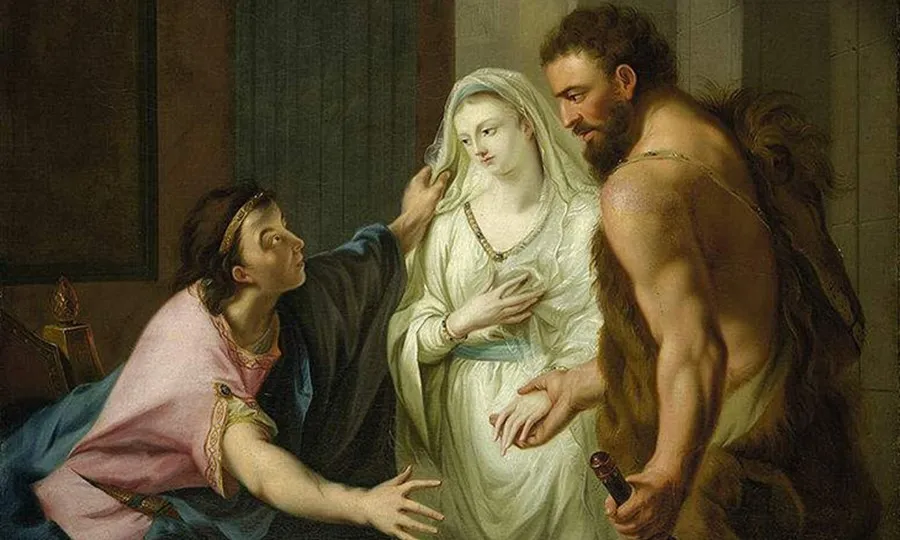
    Heracles brings back Alcestis

    What is separately striking is that we get very atypical characters and an atypical plot. The main characters are idealized lovers. Their tragedy is built on their personal, inner feelings, on their love. To make such a plot the central theme, and even so that no one died, is highly unusual for the theater of that time. So there is also an atypical image for the father, an atypical image of Hercules and an atypical image of Apollo! If we try to describe the main innovations of this play, they are as follows:

    • more expression and feeling than ever before;
    • innovations with the presentation of material (silent tearful scenes and musical intermissions between acts, flashbacks and hallucinatory images);
    • paying attention to characters’ feelings and less “high” pathos;
    • deconstructing old characters and trolling the aristocratic notions to which Sophocles and Aeschylus clung.
    • The image of the “noble slave” emerges, a man of high spirits, highly sympathetic to his masters.

    Another important difference between Euripides and Sophocles (even the early ones) was the development of an intrinsic motivation for suicide for their characters. In Sophocles, suicide is most often committed out of shame for some transgression, or out of fear of punishment; this emphasizes how terrible the transgression was, that it is even unbearable to live afterwards. In Euripides it is the opposite, the motivation is explained by his own desire and good motives, the desire to make a sacrifice to save someone, and by this to show how great was the love.

    But the central theme of the play, if not in substance, then in form, is of course the importance of hospitality. Even in parting, Heracles reminds Admetus once again: And you yourself, always be just and honor your guest.” This is, literally, the “moral of the fable.” But if we were to reveal the plot of the play through the theme of hospitality, then all other moments would have to be relegated to the background. And this theme is essentially irrelevant. We can only note that the behavior of the characters, built around the notions of etiquette — quite traditional and patriarchal, and by making this theme the main theme, Euripides brings to the forefront the notion of moral duty of Heracles. Without this point, it might seem that Euripides is quite the “sophist” and has strayed far from the morals of his contemporaries. Of course, this is not true, but he took the place of “dramatic philosopher” for a reason, so that the “sophistic” elements in his work are significant, and more significant than in any other famous tragedian.
  • Pre-Philosophy: The Nine Lyricists

    Pre-Philosophy: The Nine Lyricists

    Author of the text: Friedrich Hohenstaufen
    Written in 2019

    Russian and Ukrainian versions

    After the above-mentioned five semi-mythical characters and poets of the “Cyclic” — follows the epoch of the “sages” (which, by the way, is very funny, because the word “philosopher” means a lover of wisdom, and “sage” therefore stands above “philosopher”). But the same “Cyclic” poets had other lyricist contemporaries, so before I go on to the “sages,” I will not overlook these men. Some of the early poets were direct contemporaries of the later Nine Lyrics and Seven Wise Men, but these two groups will be separated into separate sections, and we will begin with the lyricists who were contemporaries of Cyclic poets.

    Lyric poetry

    Of the elegiac poets known to us, Callinus of Ephesus (ca. 685-630) is considered one of the oldest. The only thing that has survived from his work is the call to defend the homeland, specifically the defense of “land, children and wife”, as well as another rather archaic in meaning poem, retold in prose by us in this way:

    «You can’t escape fate, and often the fate of death befalls a man who has fled from the battlefield. No one pities the coward, no one honors him; the hero, on the contrary, is mourned by the whole nation, and during his lifetime they honor him as a deity”.

    The same theme sounds no less vividly in the elegies of the Spartan poet Tirtheus (note 665-610), who encouraged the Spartan soldiers in their war with Messenia. Tirtheus ridicules cowards and fugitives in the same way; but it is interesting that when he lists heroic qualities, using the best heroes from the epic as examples, he finds them insufficient.

    Pride will serve both for the city and the people
    He who, stepping wide, will advance to the first rank
    And, full of perseverance, will forget the shameful flight,
    and his life and his mighty soul.

    To die in the first ranks for his native city — this is the supreme feat, and the main quality of the hero. The elegies of Tirtheus also contained an exposition of the foundations of the Spartan state system; they contain praise of Spartan institutions, myths sanctifying the structure of the Spartan community, and appeals to preserve the “good order”. Not surprisingly, these elegies were sung by Spartans even hundreds of years after the author’s death. Tirteus is Lycurgus in verse. But Tirteus himself did not write in the Doric language of the Spartans; he wrote in the Ionian dialect, which was the only acceptable language for the poetry of all Greeks at that time.


    The poetry of Archilochus (ca. 680-630) is more personal and subjective against their background, although it is presented from the same conservative primitivism; he praises his personal life, his military adventures, and his attitude toward friends and enemies. Archilochus lived a life of war, for he lived in a time of constant warfare of his native island against the Thracian tribes, and most likely for this reason he honored Ares as his god. However, despite all this, he treats the tradition somewhat ironically. Thus, for example, Archilochus writes about his exploits in the high-pitched Homeric style, but in the same style he suddenly tells about how in his flight he had to throw his shield (an unforgivable impertinence within the framework of aristocratic ethics).

    In addition, he is considered the founder of the literary iambic, which originated from folk “songs of denunciation” and within which one could pour out invective and mock one’s opponents (cf. battle rap). Archilochus even prided himself on his ability to repay evil for wrongs done to him. He can safely be called the first “battle-rap” in poetry; for example, the girl who refused to marry him, he calmly denounced with epithets whore. But what is much more interesting from the ideological point of view — Archilochus already posed the problem of the changeability of existence, in which everything depends on “fate and chance” (and where are the Gods?), at the same time, he recognizes the importance of human effort. This is already a significant worldview shift; and it is worth noting separately how much Archilochus is in tune with the philosopher Heraclitus, long before he was born.


    The poet Semonides of Amorg, a contemporary of Archilochus (and with him Tirtheus and Callinus), went even further along the path of developing these conventional-progressive features. His didactic poems are dominated by pessimistic reflections on the deceitfulness of human hopes, on the threats hanging over man: old age, disease and death. In the divine management of the world he sees nothing but arbitrariness. The conclusion of all this is to enjoy the benefits of life as long as possible. Along with this, a primitive and patriarchal trolling of women can be found with him, where he categorizes female characters by comparing them to different animals, and thus deducing the very origin of women, as a human species, from different animals. Semonides therefore “went further” very conventionally, and the reasons for this are very pessimistic and “negative”. He has come to criticize tradition only because tradition is no longer good enough for his conservative spirit. But, philosophically speaking, even in this cynicism about women, one cannot help but notice that in his mind it is quite permissible for man to have descended from animals, by, we must suppose, some evolutionary change. We will not say this for sure, but there is nothing impossible in such evolutionism, because only in some 50-60 years evolutionary ideas will already be set forth in the philosophy of Anaximander of Miletus.

    The motifs of pleasure are further developed in the next generation, for example in the Ionian Mimnermus (ca. 635-570), whom the Greeks considered the first poet of love. He is a contemporary of Sappho and of the early “nine,” but little is preserved of him, and we only know that he preached meditations on the transience of life and the importance of pleasure; and that legend reduces him to one of the “seven sages.” The story goes that, it is said that when Mimnermus wrote that a life of sixty years, unmarred by disease and problems, would be considered ideally lived, the sage Solon replied to him that it was better to replace sixty with eighty (certainly wise, but we would say even better with a century). We also know that Mimnerm wrote a poem about the founding of the city of Smyrna, and about the struggle of this city against the Lydian kingdom, which once again proves how easily hedonism can be combined with “high”, in this case with patriotism and historical, paramilitary themes.

    The Nine Lyricists

    As forerunners of the “philosophical turn”, we shall begin, perhaps, with the “lyricists”. The above-mentioned Cyclic epic, together with the classical epic, were the basis not only for painting and theater of the classical era, but also for the lyric genre of poetry, and, in principle, for all Greek art taken as a whole. Under this collective name “The Nine Lyricists”, we have reached a canon, i.e. a collection of authors recognized as the best among the lyric poets of ancient Greece, which was put forward by philologists in Hellenistic Alexandria as a worthy model for critical study. Only four of them concern the pre-philosophical era, and specifically in this article we will only touch upon them (the others for later).

    The first “pre-philosophical” four contemporaries of Thales include: Alcman, Sappho, Alcaeus and Stesichorus.
    The remaining five include Ivicus, Anacreontes, Simonides, Pindar, and Bacchylides.

    So far our reviews have listed about 25 names, each of which for the Greeks was on a par with Pythagoras, and in some cases could be quoted even more highly. With all this material both the “Sages” and the “Lyricists” were well acquainted; it was the intellectual foundation for all of them. Of course there were few more significant names; even in the same field of poetry, a dozen more names of importance to the Greeks could be added. On top of this could be superimposed as many as twenty names of various great politicians, whom the Greeks honored even much later, even in Plato’s time; and this is not even counting the sculptors, architects, and musicians known by name. But if from all this mass of names, which every educated Greek had to know (Thales, for example), to sift out the unimportant ones, there would still be a dozen names, from which consisted the minimum foundation of knowledge for the new generation of sages. And for the philosophical generation itself, i.e. the generation of Pythagoras, our “seven sages” and at least four of the lyricists are added to this impressive list.

    All this I bring only for the modest purpose that when studying ancient philosophy and art, the reader should realize the scale. In the history of philosophy, it is customary to “start with Thales,” but in fact there is much more behind him than Homer’s mythology alone.

    Alcman and Stesichorus — the foundation of future tragedians

    First among the “nine” chronologically is Alcman (2nd half of the 7th century B.C.), who was almost certainly descended from slave parents; he most likely came from Sardis, the capital of Lydia. Alcman is the first poet known from surviving fragments to have written songs for chorus. But, oddly enough, he lived and worked in Sparta in the period after the 2nd Messenian War. In Sparta, where Apollo and the virgin goddess Artemis were particularly revered — maiden choirs were especially common. For them, in addition to texts, Alkman created melodies and developed dance movements. He wrote mainly paeans (hymns to the gods), proomia (introductions to epic recitations) and parthenia (songs for female chorus). It was in Sparta, where Alcman was deeply revered for several centuries, that a monument was erected to him. The text of one of his songs has come down to us; it is composed of separate parts linked by formulas that define the end of one story and the beginning of another:

    1. Glorification of the ancient heroes of Sparta, the brothers Dioscurus, then the sons of Hippocoontes, slain by Heracles;
    2. Reflections on the power of the gods and the frailty of human life, and the moral precepts derived therefrom;
    3. Glorification of the chorus itself, which performed the Parthenios, its leader, and the individual members who performed the dance.

    From the largest surviving passage we learn a few secondary-playing but interesting details:

    «All of them, brave ones, my song will not forget. Fate and Poros (wealth) have broken those men, — the oldest among the gods. Effort is in vain.»
    Or another motif: “Blessed is he who spends his days with a cheerful spirit, knowing no tears”.

    Of course, we have seen similar motifs before in Archilochus, Semonides, and Mimnermus (the latter, by the way, crossed paths with Alkman for forty years of his life); but still, don’t these words look like something out of post-classical antiquity? Isn’t this “decadent Hellenism”? And yet, against the background of the gods, even the greatest mortals are mere “nothing,” and this archaic thought, dominates in various forms throughout Alkman’s writings. Man is not the center of his plots, and it is probable that nothing depends on the will of the mortal. Nor does Alckmann bypass Homer’s plots, and he certainly does not bypass the “Trojan War” with its mythological characters. Moreover, in all “nine” taken as a whole, these motifs are found more often than in the early lyricists (who, importantly, still alive caught the Cyclic poets). This is most likely due to the fact that the wretched “Alexandrian criticism” chose these authors as the “nine”, and mainly because they wrote on the motifs of Homer, the favorite of all these critics, and not because they wrote really well.

    But still it is worth recognizing that although he lives in Sparta, but his worldview almost does not stand out in its conservatism from the average representations of the ancient Greek, from the same Hesiod or Cyclic poets. And of the distinctly good sides we may single out his philosophical views, the very fact of their existence. As we have already seen in the lines above, Poros (wealth) and Fate were considered to be his first gods. Why exactly Poros is not clear, because it is difficult to explain the formation of all things from it. It is true that Alkman seems to separate these personified gods and God as the absolute creator. Poros and Fate arose from something, and this something turns out to be the disordered and unprocessed matter of all things (cf. the philosopher Anaximander’s apeiron), which has the properties of copper. The gods arise out of this matter because before there arises “someone who masters” all things, a demiurge named Thetis. This creator creates the gods of the lower order. From Poros arose a god named Tecmor (and they are used synonymously in the beginning-end pair of opposites). Perhaps these two deities were also used as synonyms of the Sun and the Moon. But then according to Alcman, they were preceded by the god of darkness. We know nothing more, but it is enough to see at least ideas about matter, form and demiurge even before Thales of Miletus has appeared on light.

    One particular trait of Alkman’s is noteworthy — he boasts that he can eat anything, especially “thesame as the people”; he is not ashamed of it. Interestingly, he generally emphasizes eating, drinking, and, most of all, girls and love pleasures; so it is not surprising that much space in Alcman’s poems is taken up by the god Eros. But, together with what has been said before, all this seems rather strange for a poet of Sparta. Alkman’s poetry seems to preach democratic ideals. And the weirdness doesn’t end there. Alkman is credited with a very lively and modern in its spirit and style epigram about Castor and Polydeucus. Despite the fact that these are Spartan heroes, and that he himself is a Spartan poet, Alcman seems proud to be a non-Greek tiller of the soil, and emphasizes his urban and metropolitan origins in one of the poems where he recalls Sardis as his home.

    Alcman resurrects the subjects of the “hedonistic” singers of the past, and again he has glimpses of the shortness of life, the omnipotence of fate (ananke), and even passages a little strange for a Greek man, along the lines of “if only a woman were to become me!”. We even find in him the lines: experience is the foundation of knowledge”; though, of course, here he means mere worldly experience (and we shall see a similar quotation in the maxims of Pherekides). In Alcmanus we shall also find motives of pacifism (“The iron sword is not above the beautiful playing of the kyphar”). All this modern criticism is accustomed to see as a generation of the later Hellenistic epoch. The more interesting, and even more significant in such a context, these old lyricists and sages look to us.

    How such conventionally progressive motifs are combined with a pro-Spartan direction, which is a striking exception to many dozens of other cases, is a question that has yet to be resolved.

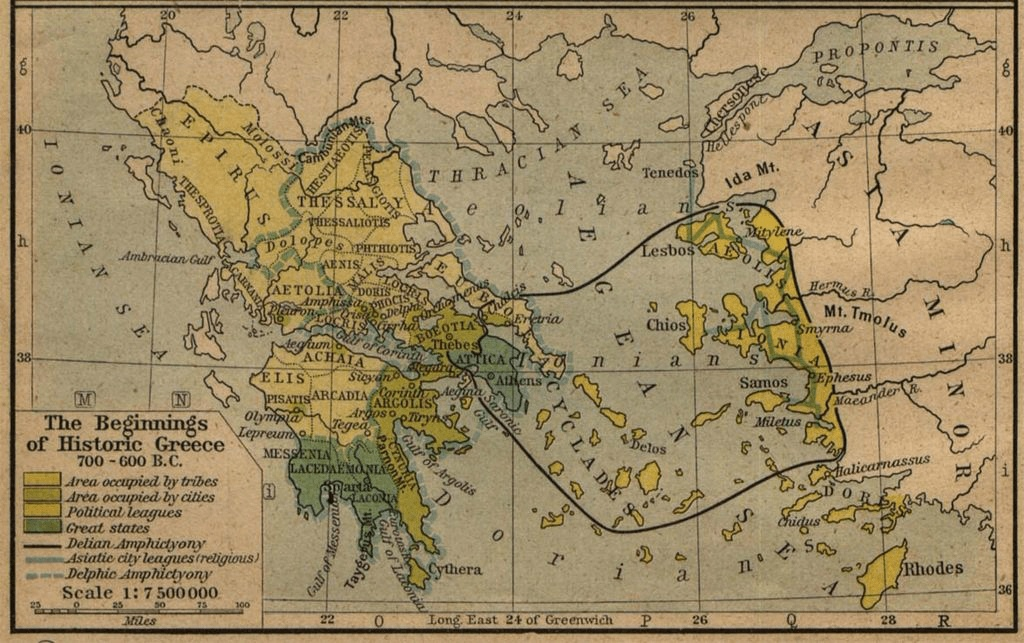
    Map showing the political situation in Greece on the eve of the Classical period

    Like Alcmanus, we can also find motifs of pacifism in Stesichorus of Sicily (630-556). Although he himself was not averse to writing about heroic wars, especially from the Homeric myths, in his conservative and military pathos he sometimes reaches very stoic maxims, such as “it is useless and not at all necessary to weep for those who have died”. And let it not go beyond the old morality of the ancestors, or poetry of Tirtheus, and quite logical for a patriarchal and paramilitary worldview, and let the Stoicism itself does not claim to a high degree of intellectuality. But, nevertheless, if Stoicism is a philosophy (and it is), then finding analogies in the past can be a useful thing, especially if in the future we find Stoic references to the same Stesichorus.

    So, the Byzantine collection “Suda” attributes to Stesichorus 26 books (more than all other Greek lyricists combined), in which the main place was occupied by lyrical and epic poems (in content adjacent to the epic of Homer and the Cyclics; in them Stesichorus gives the processing of old stories in new forms and new interpretation). To the Trojan cycle of Stesichorus belong: “Helen,” ‘The Destruction of Ilion,’ ‘Returns,’ and ”Oresteia.” To the Theban cycle include “Eryphila” (named after the wife of a member of Seven’s campaign against Thebes), and “Europaea”. Of other epic poems are known “Hunters of the Boar” (about the hunt for the Calydonian boar), “Geryoneida” (about the campaign of Heracles to the far west, whence he led away Geryone’s herds of bulls), “Scylla” (about Scylla, which Heracles killed on his return from Geryon), ‘Kerber’ (about Heracles’ feat with Kerber), ‘Cycnus’ (about Heracles’ duel with the son of Ares, Cycnus, who was turned into a swan).

    When processing the plots found in Homer’s poems, Stesichorus sometimes gives them new versions, borrowing material partly from living folk legends, partly from lost literary texts. Thus, the myth of Orestes is developed by Stesichorus differently from the version presented in the Odyssey: in Homer’s Orestes, having killed his mother, only fulfills the duty of revenge, while in Stesichorus’s he is tormented by the torments of conscience as a mother-killer. He also has a version of the myth that Helen was carried by the gods to Egypt during the siege of Troy. Both of these versions, as well as a large degree of emotionality of poetry — formed the basis of the tragedies of Euripides. Also the love motif in Stesichorus is quite strong; suffice it to say, it is from him that the first pastoral idylls are derived.

    The poetry of Stesichorus was highly valued in antiquity. Thus, Dionysius of Halicarnassus reports that Stesichorus surpassed Pindar and Simonides in the significance of his plots, and in other respects combined the merits of both. And such a tragedian as Aeschylus — created his “Oresteia” under the influence of “Oresteia” Stesichorus. It was even claimed that “the soul of Homer lives in Stesichorus”. And the famous late-antique literary critic Pseudo-Longin called Stesichorus “the most Homeric” of poets, and Quintilian said that Stesichorus “raised on his lyre the weight of epic verse,” and added that “if Stesichorus under the excess of talent did not overstep the measure, he could be considered a worthy rival of Homer”. But in all these characteristics he adheres rather to the “Cyclics,” and looks like the last representative of them, though in manner of performance it is still a new lyric.

    Alcaeus and Sappho — a Romance in verse.

    The two central figures of lyric poetry of the pre-philosophical period are undoubtedly Alcaeus and Sappho. They lived in the same place, belonged to the same conventional political grouping and were direct contemporaries, with only a slight difference in age, and I will start, however, with the better known Sappho (c. 630 — 570 BC). She differs sharply from all her predecessors and contemporaries, and even later on few people managed to reach her level of lyricism. Against the background of other poets of her time, she stands out strongly with her more practiced style; better conveys passions and emotions, more and deeper reveals the very feeling of love. She also begins to have near-philosophical maxims reminiscent of the famous “sages”:

    «Wealth alone is a bad companion without virtue around. If they are together, there is no greater bliss.»
    “I love luxury; splendor, beauty, like the shining of the sun, charm me…”.

    Unlike most poets (who were men) Sappho writes about “typical femininity” and the experiences of a girl, so, for example, she is angry that a good guy fell for a “hillbilly” who does not even “know how to wear dresses”. There are also “philosophical” musings; apparently about what kind of guys one might like more:

    «Who is beautiful — he alone pleases our sight,
    Whoever is good — he himself will seem beautiful”.

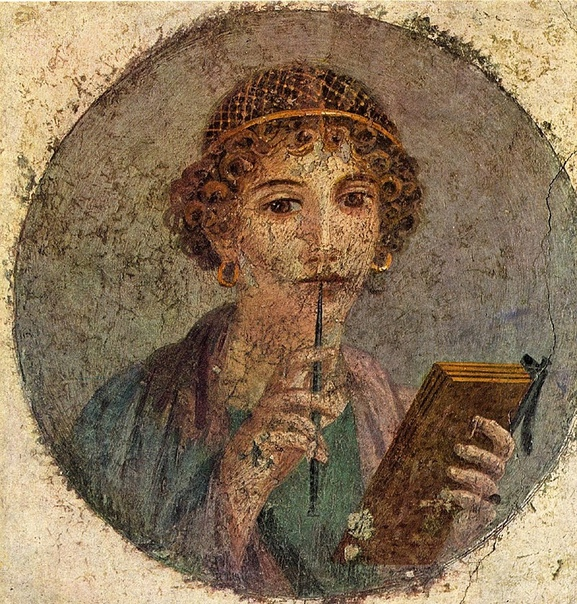
    A Pompeian fresco, possibly depicting Sappho.

    Sappho’s lyrics are based on traditional folkloric elements; they are dominated by motifs of love and separation, set against the backdrop of bright and joyful nature, babbling brooks, smoking incense in the sacred grove of the goddess. All her poems are imbued with kindness, they concern weddings, dances and other easy joys. Traditional forms of cult folklore are filled with personal experiences in Sappho, the main merit of her poems is considered intense passion, naked feeling, expressed with extreme simplicity and brightness. Love in the perception of Sappho — a terrible elemental force, «sweet and bitter monster, from which there is no defense. Sappho seeks to convey her understanding through a synthesis of inner sensation and concrete sensory perception (fire under the skin, ringing in the ears, etc.).


    One of her poems reveals the essence of the provinciality of the Greeks, their sense of their periphery, their secondary status after the Ancient East, which Herodotus would later reveal perfectly. Thus, Sappho praises the very Lydian Sardes (which played a great role for Alkman), where one of her friends went to live. Her father Scamandronimus was a “new” aristocrat; being a member of a noble family, he did not farm the land, but rather was a merchant. In the middle of the 7th century BC, the royal power in Mytilene was abolished and replaced by an oligarchy of the royal Penfelid family. Soon the power of the Penfelids also fell as a result of a conspiracy, and a struggle for supremacy broke out between the leading aristocratic families. In 618 BC the power in the city was seized by a certain Melanchrus, whom the ancient authors call the first tyrant of Mytilene. Soon Melanchrus, through the combined efforts of the poet Alcaeus, his brothers, and the future tyrant of Mytilene Pittacus (by the way, included in the list of “Sages”), was overthrown and killed. The tyrant of Mytilene became their ally Myrsil, whose policy was directed against certain representatives of the old Mytilene nobility, and many aristocrats (including the families of Sappho and Alcaeus), were forced to flee the city somewhere between 604 and 594 BC. Until the death of Myrsil — Sappho was in exile and lived in Syracuse (between 594 and 579 BC), after which she was able to return to her homeland. According to legend, it was at this time that Alcaeus became infatuated with her.


    Alcaeus himself (c. 625-560), a poet who was a contemporary and compatriot of Sappho and the tyrant Pittacus, was also born in Mytilene. When the royal power in Mytilene fell and the first “tyrant” of the city, Melanchrus, came to power, Alcaeus himself was about 7-13 years old, Sappho was about five years older than him. Soon after these events Alcaeus, just coming of age, entered military service; and at this time there was a war against Athens, in which Mytilene was defeated.

    In the battle Pittacus, a comrade of Alcaeus, distinguished himself greatly, and in a key battle of the war Alcaeus himself escaped by throwing down his shield (if this verse is not a mere imitation of Archilochus’ verses). And when, after the participation of Alcaeus and Pittacus in the coup, a certain Myrsilus became the new tyrant of Mytilene, the position of Pittacus himself (a former ally of Alcaeus and one of the “seven sages”) changed after a while; he sided with the new tyrant and was his co-emperor for some time. When this happened, Alcaeus immediately attacked Pittacus in his poems, which in a poet may be considered the most offensive. The reply was not long in coming, and was not at all poetic, so Alcaeus had to flee from the city. He (like Sappho) was in exile at least until the death of Myrsilus (between 594 and 579 BC).


    Alcaeus also has a place for Homeric myths and divine power, but this is no comparison with Stesichorus. And what distinguishes Alcaeus from his contemporaries is that he is openly opposed to the tyranny of Pittacus (which is anti-aristocratic in character), and is concretely political in his poetry.

    “Our fate is in the balance: everything will be overturned upside down if he, the madman, takes power in the city…”.

    or

    «The predator seeks to reign,
    «He wants to reign, he wants to rule,
    «He’ll turn everything upside down
    «the scales are tilted. What are we sleeping?»

    He also composed hymns, one of which, “To Apollo,” is dedicated to the patron god of aristocrats. Though, to be fair, in the lines about drinking, he doesn’t mind “swearing an oath to Dionysus” either. When his conspiracy against Pittacus failed and he was banished, he began a streak of “whining”.

    Most of the poems of his so-called “Stasiotica” (rebellious songs) should be attributed to this period of exile, in particular the most famous ode-allegory about the “ship-state” and the no less famous “ode of arms”. While in exile, the aristocrats did not forget their intention to restore the old order in Mytilene and continued to intrigue against the city government. Finally, the party of the aristocrats gained such strength that the threat of their return to Lesbos in the form of a military invasion became real. Mytilene succumbed to fear; in 589 the city elected an esimnet, who became Pittacus; he was given a term of office of 10 years, was to strengthen the city and lead the democrats in a likely conflict with the aristocrats, whose leader was Alcaeus. About 585 B.C. (when Thales predicted the famous eclipse) Alcaeus, who had become the head of his party and was supported by the gold of the Lydians — returned to the island, but was again defeated in new clashes. Pittacus did not punish his old comrade and released Alcaeus (noting, in the words of Heraclitus, that “it is better to forgive than to avenge”), and he passed from the historical stage, living out his life in silence, according to legend, going to Egypt.


    In most of his poems Alcaeus merges with the spirit of Alcman, and in some places even more radically in favor of amusement and revelry. In him one can find a strange panchline about the romance of sea travel, and an ironic attack against those who fear the sea (incidentally, Pittacus disliked the sea). And what is most interesting, this ideological defender of aristocratic valor, not only glorifies wine, but also describes in verse how he fled in battle and lost his armor and shield. What could be more shameful for an aristocratic supporter? And is his temporary victory with the help of a bribe from the Lydian king a worthy thing to mention in several different verses? Along with this, another point is interesting; it turns out that Alcaeus’ brother served in the army of King Nebuchadnezzar of Babylon, which Alcaeus mentions in one of the verses; an aristocrat, serving as a mercenary!

    Another thing is also striking, referring to the legendary king of Sparta (by the way Alcaeus also paid tribute to Castor and Polydevk), we again get an unexpected outcome for the image of Sparta’s admirers:

    Thus said Aristodamus
    The sensible word in Sparta:
    «In wealth is the whole man;
    He who is good but miserable is nothing”.

    True, despite the atypical for Sparta denial of asceticism, the motive of this saying is rather that wealth is a sign of aristocratism, and this is quite consonant with the pro-Spartan support of the “high-born”. As for the famous affair between Alcaeus and Sappho, there is little or no information about it, and his own poems are absolutely nothing, and say only that he is very embarrassed in front of her and that he is an embarrassed “hick”. So later on Sappho responds to his poems quite appropriately:

    «Be thy purpose beautiful and high,
    Be not shameful what thou wilt say, —
    Ashamed, thou wouldst not lower thine eyes,
    Thou wouldst say what thou wilt

    The beginning of an open ideological conflict

    In the 580s and beyond, the poet of greatest interest to us is a younger contemporary of Epimenides and Mimnermus; Thales and Sappho — the aristocratic poet Theognides of Megara, exiled from his hometown by the radical democratic “revolution”. Among the instructions of Theognides there is, along with the traditional aphorisms about piety, reverence for parents, etc., a large number of poems on topical political themes; they represent one of the most striking examples of the aristocrat’s hatred of democracy. It is a compound of all that is most conservative of the poetry of Tirtheus, Callinus, and Alcaeus.

    For Theognides, slavery exists by nature; men are divided from birth into the “good,” i.e., aristocrats, and the “mean.” “Good” are automatically inherent in all possible virtues: they are brave, straightforward, noble; ‘mean’ are inherent in all vices: baseness, rudeness, ingratitude. However, the “mean” get rich and become in power, while the “good” are ruined and therefore the “noble” gradually turns into a “low”. In relation to the “mean” for the “good” all means are allowed. Theognides is a preacher of violence and cruelty, even outright hatred of all these “freighters” and “ship’s blacks”. He wants “a strong heel tocrush the unreasonable nobility, bend it under the yoke”. But he treats the “noble” no better, because the “noble” themselves are mired in greed and money fetishism. Theognides sharply condemns the marriages of aristocrats to “inferior” people for the sake of their money. He also wholeheartedly condemned the conflicts of the various clans of the aristocracy among themselves, seeing in this the weakening of their conventional “party”.

    Theognides, with his belief in the innate moral qualities of the “good” man, expectedly became one of the favorite singers of the Greek aristocracy; it preserved his poems, supplementing the collection with thematic poems by unknown authors. Theognides fit perfectly into the context of the paramilitary lyrics of Tirtheus and Callinus, which were to dominate the other authors of this new collection.


    A notable contemporary of Theognides was the satirical poet Hipponactus of Ephesus (ca. 580-520). Taken together, they seem to complete the early poetic history of antiquity and echo the new, philosophical generation. By the time of Hipponactus’ death, for example, Heraclitus, though only a 20-year-old youth, was already living.

    Hipponactus came from an aristocratic family; but he was banished from the city for attacking the local rulers; so he moved to Clazomenes (a town nearby, where the philosopher Anaxagoras would later be born), where he led the miserable life of a “jester and joker.” The dates of his life suggest that Hipponactus caught the capture of Clazomenes by King Croesus, as well as the fall of Croesus himself and the advent of the Persian monarchy. From the work of Hipponactus about 170 passages have survived, in which he depicts the life and life of the urban lower classes, without stopping and before frank naturalism. Other passages depict small artisans and representatives of the social bottom, spending time in the city nooks, suspicious pubs, hapless peasant or cunning artist, belonging to the same layer of “the dregs of urban society”, all of them engaged in dark deeds, often resolving disputes with the help of scolding and beatings. Hipponactus portrays himself as a half-starved ragamuffin, expressing his hostility to the aristocratic worldview. In this respect, he already reminds us of the outlines of the Cynic worldview.

    Several of his poems parodying Homer and the Homeric epic are consistent with this social position. A special place is occupied here by one hexametric fragment in 4 verses, probably from a heroic-comic poem, praising in Homeric epithets the monstrous appetite of a certain Eurymedontiad. These two passages prove that Hipponactus was not alien to the literary tradition (in addition to the fact that the extant fragments of poems themselves testify to the high level of his poetic training). The image he created of a beggar-beggar is most likely a mask designed to “epathetize” his listeners.


    In connection with Hipponactus (perhaps someone from his direction, but a little later) there arises a parody of a heroic epic called “The War of Mice and Frogs” (“Batrachomyomachia”), which we recommend to read in full. The subject of this parody is both the aristocratic heroics of the epic, its Olympian gods, and the traditional devices of epic style, beginning with the obligatory invocation of the Muses in the introduction. The frog king Vzdulomorda, carrying the mouse Krohobor on his back across the swamp, was frightened by a water snake, dived to the bottom and sank the mouse. Krohobor belongs to a distinguished family, has a whole pedigree. A war therefore breaks out between the mice and the frogs. Both militias are armed according to the epic pattern; namely, we are shown the gradual appearance on the stage of the armament of both sides in all sorts of detail (naturally of the “helmet — walnut shell” level). The Olympian plan, i.e. the council of the gods, is also introduced. The parody of the gods is extremely sharp and probably already ideologically connected with the philosophical criticism of mythology. Athena refuses to help the mice for reasons of extremely insignificant offense:

    The peplos were chewed then, which I worked on for a long time,
    Soft fabric I wove on a thin base.
    They turned it into a sieve! And the mender, for the sin of it, has come,
    He’s asking for interest, which is always depressing to immortals.

    And in general, the gods better not interfere:

    Gods! Let’s not interfere in their fights! Let them fight themselves,
    Let none of us be wounded by their arrows.
    Their power is daring, even with immortals.

    If the author is not Hipponactus himself, he is certainly one of the main inspirations for this magnificent poem.


    Thus Hipponactus forms together with Theognides a kind of contrast of opposite extremes. Of course, even before the aristocrats had their ideological poetry, and a vivid expression of this political conflict was the struggle between Alcaeus and Pittacus, but until now the anti-aristocratic (i.e. in essence already democratic) side did not have consistent supporters, and the opposition had only an accidental character connected with the personality of a particular poet.

    Hipponactus is a conscious opponent of aristocracy.

    In the images of Theognides and Hipponactus, the conflict between the aristocracy and the people finds its extreme expression, but still in its simplest form. The “philosophical turn” that would give this conflict more gravity was just beginning to emerge. The Greeks themselves considered the beginning of this turn to be the sayings of the Seven Wise Men, among whom was the famous Thales of Miletus.

  • The scale of the catastrophe for ancient literature

    The scale of the catastrophe for ancient literature

    Author of the text: Friedrich Hohenstaufen
    Written in 2018

    Russian and Ukrainian versions

    Not everything of ancient literature has survived, it is a well-known fact; and even the little that has survived has not always been preserved in its complete form. We know a great many names of ancient authors from whom we have not a single line; but even of those authors whose works have survived and are considered “classics” today, in most cases not everything has survived. Thus, of the numerous poets in the genre of Greek tragedy known to us today by name, only three of the most prominent — Aeschylus, Sophocles and Euripides — have survived as complete works; at the same time, only 7 (or 7.8%) of the 90 plays of Aeschylus have survived in full, 7 (or 5.7%) of the 123 dramas of Sophocles, and 19 (or 20.7%) of the 92 works of Euripides. In total, out of 305 plays by only three authors, albeit extremely talented, only 33 works, or 10.8%, have survived. And this is with such prominent names! One can only imagine how many thousands of plays were written by their lifetime contemporaries alone.

    The same applies to the comedy genre. Of the 40 works of the famous comedian Aristophanes only 11 plays (or 27.5%) have survived. This is a very large index of preservation, against the background of tragedians, but the fact is that Aristophanes is the only comediographer in general anyhow preserved, while by name we know at least two more of his contemporaries, which later Alexandrian criticism put on a par with Aristophanes, and sometimes even higher. But even the recognition of the critics left no chance of preservation for them.


    Already here it would be worth suspecting that if the famous people have reached our times in such a bad condition, it means that the “average situation in the ward” was much worse. According to approximate calculations, we know the names of about 2000 authors who wrote in Greek before 500 AD (before the conditional fall of the Western Roman Empire). And these are only the known ones! At least in some form, the texts of 253 of them (or 12.7%) have been preserved, and those, for the most part, are fragmentary, in quotations or extracts. So often there is not even a page of text. Similarly, we know the names of 772 Latin-speaking authors who lived before 500, but the texts of only 144 of them (18.7%) have survived. Taken as a whole (397 out of 2772 authors), this is only 14.3% of the potential for ancient literature. It should be borne in mind that this calculation is based on the names of authors; and as we have just seen, on the example of the four largest authors, even they were preserved by about 10-15%, what to speak of secondary authors, from which there are only a few passages or nothing at all?

    Let’s assume for example, although it is not true, that 10% of their written heritage would have survived from each author; even this extremely insignificant value would have amounted to 3.6% of the total amount of literature that could have reached us. And that is only if all the authors had been preserved with the same zeal with which Sophocles was preserved. But, since the minor authors were preserved so poorly that simply nothing has survived from them, it is safe to assume that only of the known names of authors and the titles of their works, +/- about 1% of the entire heritage has survived from antiquity to our time; and how many authors remained completely unknown even by name — we can only guess.

    More striking examples: Menander — the most famous comedy writer of antiquity during the so-called “Hellenistic” period, an incredibly popular author even in late Rome — but by the end of the 19th century he was already considered completely lost. Even after the incredible discoveries of the 20th century, only 7 of his 108 comedies have survived, of which most have survived about half, and only one comedy, “The Misanthrope” has survived in its entirety. Just one comedy out of 108 works! And this is the most popular author in antiquity. No less popular in his time philosopher Epicurus — wrote about 300 works, and from them only 3 letters and a hundred small excerpts have survived. Chrysippus — a Stoic philosopher, of whose 705 works not a single one has survived (although the excerpts will accumulate to 2-3 books in the format of ancient sizes). The same Democritus, whose collection of works existed in the first centuries of the Empire, a century after the last mention completely disappears. And similar situations can be counted in dozens! Only a small part of the list is available, for example, on Wikipedia.

    Antique Libraries

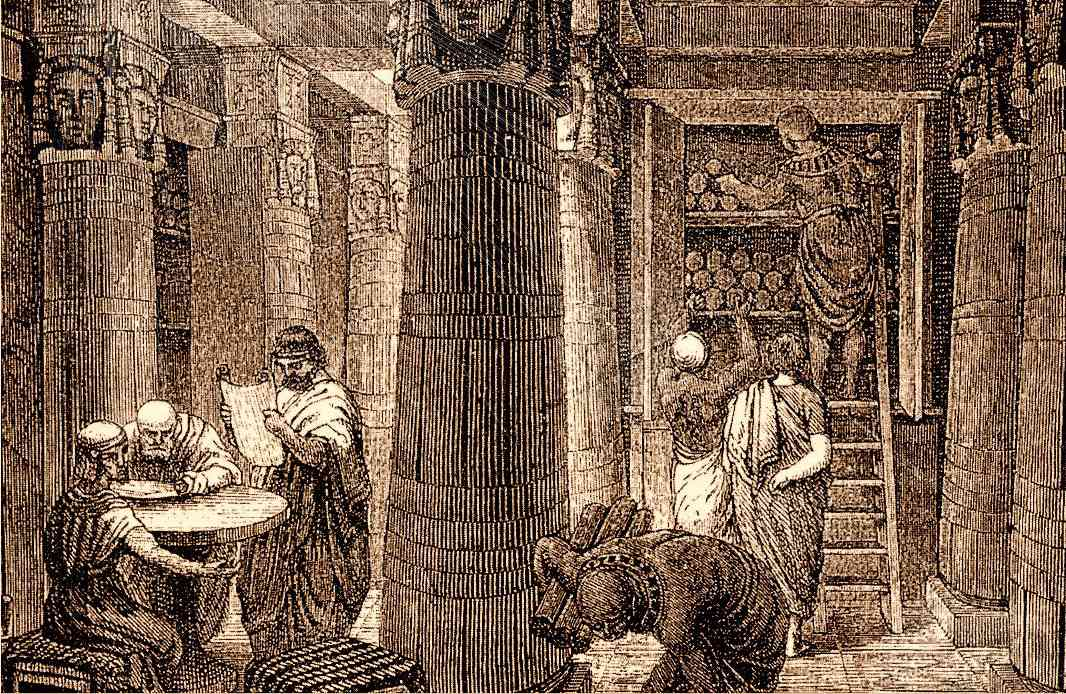
    The number of libraries in antiquity was also quite large. The largest in the ancient world was the well-known Library of Alexandria, which included, according to various estimates, from 400,000 to 700,000 scrolls, mostly in Greek. Some modern scholars believe this number is overestimated and give another estimate — from 10 to 50 thousand scrolls. But even this figure looks quite impressive. The needs of intellectuals for books led to the transcription of at least 1100 scrolls a year (which means 50 years of work to reproduce the scale of the Library of Alexandria alone, and that is underestimated).

    The volume of Latin literature was apparently comparable to the scale of the Greek world. In Rome, closer to the 3rd century AD there were large state public libraries supported by the emperors. There were 28 such libraries in all; each had two sections, Latin and Greek. And that’s not counting the numerous private libraries. One of the last mentions of public imperial libraries can be found in the edict of Emperor Valentus from 372 “On Antiquaries and Keepers of the Library of Constantinople”. The edict appointed four Greek and three Latin specialists in the restoration and copying of ancient books. In the capital of the eastern part of the empire, i.e. Constantinople, even in the fifth century, on the eve of the collapse of the west and the invasion of Atilla, the imperial library included 120,000 books. But the problems began after the so-called “Crisis of the 3rd century”. The decline of interest in scholarship and libraries in 4th century Rome was witnessed by Ammianus Marcellinus, who stated that “libraries are like cemeteries”. The civil wars of the late Empire and the barbarian invasions of 410 and 455 seriously damaged Roman libraries. According to a single mention by Sidonius Apollinaris, bishop of Gaul (Ep., IX, 16), one of the Roman imperial libraries was still functioning in the 470s, the last years of the Western Roman Empire. As a result of this desolation and the cessation of interest in the sciences, by the sixth century — by the time of Cassiodorus’ work — books had already become rare in Italy.


    It is a little more difficult to determine the scale of private libraries, since tradition has preserved only occasional names of owners of large book collections. The size of these collections was sometimes exceptionally large, and could be compared to the libraries of the capital: a certain grammarian Epaphroditus (mentioned in the “Judgment”) compiled a library of 30,000 scrolls. The collection of Tirannion (Strabo’s teacher) was about the same size. At the beginning of the 3rd century AD, the physician Serenus Sammonicus collected 62,000 scrolls, and his son gave them to the younger Gordianus. Such libraries are quite comparable to the legendary libraries at Pergamum and Alexandria. But only one single integral library has survived to our days — in a villa in Herculaneum; and it stored, according to different calculations, from 800 to 1800 scrolls, mostly Greek and related to the philosophy of Epicureanism.

    I.e. in the 3 private libraries mentioned above alone there was about 100 times more material than in the extant Herculaneum (about the same 1% preservation rate), which even so is considered an incredibly valuable find, with many fundamentally new sources. And how many other private libraries existed that we don’t realize existed? And how many more of the 28 public imperial libraries kept? Of course, the same editions must have been frequently repeated there, and yet the scale of the loss is quite estimable.

    Materials and Causes of Disappearance

    As can be seen from what we have said above, the centuries-long literary production of antiquity was very large, and the works that have survived to us in their entirety constitute a tiny part of it. The decisive role in this process played not only a simple historical accident. An ancient book could not lie for centuries due to the fact that the writing material was Egyptian papyrus, starting from the VII century BC. In the climatic conditions of Europe, papyrus scrolls wore out rather quickly: already in antiquity it was considered that a book-scroll older than 200 years was a great rarity. By the II-I century B.C., animal skin parchment began to compete with papyrus; but the parchment book (the so-called “codex” in the familiar book form) displaced the papyrus scroll only during the transition to the Middle Ages. In its bulk, the composition of the surviving monuments is the result of successive selections made (both in antiquity itself and at the beginning of the Middle Ages) by a number of generations who preserved from the literary heritage of the past only that which continued to arouse interest. An antique text written on papyrus could be preserved only if it was copied from time to time. And what is characteristic, monuments of ancient pagan culture were transcribed on papyrus scrolls, and new — Christian books were written on parchment codices. This created additional conditions for pagan knowledge to gradually disappear, even without any barbaric burnings. This point is also interesting because we can overestimate the negative influence of Christianity in the times of IV-VII centuries, when papyri, which had already decayed by the time of the Renaissance, could still be in circulation.

    According to Italian finds, codices were not yet widespread until the 3rd century A.D., when the crisis came. But somewhere from the year 400, the codex became the only form of book, and up to the year 800, there was a gradual increase in the number of books produced. Just in the period from 400 to 800 most of the manuscripts had religious content; and in the sixth and seventh centuries secular works were probably not copied at all. The originals had decayed, and as a result, when interest in ancient literature began to return in Christian Europe, it was already hard to find. A study of Codices Latini Antiquiores conducted in the 20th century found, among other things, that not a single complete Latin manuscript created before the middle of the 4th century has survived. Only fragments, mostly papyrus, found as a result of archaeological excavations have survived. Works unpopular in the fourth to fifth centuries (including Christian works) have been largely lost.

    In some cases, works that were lost in antiquity may have survived by chance; finds of this kind have begun to appear since the 19th century in connection with the discovery of papyri in Egypt (Aristotle’s «Politics of Athens» was discovered in this way). In the last 50 years, a large number of papyrus fragments from the Hellenistic and Roman eras have been discovered here; most are documents, letters, etc., but some contain literary material. Although there are very few scrolls with complete works among these papyri, and they are usually insignificant scraps, the papyrus finds are every year enriching our knowledge of ancient literature, especially in those areas that suffered from Late Antique selection. But what is particularly characteristic is that the increment of material delivered by the papyri relates almost exclusively to Greek texts; works of Roman literature rarely reached southern Egypt. And this illustrates once again the fundamental nature of the Latin-Greek division of the Empire itself.


    With regard to fiction, the selection made in late antiquity was based mainly on the needs of the school, which taught literary language and stylistic art. The school for its own purposes selected the most outstanding writers of the past, and preserved their works, but usually not in the form of a complete collection of works, but only individual works, the best examples. In this “selection” from the classics of literature, certain branches and even whole epochs could fall out of the sphere of school interests, and this circumstance strongly affected the composition of the extant monuments. Greek lyrics, the literature of the Hellenistic period, and early Roman literature suffered particularly.

    The amount of what was lost increased with the centuries, especially due to the sharp decline in the cultural level during the demise of ancient society. Meanwhile, it was this era, when papyrus scrolls were transcribed onto parchment, more durable in European conditions, that was crucial to the continued preservation of the monuments of ancient literature. The antique texts that survived in the first centuries of the Middle Ages have overwhelmingly survived to our time, as interest in them began to grow considerably from the 9th century AD. But even here, however, not all is well. For example, the “Library” of Patriarch Photius (IX century) contained abstracts of 279 works, but almost half of them have not reached our days. Therefore, let us repeat our conclusion once again: we can safely consider that only of the known names and titles of the works of antiquity have reached us +/- about 1% of the entire heritage; and how many authors remained completely unknown even by name — remains only a guess.