The title of this article was chosen for a reason; it is connected with such a scholar of the Epicurean school as Zeno of Sidon (150-75 BC). Who was this Zeno? We know that he was a man of considerable influence, and that it was under his patronage that Epicureanism became the leading doctrine in Rome. Even Cicero (in “De natura deorum”) called Zeno the wittiest of all Epicureans. According to Diogenes of Laertes, he wrote extensively; and Proclus speaks of one work in which Zeno attacked the validity of mathematical proofs and criticized Euclidean geometry. Sometimes he was even called “the leading Epicurean” (Latin: Coryphaeus Epicureorum), and Cicero declares that Zeno despised other philosophers and even called Socrates “an Attic jester (scurram Atticum).” So the recognition of wit, coupled with all this, paints us a man of great amusement and irony.
His own writings have not come down to us, but the surviving treatise of his pupil Philodemus is based on the lectures of Zeno, from whom some passages in the first book of Cicero’s De natura deorum are probably borrowed. Of his philosophy we may guess from the fragments of Philodemus entitled “On Revealed Criticism” and “On Anger,” from the titles of which the title of our own article is derived. We know that before Zeno the scholarch of the school was the “Garden Tyrant” Apollodorus, but why he received this nickname we can only guess. The scanty information does not allow us to conclude that Zeno created his philosophy in a struggle with his predecessor; he himself was most likely not against a return to the classical hypercriticism and acrimony of Epicurus. But we know for sure that already Polistratus, the third scholarch of the school, after Hermarchus (d. 250 BC) tried to carry out a reform in the school, which stated that since the main goal of Epicureanism is the state of “ataraxia” (equanimity, tranquility of the soul), then all polemics should disturb this state, and therefore it is worthwhile to simply merge with the crowd in everything and stop all bickering. The abrupt disappearance of the Epicureans from the radar of the public agenda of the time may indicate that this reform lasted until the appearance of Apollodorus (under whom Epicureanism begins to penetrate Rome). The fact that Zeno of Sidon had to theorize about the state of anger; and that when Cicero mentioned the Epicurean Albucius, emphasizing: «This is the kind of promiscuity that has blossomed in the Epicurean garden!You are in the habit of getting hot-tempered.Zeno even used to swear.And what to say about Albucius?» —suggests that this was indeed an important turn. And the fact that “Zenoeven scolded” speaks unequivocally of the way in which he could interpret criticism, and the anger it provoked.
If we consider the question of the opinion of Epicurus himself, as well as of his closest disciples (Metrodorus, Hermarchus, Polyen, and Colotus), they were all openly determined to criticize their rivals. So there is nothing surprising in such a turn even from the point of view of “dogmatics.” The only question arises as to how legitimate was Polystratus’ reform of anger? This is what we will discuss in our paper.
The central thesis of Epicureanism is that the goal of life is not just “the reduction of suffering” but pleasure. And although it is even interpreted as a result of the reduction of suffering, but still, if it were completely so, then the Cyrenaic philosophers would be right that such a blessed Epicurean sage would be no more alive than an ordinary stone. After all, both pleasure and suffering are some kind of movement in the soul (which should be understood by analogy with the movement of blood in vessels, but rather along nerves — see Lametri‘s theory of animal spirits). The absence of “bad” motion is not yet the cause of “good” motion; and pure rest is insensibility, and therefore not pleasure at all. Epicurus must have been aware of this criticism, since it arose in his youth, so that it was not for nothing that he himself emphasized not so much that he was delivered from suffering as that he received from life precisely that pleasure. Here it is also worth recalling that Epicurus quite considered pleasure in two kinds, as “passive” and “active”, and recognized in general both kinds, though with preference for the passive. But what is this active pleasure?
“Serenity [ataraxia] and the absence of suffering of the body are the pleasures of rest [passive pleasures], and joy and mirth are regarded as the pleasures of motion [active pleasures].”
So, we see — these are joy and mirth. A fairly moderate version of what might be considered active pleasures, but Epicurus in this form recognizes them too. So if anger causes a “negative” movement in the soul, how can one derive pleasure from it? This is where another of Epicurus’ theses comes partly to the rescue: ‘It is better to endure these certain sufferings in order to enjoy greater pleasures; it is useful to abstain from these certain pleasures in order not to endure greater sufferings‘.
Or more simply put, if we paraphrase it to suit our topic, «one may endure the negative aspects of anger in order to enjoy tranquility of mind afterward.Or it is useful to disturb the tranquility, so that it will not be further disturbed in the future by the unexpected discovery that you have been wrong all your life”.
Criticism of opponents allows us to realize some possible misconceptions of our own, which would inspire uncertainty in the soul, and therefore some anxiety, and therefore distance us from that very “ataraxia”. Only full knowledge of the nature of things (see our essay on Truth) is a reliable basis for peace of mind (this is the essence of the whole letter to Pythocles). It is not even the exact certainty of how a phenomenon, such as snow and hail, arises that is important, rather it is important that all “equally probable” explanations, no matter how many there are, have the same origin (the physics of atomistics). In that case, Epicurean physics will be right in its very essence, whatever the nature of the phenomena in its external manifestations actually is. A first-order truth need not establish a secondary truth; so relativity is combined with dogmatism. But the main pathos of this principled atomism was not to admit any “non-physical” explanations. By allowing the latter we open the way to superstition, and through them to all kinds of fears of the beyond, which prevents normal ataraxia (cf. — practically all Stoics except Panethius recognized astrology and the science of divination, etc.).
However, we have gotten too far off topic. The occupation with physical questions and the defense of atomistics forces one to polemize (!) with the opponents of the atomistic theory. And these questions always shift from pure physics to metaphysics and theology as well. It turns out that it is necessary to refute opponents on all fronts at once, and it means that it is necessary to possess all kinds of knowledge in order to defeat enemies comprehensively.
As one Epicurean says in Cicero — “Epicurus was not uneducated, but ignorant are those who think that even an old man should repeat as learned what a boy is ashamed not to know”. Thus, for example, Philodemus of Gadara, before denying the usefulness of the science of music (for which he could be called ignorant of music) — thoroughly goes through the work of the Stoic Diogenes of Babylonia. It is not a simple denial, but a denial already after assimilating and analyzing the views of the opponent. It was not the fault of the Epicureans that the systems of the time collapsed under the weight of their own imperfection.
In the process of covering all knowledge in all subjects, you are forced to polemicize willy-nilly against all hitherto existing schools. This is the inevitable fate of the “polymath,” of any pretender to the role of Homo Universalis. The only question is how to synthesize all this knowledge into a consistent system; otherwise, “total criticism” will end in a simple denial of the correctness of everything at all (which is what the same “polymathic” skeptics have done). But what happens if you try to combine everything? Obviously, you’ll end up with the same little-revered and internally contradictory eclecticism (which Stoicism is to some extent). But the main goal is the absence of fears and anxiety; and in order not to be afraid, one must have a firm knowledge of everything; so skeptical doubt or pseudo-scientific eclecticism will obviously not fit here. Already at the level of this attitude it becomes obvious that the Epicurean’s aim is to become smarter on the way to ataraxia. After all, the main danger to the tranquility of the soul hides in stupidity, with which even Aristippus agreed.
This is why Epicurus says that “itisbetter to be miserable with reason than to be happy without reason”.
Let’s imagine that there is both criticism and anger going on here
So, the intellectualism of Epicureanism is generally explained. Yes, the sciences are not an end in themselves, but one cannot do without them; after all, what if I am wrong, and it turns out that I am destined for the afterlife, and that this could easily be proved in my lifetime? Hence the need for polemics. But don’t other schools have the same situation, perhaps with different goals? Why is it that the same Stoicism cannot claim to be intellectualism? And why is it that, concerning our topic, polemics cannot be conducted without anger and scolding?
Answering the first question — it is enough to recall that Stoicism does not burden itself with unnecessary reflections on the nature of virtue. It is practically self-evident (and is actually drawn ready-made from society), and makes the picture of the world strictly black and white. Although to some extent this leaves the Stoic with a choice, it is not so difficult to make that choice when you already know what the obvious “evil” is. And if there is still some choice here, in general, necessity reigns over the world, and this also eliminates the need for any further reasoning. Everything that happens is right a priori. And in general, since “fate” in many respects has the features of a deity, everything is not just right, but is pre-conceived by the most perfect being (God/Reason) according to a certain plan, having assigned its goals to everything (teleology), which only need to be fulfilled in order not to violate the most perfect plan. This is how the study of physics-theology leads to the conclusion of what is “good” (yes, they do have an explanation, but it is extremely weak in its foundations). Good is everything that is necessary for God-Logos-the Whole; and he needs a priori everything that you observe. In principle, it needs even the existence of evil (see Chrysippus and Aurelius on this).
And if the society has already defined what is good and what is evil, but its members themselves constantly allow evil — then the task is simple, to try to avoid evil as much as possible. That is, to take the conditional patriarchal norms as a given, and to bring their ideas about “virtue” to the maximum limit. Of course, reasoning about the Whole and its parts requires some prudence, and of course it is still desirable to read Heraclitus and reflect on it — but in the future the Stoic will not need to burden himself with the choice. Always do the “right” thing. It would seem very simple and convenient, why not use it? But the problem is that you are just as much a member of society, a “common man”, and also constantly allowing evil, one way or another. That’s why “meditations” are so important for Stoics; you have to remind yourself of your goals every day, you have to constantly monitor yourself, etc. etc., which only proves that the Stoic himself is unable to fulfill his own requirements, and that he has a hard time putting “Stoicism” on subconscious autopilot. But that is another story altogether. For now, the central thesis is that Stoicism is “theoretically” simple, a binary opposition and primitive logic stemming from teleology.
But Epicureanism is quite another matter! It postulates indeterminism at the level of physics to further defend free will, but now at the level of our lives; and this opens up a much greater variation of choice. In addition — Epicureanism destroys the very logic of “absolute good and ‘absolute evil’ by introducing a theory of the origin of society and the state, as well as a theory of the emergence of knowledge from ‘experience’ (to argue against the skeptics, Stoia created a more elaborate sensationalism than even Epicurus, but it had no serious consequences for the Stoic view of the world, just a tool against the skeptics). In other words, “good and evil” are either subjective or socially conditioned, which does not make these views true (cf. Helvetius), and this widens the range of our choices even further. One could argue that here, too, the binary opposition (pleasure-suffering) governs choice, defining “good” and “evil”. But unlike Stoicism, it says that not all pleasure is good, and not all suffering is evil. There is no such variation in Stoicism, for vice cannot be good and virtue evil; it cannot by definition, not even in some trivial matter. What compels the Epicurean to make the “right” choice? Only the fullness of knowledge of all the nuances, not the fullness of knowledge of one trivial truth from the Logos. These are quite different levels of intellectualism, and this difference stems precisely from the degree of complexity of the basic concepts of good and evil.
The second problem was: why can’t polemics be conducted without anger and profanity?
Of course it can. But if we recall the title of Zeno-Philodemus’s work, it sounded in full as “On frank criticism”. Here it is obvious that if we try to behave courteously, the criticism will not have all frankness, its corners will be smoothed, and thus the goal (the assertion of one’s rightness and total destruction of the opponent) will not be achieved. And then why, one might ask, should we start a polemic? Ataraxia requires conviction in one’s own rightness. It is possible that frank criticism will force your opponent to answer frankly as well, and thus better show your own weaknesses. As Epicurus said, “In philosophical discussion, the victor gains more from the debate — in the respect that he multiplies knowledge.” And then what good are the smoothed corners for your own enlightenment?
Still, even if we found justifications in the spirit of “allowing evil for the greater good,” the big question remains to what extent “criticism” and anger are permissible. But to be honest, in fact, this chain of reasoning was originally constructed incorrectly, with the expectation of philistine perceptions. Frankly speaking, anger and outright criticism are not even evil! If this is just one way of learning through polemics, then what is wrong with learning?
“In all studies the fruit with labor comes at the end of them, but in philosophy pleasure runs alongside cognition: it is not after study that there is pleasure, but at the same time there is study and pleasure.”
You gain knowledge, so why this suffering, by what? The sensation of anger? But if it is rousing, what is it not the very “activity and exhilaration,” i.e., the enjoyment of motion? Why can’t defeating your opponent and his stupidity, mixed with his own serious face and conviction of the truth of his delusions — cheer you up? As Epicurus says: “One should laugh and philosophize and at the same time engage in household chores and use all other faculties and never stop uttering the verbs of true philosophy”. What could be funnier than an opponent who is angry with you, just for breaking the conventional rules of etiquette? Who is willing to accuse you of ignorance and pigheadedness for some technicalities, while hammering away at the very heart of the matter! This was also the whole controversy of the enemies of Epicureanism about the attitude to rhetoric.
Thus Plutarch complains, “They write that we should not orate.” And Quintilian says: “I am not at all surprised,concerning Epicurus, who shuns all teaching, judging from what he has written against rhetoric.” Believing that rhetoric is “sophistic science to make speeches and create evidence”, Epicurus considered oratory as a bad art (cacotechnian), valuing in it exclusively only one property (if it was caught there) — clarity. If political speeches are admissible, then here “nature itself is what directs speeches, not any art”. Therefore, polemics can and should be crude, because substance is more important than form. Nevertheless, it was for the form that Epicurus was criticized by everyone, especially by Cicero, a lover of rhetoric.
So, it’s natural to get angry when criticized openly. And to be a frank critic is pleasant and useful at the same time. So, within the framework of philosophical discussion, anger is more than permissible, especially if it is mixed with cheerful mood and laughter. In fact, it is not even anger at all, but only a “form of anger”, only “angry words”, which may not even hide the affect itself. The opponents of Epicureanism could not (and still cannot) understand this at all. In today’s youth culture it is called “doing on a whim”; and it may well be pure pleasure! Even the Stoic Seneca, in his work On Anger (which may well refer here to our Zeno) writes:
«Heraclitus whenever he left the house and saw around him so many badly living, or rather to say badly dying people, began to cry and pity all the passers-by he met, even if they were cheerful and happy … About Democritus, on the contrary, they say that he never appeared in public without a smile: to that non-serious it seemed to him everything that seriously engaged in all around.But where is the place for anger?You either have to laugh at everything or cry.»
But what is more interesting is that Democritus was the basis of the physics of Epicurus, while Heraclitus is the basis of the physics of Stoicism! And yet Seneca opts for Democritus. But maybe Epicurus’ ethics is not entirely taken from Aristippus either? After all, Democritus was as much an advocate of “tranquility of soul” as Epicurus himself; but no one deprives him of his right to laughter and contempt, not even a respected Stoic like Seneca. Whereas the acrimonious Epicurus is censured by everyone.
So “anger” in our case is not anger at all, and even if it were negative, it would be a very minor evil in the context of all that is going on. Therefore, anger and criticism are not merely not hindrances to Epicureanism, but are one of its tools on the way to achieving ataraxia, and partly (as in the case of Democritus) even the result of ataraxia! With this attitude one can challenge one’s opponents without disturbing one’s own serenity. The question of anger and criticism is so central to Epicureanism that the entire fate of the school depended on its resolution at some point. By excluding anger, as Polistratus tried to do, he excluded at the same time the very essence of Epicureanism — the craving for knowledge, the elimination of stupidity. He deprived the school of the possibility of choice, determining everything by the pre-established traditions of society, and by doing so he deprived us of much of the pleasure, which almost doomed the school to extinction and oblivion.
The Greeks themselves believed that philosophy, as well as other varieties of high culture, came from the more ancient and developed Middle East. It was considered very prestigious if you are connected with something more ancient, because as it is known “it was better before”, and veterans should be respected. The reason for this lies not only in the archaic view “ancient means good”, but also in the very genealogy of Greek civilization. The origin of philosophy in the East is by no means a mythologem of the Greeks. We already know the examples in Egypt and Babylonia; but the question of the importance of ancient Phoenicia in the genesis of Greek civilization is still very little touched upon, or rather underestimated and even depreciated, in historical science.
Of course, we know, and it is constantly said, that the Phoenicians before the Greeks monopolized navigation and began the colonization of the West; including, incidentally, the Phoenician colonization of Greece itself. We know that these colonies, as well as the “metropolis” of Phoenicia itself, were always located on the seashore and were commercial in character. All this applies equally to the Greeks, but the Phoenicians began their maritime expansion much earlier. In addition to what has already been said, the Phoenicians also had a state-city structure (by the way, this structure at an early stage of development had the cities of Babylonia, and for some time even in Egypt, and probably, in general, all over the world), again, earlier than the Greeks. Already here one would think that the influence on the Greeks must be undoubted; and as we shall see further on — it is even much deeper and stronger than it is usually considered.
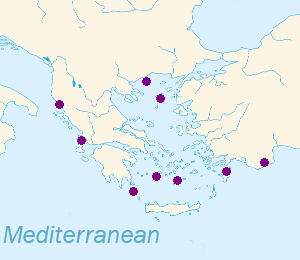
Phoenician colonies in Greece during the Dark Ages
This “Phoenician question” is not emphasized much, if only because all of the above is considered to be the reason for the unique development of Greece. Considering Phoenicia itself from this point of view, as it were, forces us to conclude that the reasons for the success of the Greeks are different from the generally accepted ones. Such an approach forces us to take all the overlapping places out of the brackets of our equation. And this deprives us of most of the usual and very reasonable explanations. And then in our investigation of the “phenomenon of the Greeks” we lose the trail, we are left almost empty-handed, which is extremely inconvenient.
But one could go the other way, and insist that the Greeks’ explanations of success still work properly; in that case, the Phoenicians must have at least started down the same path that the Greeks started a little later. And if Phoenicia had rich trading and maritime polities, had alphabetic writing, etc., which is certain — where is their high culture? Where are their philosophers? Why do we know so little about the Phoenicians? I will not answer these questions, as I myself do not know the final answer to them; there is very little information about the Phoenicians.
We know that even in their heyday they were monarchical and oligarchic states with a large property stratification. The degree of their proximity to ancient civilizations, which set the tone of social life in the entire eastern region, is of no small importance in explaining the failure of the Phoenicians. Such proximity rather inhibited cultural development. We can only hope for future archaeological discoveries that we will find at least a few authentic Phoenician literary works. On the basis of what is available now, little can be said for certain. In my opinion, however, it seems to me that all evidence points to the Phoenicians having a very advanced culture (if only because of the probable influence of Minoan Crete), ahead of Egypt and Babylonia, or at least not inferior to them.
In this article I only want to briefly characterize the circumstantial evidence for Greek-Phoenician connections, without regard to exactly how advanced the culture of the Phoenicians was.
“Phoenician” myths
The most interesting for us are the legendary characters that Greek mythology itself associated with its origins. Phoenicia’s own history, religion and mythology are a second order matter, given their fragmentary nature and lack of a prescribed connection with the Greeks. The Greeks, however, see the matter this way. The king of Tyre and Sidon (the largest cities of the Phoenicians) named Agenor was the son of Libya, the daughter of the king of Egypt named Epaphus (and the son of Zeus from Io). Thus the Phoenicians are painted as “grandsons of the Egyptians and children of Africa”. Agenor’s father was the sea god Poseidon himself, from whom Livia gave birth to a second child, Agenor’s twin named Bel. Bel later became king of Egypt, like his grandfather Epaphus. The whole myth is one continuous reference, speaking of the Egyptian origin of Phoenicia and Greece. This Agenor had many children, but for Greek mythology the most famous and significant were Cadmus and Europa.
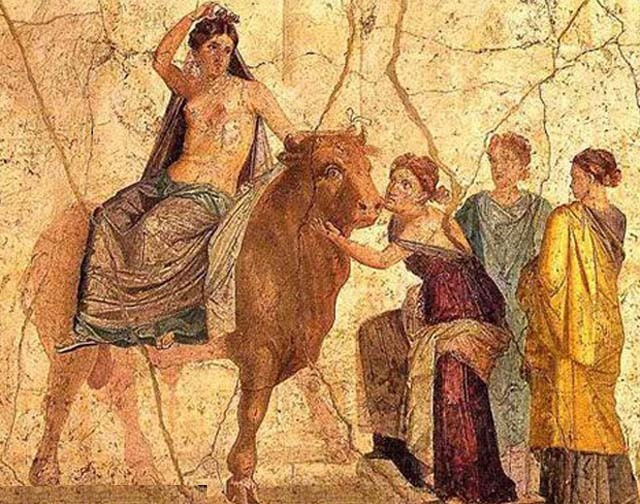
Once Zeushaving turned into a bull kidnapped Europa, who liked him, and lay with her on the island of Crete, where she remained to live further, becoming the mother of Minos, Radamanthus and Sarpedon. As a whole, her destiny has developed even well, in fact it has taken in a wife the tsar of Crete, and as there were no children from this marriage, the further governors of island became descendants of Zeus and Europe. However, Phoenician relatives knew nothing about it, so worried Agenor sent four of her brothers in search of his daughter, forbidding them to return home without their sister.
The brothers, by the way, never found her, but in the process of searching they traveled all over Greece.
After an unsuccessful search, the chief of Agenor’s sons, the Phoenician Cadmus, was forced to settle in Greece. Legend attributes to him the founding of the city of Thebes in Boeotia(where Europa was also honored). In his wanderings Cadmus also visited Rhodes, also bearing traces of Phoenician colonization, where he offered sacrifice to Athena Lindia. “The Arabs who crossed with Cadmus» settled on the island of Euboea, which is also interesting, because it is the same island from which the history of Greek colonization will begin, the location of the famous trading polities of Chalcis and Eretria.
The Greeks associated the advent of the Copper Age with the appearance of Cadmus; he is also the legendary inventor of Hellenic writing (historical fact, the Phoenicians brought the alphabet to the Greeks). Sailing from the East to Greece, he stopped on the island of Santorini (Thera, Fira) and left some of his companions there. Later, Teras (Thera) arrived on this island, after whom the island was named. This island is known today as the brightest place of preservation of cultural monuments of the Minoan civilization. It is here, on Teras, the oldest (XVIII century BC) Greek writings were found. And recently (in 2003) a letter from the king of the state of Ahhiyawa (that is, apparently, the Mycenaean power) to the king Hattusilis III (c. 1250 BC) was found. This Greek king mentions that his ancestor Cadmus had given away his daughter to the king of Assouba, and certain islands came under the control of Ahijava. The king of the Hittites responded by claiming that the islands belonged to him. This conflict over the Asia Minor coast chronologically coincides with the dating of the Trojan War. And if this is so, the Achaeans directly derived their descent from the Phoenician Cadmus.
In general, the role of the figure of Cadmus for the Greeks cannot be overestimated. Cadmus was not the only one who went in search of Europe and continued to live outside of Phoenicia. Having made sure that it was impossible to find his sister, his brothers settled in different countries, founding other royal dynasties.
The first of the brothers (Thasos) settled in Thrace, founding there the city of Thasos on the island of the same name (the colonization of this area is historically confirmed, there is also the Phoenician colony of Abdera nearby). Another brother of Cadmus, Phoenix , is the founder of “Phoenicia” (a certain united Phoenician kingdom); according to another version, he went to Africa and stayed there, which is why Africans are called Punyans (mythological explanation of the colonization of Carthage). Cilicus, in the manner of his brother Thasos, called the land he conquered Cilicia. Earlier its inhabitants were called Hypacheans. According to the later philosopher Eugemerus (a fan of “grounding” myths), this is the ruler of Cilicia, defeated by Zeus. Sometimes his children are called Phasos and Thebes (a reference to Thebes?).
So there is a brother and a sister, both Phoenicians, and both of extraordinary importance to the genealogy of the Greeks. Cadmus is the ancestor of the Achaean kings, and Thebes is one of the most important cities of antiquity. Europa is the queen of Crete, the mother of the first of the most powerful “Greek” kings. The Minoans and Mycenaeans, as we know, were in conflict; but for later Greeks, they are almost one culture, their great past, and both appear to be linked to Phoenicia.
Now, for completeness of the context, let’s go a little on the “line of Europe”. One of the sons of Zeus and Europa was Rhadamanthus, who was famous for his justice, as it was he who, according to legends, gave the Cretans laws. At some point, he probably killed his brother (Minos), for which he was banished from the state. While in exile, Rhadamanthus settled in Ocalea in Boeotia (near Thebes, which is obviously not accidental) and married Alkmena, the mother of Heracles (already the widow of Amphitryon). The name of Rhadamanthus became nominal as a strict judge. So it is not surprising that after his death he, as a reward for his justice, became, along with Minos and Eak, a judge in the afterlife (according to another version — on the “Islands of the Blessed” together with the titan Kronos). His instructions were set forth in Hesiod’s poem “Great Works” (by the way, Hesiod came from Boeotia, and Phoenician roots are not excluded). Later Hellenistic rationalization of myths already stated that there was a historical ancient Rhadamanthus, who first united the cities of Crete and civilized it, established laws, claiming that he received them from Zeus. And Minos, who ruled later, only imitated Rhadamanthus.
The story of Heracles’ mother is also not accidental, because the kings of Sparta traced their ancestry back to him, and the Spartans themselves believed that they owed their laws to Crete (so we see here a triangle of Crete-Sparta-Thebes). Later, archaeologists found recorded laws on Crete, but not from the Minoan period — and those actually turned out to be similar to the Spartan laws. The philosopher Socrates, according to Plato, considered these laws to be the best, and put Sparta and Crete on the same level in this matter. So, perhaps it is not accidental that the Spartans did not want to build walls, as it was accepted long before them in the Minoan civilization.
King Minos is the most famous of the sons of Europa — he is the legendary founder of the Minoan civilization and the father of “thalassocracy” (maritime hegemony, as Samos or Athens would later be). He is father to Androgeus, Deucalion, Glaucus, Catreus, Eurymedon, etc.
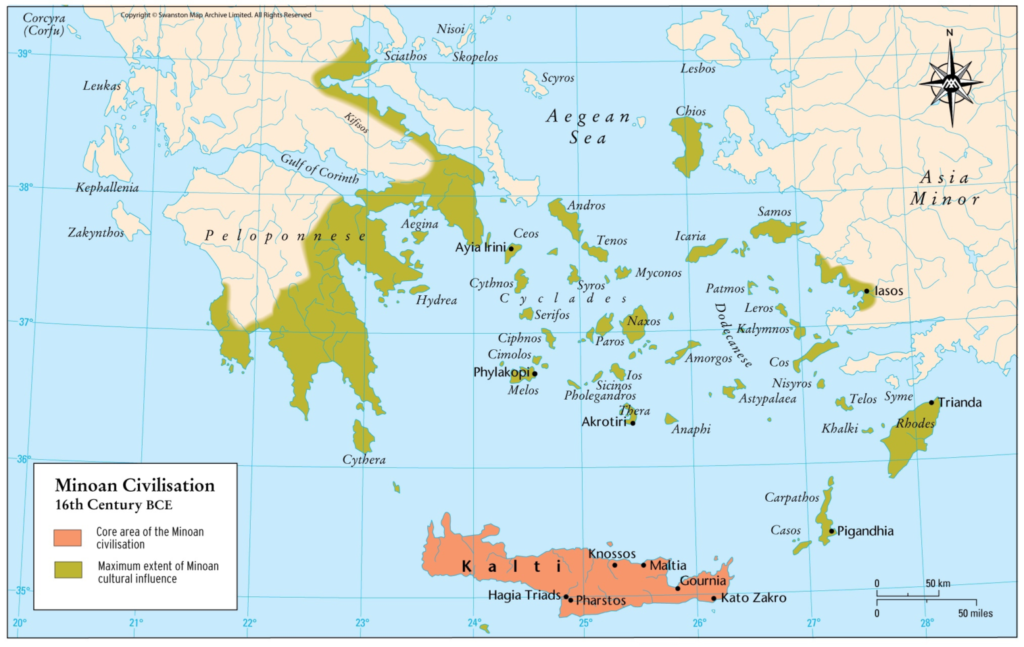
Minos drove the Carians out of the Cyclades and established colonies there, placing his sons as rulers, and succeeded in capturing Megara and extending power to the mainland. When his son Androgeus was murdered in Athens, Minos forced King Aegeus to pay tribute, 7 young men and 7 maidens every year, or every nine years. It was believed that these captives were condemned to be eaten by the Minotaur who lived in the Labyrinth. This lasted until the hero Theseus (son of King Aegeus) killed the Minotaur. Archaeology has confirmed that the palaces of the Cretans were built with a labyrinth-like layout; and not only was the Bull their religious symbol, but there were traces of ritual cannibalism of children.
Crete and the spread of its cultural and political influence.
Subsequently, the great-grandson of Europe and grandson of Minos — Idomeneus, will be one of the main allies of Agamemnon and Menelaus in the campaign against Troy, and put up one of the most significant flotillas. It turns out that even in Trojan times — Crete is one of the strongest parts of Greece. But all these ruling dynasties raise themselves to the Phoenicians, and according to mythology it was the Phoenicians who showed the Cretans the beauty of the state system, established laws (the good for which the Greeks later called even mediocre fools “Sages”), and the Greek alphabet was quite consciously raised by the Greeks themselves to the Phoenicians.
Phoenician pre-philosophy
Diogenes of Laertes has a lengthy mention that philosophy could theoretically have arisen much earlier in the East. He himself, however, does not think so, for he feels contempt for barbarians; but he says about the existence of Eastern doctrines that were older than Greek ones (not worthy of the name of philosophy, apparently), and he himself trusts this information. The general picture is approximately as follows:
“… the Persians had magicians, the Babylonians and Assyrians had Chaldeans, the Indians had Himosophists, the Celts and Gauls had the so-called Druids and Semnotheans (Aristotle [probably his student] writes about this in his book On Magic and Sotion in Book XXIII of the Successions); the Phoenician was Oh, the Thracian was Zamolxis, the Libyan was Atlanteus.”
Mochus of Sidon was an ancient Phoenician philosopher from Sidon, who lived at the end of the 2nd millennium B.C. The exact time of Moh’s life is unknown, Greek authors usually define it as “the era of the Trojan War”; but this is most likely just one of the synonyms for the phrase “long ago”. Only the recognition of Mochus as the oldest of the Phoenician sages is certain — Diogenes of Laertes calls him a proto-philosopher, placing him next to the legendary Atlantean.
Mochus was an astronomer and historian (as were members of the Greek school in Miletus), but is best known as a “physiologist,” that is, a researcher into the nature of things (the main theme of all early Greek philosophers). Moss formulated his own conception of the creation of the world, according to which the “primary elements” were Aether and Air. He also believed that, like language, which consists of letters, the world also consists of indivisible particles, thus becoming the “father” of the atomistic theory, later revised in different versions by Pythagoras and Democritus.
In addition to these achievements, Mochus is considered the founder of a philosophical school, the first in his time, which included Chalcolus and Darda, mentioned in the Bible. According to the late antique philosopher Yamvlichus, Pythagoras also communicated with representatives of the school of Mochus, which means that it continued to exist at the same time as the school in Miletus. Unless, of course, all this is not one continuous modernization of late antique authors, which is very, very likely.
Mochus is mentioned in his works by Strabo, Josephus Flavius, Sextus Empiricus, Diogenes of Laertes, Tatian, Eusebius of Caesarea, and Suda; i.e., this is by no means an isolated mention, although all of them probably simply depend on the Stoic Posidonius, who first mentioned the Phoenician from the sources available to us, and he did so probably because Posidonius himself came from the same Sidon.
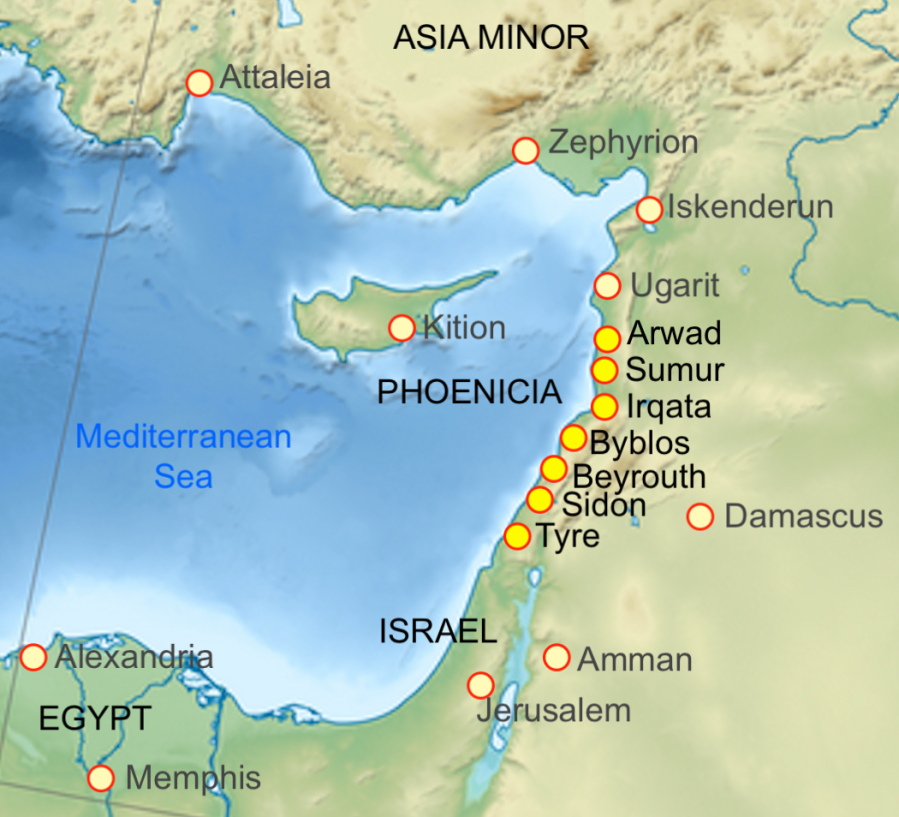
The “Libyan” Atlante, not a titan but the first king of Atlantis, is also associated with Phoenicia. He was the son of Poseidon and the mortal woman Cleito. Similar versions are found in the works of Eusebius and Diodorus; in these accounts Atlanteus’ father was Uranus and his mother was Gaia. His grandfather was Elium “king of Phoenicia” (this was the name by which the Phoenicians called the Most High God), who lived in Byblos with his wife Berut (a hypostasis of Baal). Here Atlanteus was raised by his sister, Basilia (the legendary first queen of Atlantis). Most of the information about the thought tradition of the Phoenicians has come down through the text of an ancient Phoenician author from Beirut named Sanhuniaton, who lived, according to Eusebius, “when Semiramis was queen of Assyria”.
Major Phoenician cities
In three books he expounded the main points of the Phoenician religion, which he drew from the columns of the sacred temples before they were perverted by the priests of later ages. The content of his work in Phoenician was transmitted in Greek by Philo of Byblos in his History of Phoenicia, fragments of which are quoted by the church historian Eusebius in his Chronicle. In particular, Eusebius cites Sanhuniaton as evidence that most pagan gods were based on real historical figures. It turns out that already in those times Phoenician historians were grounding mythology and engaging in rationalistic interpretations.
In Sankhuniaton’s account all titans, including Cronus, come from Phoenicia, and they, the titans, founded it themselves. This surprisingly lies on the Greek legends about the war of gods and titans, for then we get a version of the interpretation of the myth, where the gods (Greeks) are children of titans (Phoenicians), against whom they soon rebelled and defeated their fathers in the struggle (maybe an illustration of conflicts for colonies?). The most important thing for us is that this Phoenician writer also existed before Greek philosophy, and if Moh’s atomism can be deduced from his texts (and this is theoretically, with a stretch, possible) — then Greek philosophy loses a lot of its originality. Although it is always possible, of course, to doubt the authenticity of Sankhuniaton’s texts and all the testimonies about Moha, and to see in them the modernization of the Hellenistic era.
“These Phoenicians, who came to Hellas with Cadmus, settled in the land and brought to the Hellenes many sciences and arts and, among other things, a written language, previously, I believe, unknown to the Hellenes.” (c) Herodotus
In addition to the Phoenicians, Diogenes of Laertes mentions the sage Zamolxis, the main deity of the Thracian cult. The most characteristic elements of the cult of Zamolxis (andreon and feasts, occultation in the “underground dwelling” and epiphany after four years, the “acquisition of immortality” of the soul and the doctrine of a happy life in the afterlife) bring it closer to Greek mystery. It was from Thrace that came the Greek cults of Dionysus, associated with the Eleusinian Mysteries, so prevalent among conservative rural farmers, and generally recognized as having influenced the philosophy of Pythagoras. According to Strabo, Zamolxis himself was a slave of Pythagoras, from whom he learned “certain celestial sciences.” It was also believed that Zamolxis (like Pythagoras) traveled to Egypt, then known as the land of magicians, and learned “some things” from the Egyptians. Back in his homeland, Zamolxis managed to convince a ruler to take him on as an advisor (much like the Pythagoreans convinced rulers in Italy) because of his ability to communicate the wishes of the gods. At first Zamolxis was a priest of the most revered god of the Dacians, but later he succeeded in getting himself honored as a god (which also reminds us of Pythagoras).
In the dialog “Charmides,” Socrates describes his meeting with one of the herbalists of “the Thracian ruler Zamolxis, who possessed the skill of conferring immortality,” and reports:
«This Thracian physician narrated what he had learned from his ruler, who was a god.Zamolxis, the physician reported, taught that one should not treat the eyes without curing the head, and the head without paying attention to the body, and the body without making the soul well.Therefore, concluded the Thracian healer, the remedy for many diseases is unknown to Greek healers, because they do not pay attention to the body as a whole.»
And even this maxim strongly resembles the philosophy of Pythagoras and Pythagorean physicians such as Alcmaeon.
I will not go into more details, but it is obvious that Egypt and Babylon had a direct influence on (->) Phoenicia, which itself had an influence (->) on Greece. All early Greek wisdom is just repeating what had already existed centuries before them, there is virtually nothing new there. The first worldview revolution took place around 900-700 BC in Babylonia and Phoenicia, the Greeks had already adopted it in a ready form around 650-600 in the person of the same Thales. All Greek historians almost unanimously attribute the invention of geometry to Egyptian surveyors (from where Pythagoras’ voyage to Egypt came), but they immediately separated geometry and theoretical mathematics, and also separately distinguished astronomy.
Thus, mathematics was attributed to the Phoenicians, and astronomy to the Chaldeans (Babylon). But later Hellenistic historians considered the practical origin of all sciences to be a more reasonable explanation. Therefore, for them the development of astronomy by the Phoenicians looked much more logical, since they surpassed everyone in navigation to such an extent that they sailed at night in the open sea, and for this they needed developed astronomy (unlike mainland Babylon).
If all this is true, then the development of astronomy and mathematics (here the argument also went through the practical need of traders in bookkeeping) should coincide with the heyday of Phoenician colonization, and this is 900-700 BC, and here also lies another argument. After the Macedonian conquest of Persia — Greek scholars had access to many temple archives, and they compiled a regular calendar of lunar and solar eclipses (what so progressed Thales of Miletus). The calendar starts around 760, arguing that the Babylonians began regular accounting only from that time (in fact, such things could have been done much earlier). Thales made his eclipse prediction in 585, just a century and a half later. Also, it was Thales who was considered the founder of Greek mathematics, and it was only later that the young man Pythagoras learned from him.
But the most interesting thing is not even this, but the fact that the ancient tradition itself considered Thales a Phoenician by blood, and Pythagoras, who studied under him, was also a descendant of Phoenician merchants, and even the more generally recognized teacher of Pythagoras, the poet Pherekides, was also considered, if not a Phoenician, then a man who “got his wisdom from the secret Phoenician books”. As mentioned above, Thebes (Boeotia) was proud of its Phoenician mythological history, but it was from Boeotia that the poets Hesiod and Linus originated. Here is what Diodorus of Sicily wrote about Linus:
«It is said that Linus was the first of the Hellenes to discover the laws of rhythm and singing, as well as to apply for the first time to Hellenic speech the special scripts brought by Cadmus from Phoenicia, while establishing the name and defining the lettering for each sign.These letters are commonly called Phoenician, because the Hellenes borrowed them from the Phoenicians … Linus reached extraordinary heights in the field of poetry and melody, he had many pupils”.
The remnants of Linus’ writings fit very well into the cultural context of Thales and Pherekides, and even go beyond them, even touching on the philosophy of Parmenides. Other legendary hero-poets, Orpheus and Museus, were considered contemporaries of Linus (incidentally, this is around 900-800 BCE, just when the Phoenician cultural upheaval began), and they also have passages highly reminiscent of Parmenides’ philosophy (which greatly devalues his innovation). As mentioned above, even atomism may have been invented in Phoenicia, though this is no great tragedy for Democritus, for before him atomism was actually preached by Pythagoras as well. But as in the case of Moh of Sidon — all this can be safely denied, seeing here late antique insertions and modernization.
The other eastern influences
We have only to mention Diogenes of Laertes’ excerpts on the philosophy of Egypt, Persia and India to finish our cursory review of the pre-philosophy of the East: «The hymnosophists and druids spoke in mysterious sayings, taught to honor the gods, to do no evil and to exercise courage; the hymnosophists even despised death, as Clitarchus testifies in Book XII. Nothing special, except a slight hint at the importance of ethics and, perhaps (but not fact), a philosophical solution to the problem of death, which is considered an achievement of early Hellenism. And here we see practically Stoicism in embryo.
«The Chaldeans practiced astronomy and divination.The magi spent their time in the service of the gods, sacrifices and prayers, believing that the gods listen only to them; speculated about the essence and origin of the gods, considering fire, earth and water as gods; rejected images of the gods, especially the distinction between male and female gods.They composed works on justice, asserted that to give the dead to fire — unholy, and cohabit with mother or daughter — not unholy (so writes Sotion in Book XXIII), engaged in divination, divination and asserted that the gods are to them in person, and in general, the air is full of visions [mystical theory of Democritus], the flow or soaring of which is discernible to the keen eye.They did not wear gold and jewelry, their clothes were white, their bed served them the earth, food — vegetables, cheese and coarse bread, staff — a reed; with a reed they pierced and brought to the mouth pieces of cheese at meals.They did not practise sorcery, as Aristotle testifies in “On Magic” and Dion in Book V of the “History”; the latter adds that, judging from the name, Zoroaster was a star-worshiper, and in this Hermodorus agrees with him.Aristotle, in Book I of “On Philosophy,” holds that the Magi are more ancient than the Egyptians, that they recognize two primordials, a good demon and an evil demon, and that the former are called Zeus and Oromazd, and the latter Hades and Ahriman;Hermippus (in Book I of “On the Magi”), Eudoxus (in “A Tour of the Earth”) and Theopompus (in Book VIII of “The History of Philip”) also agree with this, and the latter adds that, according to the teachings of the Magi, people will rise from the dead, will become immortal and that only by the spells of the Magi and the creature is kept alive; the same thing is told by Eudemus of Rhodes.And Hecataeus informs us that the gods themselves, in their opinion, had a beginning.Clearchus of Sol in his book “On Education” considers the Gymnosophists to be disciples of the magicians, and others raise even the Jews to the magicians”.
Here already very striking is the knowledge of all the above-mentioned Greeks that Persian and Indian philosophy have the same roots (Vedic religion), and strangely enough, they consider the Indian offshoot as later, or less “orthodox” from the point of view of the Proto-Indo-Iranian religion. It is not difficult to see that this description alone is worth more than what the Greeks themselves enthusiastically tell us about their “seven sages.” But the Persian “magicians” are not inferior to the Egyptian priests.
«The Egyptians in their philosophy reasoned about the gods and about justice.They maintained that the beginning of all things is substance, from it are distinguished the four elements , and in completion are all kinds of living beings.They consider the sun and the moon as gods, the first under the name of Osiris, the second under the name of Isis, and the beetle, the serpent, the kite and other animals serve as allusions to them (so say Manephon in “A Brief Natural History” and Hecateus in Book I of “On Egyptian Philosophy”), to which the Egyptians and erect idols and temples, because they do not know the appearance of the god.They believe that the world is spherical, that it is born and mortal; that thestars consist of fire, and this fire, moderating, gives life to everything that is on earth; that eclipses of the moon come from the fact that the moon falls into the shadow of the earth; that the soul outlives its body and moves into others; that rain is obtained from transformed air; these and other of their doctrines about nature are reported by Hecataeus and Aristagoras.And in their concern for justice they have established laws at their place and attributed them to Hermes himself.They consider animals useful to man as gods; it is also said that they invented geometry, astronomy and arithmetic.This is what is known about the discovery of philosophy.»
So Linus, Hesiod, the philosophers of Miletus, Pherecydes and Pythagoras all belong to plus or minus one tradition, the roots of which are partly in the Phoenicians and partly in Egypt and Babylonia, if we are to believe the doxography. As time goes on, the version of eastern influence finds more and more confirmation, and hopefully all these strings will still be tied together at some point on the basis of more convincing sources than we have now.
What does all this mean?
At least, all the early Greek wisdom (the so-called pre-Socratics) — only repeats the already existing before them for centuries, there is almost nothing new. But, in any case, in defense of the Greeks we can say that their lag is minimal. And since there are no names left from the Eastern sages, nothing has changed for us in fact; our heroes are still heroes, just deprived of the title of discoverers.
Heraclitus is striking and stands somewhat apart. The East was too focused on the Whole, on unity; so were the ancient Greek sages. But Heraclitus outlined a conceptual breakthrough (although in a general sense he also shared the concept of the Whole), and in this case, Parmenides’ reaction to him is nothing more than an archaic attempt to “return to the roots”. A separate achievement is the effect of scale. The wisdom of the Near East and Greece is one, but in the East the sages perceived it as a whole, while in Greece this unified “wisdom” was broken into parts and cultivated by “schools”. As a result, there was a total concretization of essentially the same material (Empedocles, Anaxagoras). And when all this mountain of additions tried to cover again as a whole, somehow to systematize — there appeared encyclopedic doctrines (Sophists, Democritus, Aristotle), which had never existed before. Such emergence of separate schools and new systems occurred synchronously with the Greeks in India and China, but the Greeks, nevertheless, were able to go further than their competitors, and this phenomenon still requires clarification of the reasons.
The futility of trying to go further in the knowledge of physical and logical theories leads to a focus on ethics. In fact, the primacy of the Greeks in this area is also called into question. There is evidence that well-developed ethical systems could have existed in pre-Socratic times, or even earlier (if we take into account the “teachings” of the Old Kingdom, etc.). To a great extent this question also depends on the decision about the historical dating of the book of Ecclesiastes and the book of Job. But, in any case, “Eastern Ethics”, even in its most radical version, is still more conservative than Hellenistic ethics, so we can say that the Greeks are still innovators in this matter.
Besides, it is the division of the “whole” wisdom into parts, and the subsequent view of the “whole” from the parts’ side, that sets a quite unique specificity. From a purely formal point of view, even the teachings of the Stoics and Epicureans do not differ much, and sometimes even coincide verbatim. But precisely because of the different starting points, in fact, the “same thing” in its form, and subject matter, leads to quite different worldviews. Such elaborate detail and subtlety of difference clearly could not have been available to philosophers in the pre-Socratic era.
And yet, the picture of early Greek philosophy is seriously altered. It changes seriously, even if we want to consider the history of Greek philosophy in isolation from the world context, in and of itself. And this is what we will try to talk about in the following essays.
This article is a kind of bridge between the «Prephilosophy» series (the previous article in the cycle) and the «Formation of the Canon» series (the next article). In a way, it touches on both of them.
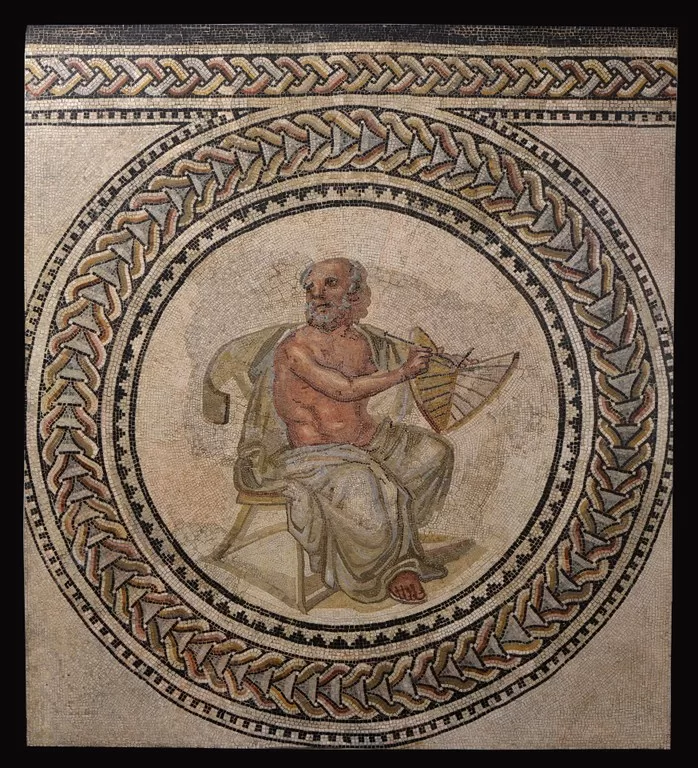
Thales, the first empiricist
“To begin philosophy with Thales” has long been a good tradition, and even in antiquity itself it was considered that Thales of Miletus was the first philosopher, and the first to reason about nature. But after excursions in history of the East and the analysis of poetic tradition, we already understand that everything is not so simple, in fact even in antiquity itself which has created habitual to us image of Thales as the first of philosophers, in cohort of philosophers many of his predecessors were included. We ourselves have seen that Thales was in the context of the activities of the “Nine Lyricists” and the “Seven Sages”, who are no longer classified as philosophers. And this ancient idea of Thales as a man equal to the “Seven” was in many respects justified, because from what we know about Thales — his level of thinking barely went beyond the simplest notions, which had already Solon or Pittacus (notions at the level of mother should be respected, honor should be cherished, friends should not be deceived, etc.). In cultural and world outlook Thales is an open conservative. But we have already considered the fables about Thales, and if we speak about him as a philosopher, the only thing in which he really made his mark as a unique personage was the creation of a special philosophical “school”; or rather a chain of succession of thinkers. This group of sages is now called by us after their place of residence: the “Milesian School”, or even more broadly, the “Ionian Philosophy”.
Certainly, all it is so, only if to consider as a fiction existence of school Mochus from Phoenician Sidon (one of applicants for udrevlenie atomistic philosophy). If Mochus existed, then Thales borrowed the concept of the philosophical school from the Phoenicians. As we shall see further, the most part of views of Thales perfectly lays down in a context of occurrence of views of Phoenicians (earlier we have already told that Thales on blood was rather Phoenician, than Greek), and ancient biographers insisted that he has transferred many knowledge from Egypt. The years of Thales’ life are known presumably (c. 630-548 BC). He is about the same age as Sappho, Alcaeus, Mimnermus, Stesichorus, Solon, Pittacus, and many others. At quite a conscious age his life must have been caught even by the Athenian tyrant Pisistratus. Therefore, we should not think that the “Milesian School” opens some fundamentally new era in Greek culture, it arises synchronously with other cultural phenomena. Up to our days almost no authentic passages have survived, where the philosophy of Thales “in the first person”. Literally few passages have survived, as presented below:
“The primary element Thales supposed to be water» (1). “The earth is held on water, like a plank or ship on the sea, surrounded on all sides by the ocean” (2). “Thales hypothesized that the soul is something that moves. Stone has a soul because it ‘moves’ iron” (3). “Thales was the first to proclaim that the nature of the soul is such that it is in perpetual motion or self-movement” (4). “According to Thales, mind is the deity of the universe, everything is animated and full of daemons” (5).
And what is important to note here is that Thales is interested in the problem of motion; and this is a very important problem in the history of philosophy. Now we are not talking about the physics of any particular motion, but about the independent motion of the whole Universe, about motion in the broadest sense, almost about “motion as such”. From this another theme inevitably develops; that since the cause of motion is the soul (it is also the cause of the will of our body, and it is the will that pushes us to motion), then it follows that since the whole universe is in motion, the soul is not only in living beings, but absolutely everywhere. This view would later be called “hylozoism”; although it is obvious that Thales was not its discoverer; it is a pre-philosophical, primitive and ancient view, observed even among Stone Age people or in the Greek Olympic religion. The main feature of Thales in this context is that he calls Mind the world god. We do not know how this relates to the rest of Thales’ ideas, but in the next generations philosophers will deal with this very thing: the harmonization of nature and Mind. The hypothetical fragments of Thales from the collections of statements of the “sages” say more about it, and we will take them into account in the further presentation.
The theme of “water” as a primary element, strange as it may seem, is not so interesting at all, and even trivial. Already if only because the ideas about philosophical elements existed both before Thales and during his life — and these ideas were already then more developed. Thoughts about the “water beginning” simply repeat mythology, both Greek and Eastern, where at the beginning of time there was no land on earth yet, and the whole world was “Chaos”, or more often “Ocean” (the ancient poets themselves, the same Homer, could consider them synonyms). The cosmogony of his contemporary Pherekid, which is considered much less philosophical and more mythological, is fuller and freer to operate with all the elements at once, and therefore Thales still looks somewhat weak even for his time. If we believe Aristotle, the other reasons for choosing the water element are also taken from everyday observations.
Dying organisms literally “dry up”;
plants need water to grow;
all food is soaked in juices;
and all living things need water;
and even the sperm of all creatures (the beginning of life) is moist.
His very life in the main commercial and maritime center of Greece simply had to inspire him with analogies to ships, and the opinion of the great role of water in the world. Such a life may well have inspired many of the astronomical and mathematical observations, for these sciences were then of an applied nature. From all that we know about Thales, he was most likely primarily an astronomer (as can be seen from the titles of his extant books, e.g. “Marine Astronomy”, ‘On the Equinox’).
So maybe the Neoplatonist Proclus was right when he reported that it was Thales who was the first Greek to start proving geometric theorems. Therein lies his main philosophical contribution. So, for example, Thales learned to determine the distance from the coast to the ship, for which he used the similarity of triangles. And according to one of the legends, being in Egypt, he amazed Pharaoh Amasis that he managed to establish exactly the height of the pyramid, having waited for the moment when the length of the shadow of a stick becomes equal to its height, after that he measured the length of the shadow of the pyramid and received its height. It is not accidental that even centuries after his death, in literary works the image of Thales was accompanied first of all by indications of astronomical interests, and his main attribute was a circlet. All this shows us that already in the time of Thales there were some rudiments of scientific, empirical, or practical approach to the matter. Here separately it is necessary to mention that according to Aristotle, except for a magnet Thales has found out attractive force of amber which is impossible to find out, without that to electrify amber by friction, for example about wool. Hence, Thales could conduct an experiment with electricity, and discover its magnetic properties. What conclusion Thales draws — we already know (motion = animatedness). But now we can assume that the action of the soul was directly connected with electricity. And it sounds already in spirit of modern images about Dr. Frankenstein. Certainly Thales hardly understood that deals exactly with electricity in our sense of this word, therefore his discovery had absolutely no value, neither theoretical, nor practical. But nevertheless we can say that we have before us the rudiments of the experimental method.
Thales’ hypothetical positions on philosophy
In the list of sayings of Thales, as a representative of the “Seven Sages”, there are philosophical lines. But they should be used very carefully, because a significant part of the heritage of the “sages” is a late antique fanfic. Here we may be interested in such statements:
The oldest of all things is god, for he is unborn. The most beautiful is the cosmos, for it is God’s creation. The greatest of all things is space, for it contains everything. Fastest of all things is thought (nous), for it runs without stopping. Strongest of all is necessity, for it overpowers all. Wisest of all is time, for it reveals all. … When asked what is difficult, Thales answered, “to know oneself.” To the question, what is deity — “that which has neither beginning nor end”. To the question whether a man can secretly commit iniquity from the gods — “not only can he do it, but he cannot even conceive of it”.
We will assume that these statements could have belonged to Thales, and if so, we learn many new details here. It turns out that Thales thinks as a strict monotheistic philosopher, and asserts that God is not born (and probably not subject to changeability), he has neither beginning, nor end, and therefore most likely he is infinite. God clearly pervades the entire universe, and it is impossible to hide even his own thoughts from him. He has strictly determinized the world, for “necessity overpowers all.” And this world created by God is in an indeterminate state, because God seems to permeate it everywhere, but he is also its creator (hence, the world, unlike God, is created, and the existence of the world is not necessary for the existence of God himself; their identity in fact turns out to be quasi-identity). In a fragment from the “Refutation of All Heresies” of the writer Hippolytus there is a statement that, according to Thales:
Everything is formed from water by its solidification as well as evaporation.Everything floats on water, from which earthquakes, whirlwinds, and star movements occur.
This makes him the first author of the notion of the transformation of the elements by changing aggregate states. But the most interesting point is the recognition that space includes the concept of space, and objects are in that space. He explicitly derives this notion as a special “reservoir” for objects, and it is possible that he already implies emptiness here. This means that emptiness is also included in the definition of the nature of God. Why all this is significant, we will see next, through the example of Thales’ disciples and followers. But again, this is the most hypothetical part of his philosophical heritage, and it should be kept in mind.
Thales as a politician
To summarize his philosophical positions — Thales does not stand out at all from the thinking context of his epoch, he stands out only as a man who first voiced these ideas on the Greek cultural field, and with a claim to philosophy as a special kind of wisdom. All the strong points of Thales’ philosophy would be developed by his followers (includingPythagoras), and what is much more interesting in his story is that this “first philosopher” immediately shattered the notion that philosophy was incompatible with politics — i.e. practical and social activity. One of the popular fables about Thales tells how he foresaw a future harvest year, so he rented oil mills while the price was low, and then collected a huge income from the sales of olive oil. The story was meant to show that a wise man, if he wished, could easily acquire wealth that he did not need, and so wise men live in poverty of their own free will (this was a response to claims that philosophy is useless). But we also see in this an example that the image of the philosopher was easily incorporated into everyday practice. Most likely, Thales was a personal advisor to the ruler of Miletus; we even have information about two of his recommendations:
In the first, he advises the 12 cities of Ionia to unite into a single federation, the center of which was to be the city of Theos. But this recommendation remained in the drafts.
The second piece of advice concerned joining the coalition against Persia during the Lydian-Persian War. Thanks to Thales, Miletus was the only one who did not fight against the Persians, thus saving itself from destruction.
Even the most famous story in Thales’ life, namely the prediction of a lunar eclipse in 585, had significance on the scale of the entire Lydian state, directly affecting its fate, i.e. this event links him to political history. His ties to seafaring, his story of the oil trade, and his service to a tyrant of Miletus (and tyrants led the fight against the landed aristocracy) make Thales an economic progressive. But his statements as one of the Seven Wise Men — show him as a domestic conservative. In the context of his time, it is still worth considering him as a progressive thinker, given that he made a great contribution to the establishment of philosophy and popularization of Eastern knowledge.
In the end, it turns out that Thales is a court counselor, astronomer, and navigator who believes in mythological ideas about souls and promotes a prototype of monotheistic religion. A conservative in socio-cultural views, but a progressive thinker overall. He is of Phoenician rather than Greek descent, and his main historical achievement and contribution was the development of geometry. All of this is somewhat different from the image that has already managed to be stereotyped.
Anaximander and his Apeiron
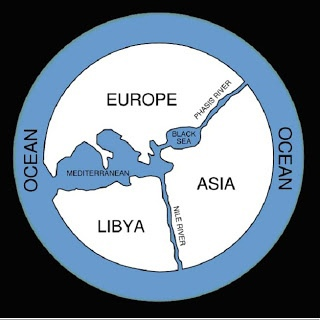
A disciple of Thales named Anaximander (610-546 B.C.) was also no stranger to social and political activity. It is known, for example, that he led the eviction of people to another Black Sea colony called Apollonia (today’s Sozopol in Bulgaria). But as a philosopher he is known primarily for being one of the first to write in prose, and for creating the first known map of the world; although this is more geography and literature than philosophy. At least two of the four known titles of Anaximander’s works (On Nature, Map of the Earth, Globe, On the Fixed Stars) suggest that the basis of his work, like that of Thales, was astronomy, and it is likely that it also had applications for sea travel. It is even possible that it was the fruit of their joint labors. It is believed that Anaximander wrote his works not just in prose, but in flamboyant prose, which gave away his love of all things luxurious. Thus, for example, it is said that he aspired to theatrical posture and dressed up in pompous clothes on purpose.
Anaximander World Map
Anaximander (like Thales), borrowed much from the Near East, especially in matters of cosmology and the numerical calculations that depend on it. From astronomical achievements it can already be noted that Anaximander considered the Sun and the Moon larger in size than the Earth, and had a whole theory of lunar and solar eclipses, although again, some sources attribute these achievements to Thales. But it is undoubtedly Anaximander who is credited with the creation of astronomical instruments, particularly the gnomon, as well as models of the celestial sphere (i.e., the globe). And if Thales was evaluated by descendants as a “predictor of eclipses”, then Anaximander over and above this allegedly predicted an entire earthquake.
Speaking of Anaximander’s natural philosophy in detail, he believed that «the beginning of all things is apeiron.It is neither water, nor earth, nor air.It is nothing but matter itself.» This mysterious word is translated literally as “infinite” (or “limitless”), so we can consider that Anaximander’s universe is infinite. Apeiron itself is also indestructible, eternal, not created by anyone, and, most likely, also qualityless. As Epicureans, we are attracted by the fact that such a set of characteristics makes apeiron almost a complete analog of the atomistic theory, with the only difference that apeiron was not concretized as “the smallest particle” (and can be perceived as spatially infinite “matter as such”). Perhaps this happened because Anaximander did not even imply the existence of absolute emptiness; or perhaps simply because it is extremely poorly preserved for us. At least emptiness can be easily deduced from his theory on its own, which means that it was not something impossible, especially since other parts of his philosophical system, or Thales’ possible ideas about space in the cosmos, hint at it. On the other hand, apeiron can also be considered within the framework of the continuum theory. The set of its properties is quite consistent with the ideas of God as a Whole; besides, there is a lot of evidence in favor of this version. And among the hypothetical expressions of Thales we find that God had the quality of the infinite.
What is this magic apeiron, from which everything in the world is born? One can imagine many things, but there are only a few basic versions: (1) it is a pantheistic idea of God-Nature, who, having all the attributes of divinity, “creates from himself” our visible world; (2) or, following Aristotle’s version, it is not a qualityless prime matter, but a banal “mixture” of all elements, which would later be used by such philosophers as Empedocles and Anaxagoras;(3) or, more likely, both are true, that it is both a divine nature and a “mixture of elements” that the deity has produced “in himself.” From this may arise the notion of dualism, which was expressed in the words of Anaximander “theparts change while the whole is unchanging”.The analysis of what happens in the material apeiron (in the parts) is naturphilosophy, and the analysis of what happens in the original apeiron (in the whole) is theology. At the same time, it is obvious that naturphilosophy must be subordinate to theology. One can argue about these versions, it is no longer possible to prove anything for sure. Therefore, many will insist that Anaximander is the purest materialist. However, in such a case it would be strange that his followers do not pay any attention to this and develop his ideas in a theological way (e.g.Xenophanes).
Speaking about such an important category as motion, Anaximander believed that it is eternal, and that motion is even more ancient than moisture (and perhaps this is another property of apeiron). After all, it is due to motion that one thing is born and another perishes. And moreover, from this chain of reasoning Anaximander comes to the conclusion that the opposites (parts)united in it are separated from the one (the whole), and that the birth of things is not due to changes within the four elements (i.e. not by solidification or evaporation), but by means of their separation from this one. Of the opposites, the most basic are warm and cold, wet and dry. They influence the undefined “matter/apeiron”, resulting in different elements, combinations of substances, etc. The pair of dry and cold forms earth, wet and cold forms water, wet and hot forms air, dry and hot forms fire. Yes, it is possible to assume that here there is also a change of aggregate states of each of the elements, but this change also occurs due to the action of some of the opposites. In general, all world processes, which can only be imagined, occur due to the eternal movement of opposites. And here we have before us a ready-made theory of dialectics, which explains the principle of “motion as such”; and at the same time we have before us also a theory of determinism:
«From what all things derive their birth, to what they all return, following necessity.They all punish each other in due time for injustice.»
As far as the sources allow us to judge, apeiron is in rotational motion. If this is transferred to a single solar system, we can imagine how the mass of matter, due to this vortex motion, begins to stratify, and the heaviest of the elements (earth) is in the center, and the lightest — surround it with three rings. First comes water, then air, and then, as the lightest element, fire. Somewhere between air and fire, Anaximander depicts three spheres that cover the sky like an onion. In this conception, all visible celestial objects are essentially one object, i.e., celestial fire; and the only differences are that at different locations in the different “spheres” are different sized “holes” through which this light reaches us, in case the holes from the different spheres cross each other (these representations can also be found in Eastern cosmology). In this interpretation, celestial bodies for Anaximander are not even bodies at all, but only light, and then eclipses are the result of overlapping holes.
Geology and the theory of evolution in the system of Anaximander
Of some value is also the way in which he justified the immobility of the Earth. As mentioned above, he proceeds from the fact that the Earth is at the center of the world, which is proved by the vortex motions observed empirically in water and air. He transfers these observed motions to the whole world, and it turns out that the heavy elements are pulled toward the center of the world, and the heaviest element of the four basic elements was the earth. In addition, this explains why objects in the heavens revolve around us. Based on this premise, one could already understand why the earth is immobile; the center of the world automatically implies immobility. But Anaximander put forward an additional argument. For this purpose, he invented the principle of «no more this than that” — a principle actively adopted in the future by the atomists Democritus and Epicurus. Located at the very center of a strictly symmetrical universe, the Earth has no reason to move in one direction or another: up or down, in one direction or another. All directions are equally preferable, and therefore it is unrealistic to make a choice; there is no basis for a verdict as to why one direction is better than another. Hence, the Earth is stationary. And as we can see, it does not move for reasons of logical order, and is naively endowed with its own reasoning.
If we assume here that the earth is spherical, then the universe is also a sphere (and Anaximander is known as the compiler of some kind of “sphere” that was most likely a globe of the earth). The only thing that contradicts this is the vast amount of ancient evidence that Anaximander envisioned the earth as a cylinder, or drum, with two planes. In that case, the “no more this than that” argument loses its beauty. The contradiction here is on the face of it, and which interpretation is wrong, the sphere or the drum, is unknown. It may be a contradiction of Anaximander himself. But the contradictions do not end there. Despite his tendency to reason about the universe as an unchanging whole, Anaximander argued that the worlds (which for the Greeks was synonymous with the Galaxy) are many. In Augustine we find this passage:
«And these worlds … are then destroyed and then born again, with each of them existing for the time possible for it.And Anaximander in these matters leaves nothing to the divine mind.»
While Thales says quite differently: “mind is the deity of the universe”. Perhaps in this we can see the internal divisions of our conventional “school”, which does make Anaximander a more materialist-oriented thinker. This issue would later take center stage for the next generations of philosophers. Many will fall into confusion, and assume that the world (and on the universe) = god. Which means Anaximander is saying that gods can be born and die. Cicero and many others believed so (which is already more similar to Thales’ concept, but only allows for polytheism). But this view is opposed by writers such as Aecius, who defends Anaximander, and stands on the point of the inactivity of Anaximander’s “mind”. A perfectly reasonable assumption, especially since Cicero elsewhere tries to make almost all ancient thinkers (pan-)theists. But this does not in any way cancel the fact that Anaximander could be a pantheist within the whole universe, and consider the individual worlds as its numerous parts, which can be subject to change.
Worst of all, if the world and the universe were one and the same (i.e. if the plurality of worlds were not allowed), then the argument about the vortex motion of apeiron would work quite well. But now it turns out that all the above arguments about elements concern only a single world. The nature of apeiron now becomes unknown, and in what relation to each other are the worlds, whether they also move in a circle relative to some center — it is impossible to understand. All these contradictions and confusions will be solved by subsequent generations of philosophers.
And the most original development of Thales’ ideas was a completely new idea of Anaximander about the origin of life, and, in particular, the origin of man. In his account, the earth was originally completely covered with water, but the “heavenly fire” evaporated some of the moisture, lowered the sea level, and thus the earth emerged, and the vapor itself became the personification of the “element of air”, which also set in motion (air = motion = soul) the celestial objects. Here the transformations of the elements, beginning with water, come full circle. Thunder, lightning and storms were explained with the help of physics, where no mythological allegories with Zeus’ feathers were allowed, and stars were simply manifestations of a single fire. In such a scheme of spontaneous transformations, life originates somewhere on the boundary between earth and water (in a swamp). But even here Anaximander allows another contradiction, because in this case life arises only after the earth has emerged from under the water. But in separate passages he says that since originally there was no land, the first creatures were exclusively sea-dwellers, who only later had to adapt to life on land. And so even the first humans were fish. It turns out that life arises before the earth rose out of the water. So Anaximander has the first systematic ideas about the evolution of species. From the presentation of the elemental “cycle” of transformations it becomes clear to us why the philosopher represented consciousness, the human soul, in a very ordinary way, as a “water-like essence” (the element in its very essence represents movement).
Anaximenes and meteorology
The importance and further influence of Anaximander on posterity was enormous, far surpassing that of his teacher Thales, for two succeeding generations of philosophers drew from Anaximander. Alas, but the preservation of his works is too low, and this influence can be understood only indirectly, comparing the available passages with later authors. Still, we see that Anaximander’s system already contains all the later problematics, while he has these problematics relatively uncontradictorily united, and in his “apeiron” he was already one step away from atomism. The worse all this affects the evaluation of the subsequent representative of the “Milesian School”, who bears the name Anaximenes (approx. 585/560 — 525/502 B.C.), who already looks mediocre and weak against the background. Most likely he still caught the living Anaximander and even was directly trained by him. All sources agree that the main difference between the two is that Anaximander’s apeiron acquired qualitative certainty as the element of air. And that all further arguments almost completely duplicate Anaximander, including even the idea of cosmic spheres and the nature of stars. There is no way we can agree with this. Therefore, having depicted all the similarities, we will emphasize the more important, the differences.
In general, Anaximenes reduced all causes to the limitless(apeiron) air. The reasons why he did this can be different. For example, speaking about the question of motion, Anaximenes directly continued the logic of his predecessors, following Anaximander he recognizes air as a kind of allegory of motion, and from him he borrows the thesis that motion is more important and older than all other origins. But if so, then motion = air, and so it is the first element, which by its property is infinite. This reasoning may directly stem from a consistent reading of Anaximander. Besides, air could have been chosen because of a more universal and convenient explanation of phenomena of a complex order, the same questions of animation of bodies, their movement (there is no need to invent how the soul and movement arose, if these are already properties of air, which is the basis of everything). It is not clear, of course, why he did not like Anaximander’s universalism, but going back to the elements, the choice of air seems a very logical step.
«Just as our soul, being air, binds each one of us together, so breath and air encompass the whole of creation.»
Speaking of the cosmos, here Anaximenes also has a few refinements to Anaximander’s system. For example, there is only one cosmic sphere (not three), and it is an ice wall with fire leaves attached to it (not holes drilled in it). Like our earth itself, the cosmic objects are flat like leaves, which is what allows them to float in the air. If the principle remains the same (flat circles on an invisible sphere far above), the explanation is already somewhat different. In addition, Anaximenes stated that the Sun and Moon are of a special nature; that they are burning blocks of earth that are lower than the sphere of stars (according to Anaximander it is the stars that are on a lower tier). So it can be said that Anaximenes was more accurate in his teaching. This can be suspected even in terms of the stylistics of their writings. Readers complained that, unlike the “pretentious” Anaximander, he wrote very dry prose without artistic embellishments.
However, despite all this “scientificity”, according to Anaximenes, air is a god(Aecius, who had already defended Anaximander’s atheism before, calls to understand also under this “god” — the forces pervading the elements and bodies). The fact that air pervades the whole world and animates it, quite logically leads to the conclusion that it is God, in this we can see a clear borrowing of Thales’ ideas. As we said above, it is quite possible that apeiron was a god for Anaximander. Following his predecessors, Anaximenes considers motion as eternal; thanks to it all things turn into each other. But he entered the history of philosophy by the fact that, unlike his predecessors, the element of air is distinguished by the density or rarefaction of its essence. At rarefaction fire is born, and at densification — wind, then fog, water, earth, stone. And from this everything else already arises. From the degree of “thickening” its substance can change several times in succession, but at all stages it is the same substance. Even in the form of earth, air remains air. This is not a cycle of transformations of the four elements, but as if to postulate air as some special element standing above and including them all. It is also the first detailed expression of the idea of the transition of quantitative changes into qualitative differences.
“Out of air, when it is condensed, fog is formed, and when still more condensed, water is formed; still more condensed, air becomes earth, and the greatest condensation turns it into stones.”
Of course, we observe the transition of aggregate states even in Thales (not to mention Anaximander, where this view is also present). His predecessors, too, used opposites to explain such transitions. One significant difference here is that Anaximenes does not want to recognize “dry and wet” or “warm and cold” as substantively important elements from which the elements are generated. It seems absurd to him, because it should be just the opposite, such properties are consequences of material elements, not their cause (of course, if apeiron was a qualityless matter, then it also had consequences of the material substrate, but Anaximenes has already rejected pure apeiron). In this respect Anaximenes is even more materialistic than his predecessors. His pair of opposites concerns the properties of matter itself, not the effect we evaluate with the senses.
Here we may suspect that Anaximander also knew this, for he believed that the earth is heavier than fire; Anaximenes literally explains why this is so. Therefore, either Anaximander could also have used a similar explanation, or he proceeded from trivial obviousness without offering an explanation. In the latter case, Anaximenes made a significant addition explaining the difference in the weight of the four elements. More importantly, in order for the density of matter to change, we must allow for its porosity, some semblance of “emptiness,” the displacement of which increases the density. Although it is impossible to prove this with precision, Anaximenes is at least in extreme proximity to the discovery of elementary particles and the void. Certainly such detail helps to interpret meteorological phenomena more correctly. Anaximenes himself is considered primarily a meteorologist. That is, he explained all the phenomena of nature; not only thunder, lightning and hail, but also, for example, the phenomenon of rainbows and the causes of earthquakes.
So, speaking about the “secondary character” of Anaximenes, we cannot condemn the pupil of Thales and Anaximander for a huge number of borrowings, for he was their pupil. This is not surprising at all, especially since he introduced a number of innovations. What is surprising here is that he even needed to return to the level of Thales’ ideas, choosing one of the four elements as the central one, and talking about “divine Providence”. And yet, with that said, it is believed that it was Anaximenes who directly influenced philosophers such as Anaxagoras, Diogenes of Apollonia, and even the atomists. Therefore, it cannot be said that he was secondary within the Milesian school.
The Milesian school taken as a whole
Since we are already talking about the “Milesian” school, it is worth remembering about Hecataeus of Miletus (c. 535-476 BC), who was even scolded by Heraclitus in his time, accusing him of stupidity along with Xenophanes and Pythagoras. This Hecataeus was an active politician who participated in the Ionian revolt against the Persians, and was also almost the same age as Parmenides. The sphere of his professional activity was history and geography (he improved the map of the world created by Anaximander); and until the appearance of Herodotus’ “History”, it was Hecataeus who was considered the best of the authors on this subject. Like the rest of his contemporaries, including Heraclitus, he was most likely extremely arrogant, since the phrase: “I write this as it seems to me true, for the accounts of the Hellenes are manifold and ridiculous, as it seems to me”. That said, almost all of his writings are heavily influenced by mythology; he even engaged in a critical evaluation of mythology, attempting to “ground” that very mythology.
If the myth says that King Egypt and 50 of his sons came to Argos, Hecateus says: “Egypt himself did not come to Argos, but only his sons, who, as Hesiod composed, were fifty, but as I think, there were not even twenty”; and when it was necessary to explain what Cerberus was, he decided that it was a snake, and also began to diminish the scale of mythological pathos: “I think that this snake was not so big and not huge, but [just] scarier than other snakes, and therefore Eurystheus ordered [to bring her], thinking that it is not possible to approach it”.Skepticism as a methodological principle is evident throughout. Not so big, not so much, etc. If someone would say that the pyramids in Egypt are huge, here too, Hecateus would probably say that they are not so huge since ordinary people were able to build them. The subject of geography, the occupation of politics, the scientific approach to business — all this we have already seen above, and it is possible that Hecateus did not pass by the philosophers of his city, and is also worthy to be considered part of the “Milesian school” of philosophy. In addition to Hecataeus, the life of Cadmus of Miletus, another historian-logographer, who, like Anaximander, was regarded as the progenitor of literary prose, was around the same time. He wrote “The Founding of Miletus and All Ionia” in 4 books, and because of his name was later considered the man who adapted the Phoenician alphabet to Greek (the mythology of a hero named Cadmus is known to speak of this). But because of the connection with the mythological character, there are reasons to doubt that Cadmus existed at all. The noble families of Miletus often painted themselves as descendants of the Phoenician Cadmus, and this character may simply be an attempt to justify that “that” Cadmus was a resident of this city.
Besides Cadmus, one more woman can be attributed to the “Milesian” school, in connection with which there are also few convincing arguments, but nevertheless, it is worth to mention it so that the article about the “Milesian” school would be as exhaustive as possible. Cleobulina of Rhodes, daughter of the tyrant of Rhodes Cleobulus, one of the “Seven Sages”, became famous as a poetess and compiler of riddles. In some sources (Plutarch) she is considered to be a “companion” of Thales, which means that it can also be considered that she was significantly influenced by Milesian philosophy. Plutarch even wrote that Thales characterized her as a woman with the mind of a statesman. But Laertes generally claimed that she was the mother of Thales, which is not at all plausible, but at least confirms that her name was perceived as part of the story of Thales.
All distinctions made by us between Thales, Anaximander and Anaximenes can be made only on the basis of very scarce extant materials. Most likely, all philosophers of this school complement each other, and everything that Thales and Anaximander knew was also present in some form in Anaximenes (even if it is not directly in the fragments that have survived). Conversely, something of Anaximander’s ideas may have been shared by Thales. It is just that all this cannot be learned directly from the sources. If we consider the “Milesian School” taken as a whole, several common points can be traced here:
Recognition of the elements as the beginning, which ideally, with maximum abstraction, reaches apeiron.
The soul is the cause of motion, and it is almost the universal God Himself. Everything in the world is animated, because the whole world is in motion (and the whole world is in motion, because everything is animated).
Motion (= soul?) is the result of various opposites making the transition from one to another, and this motion is eternal. Contradictions are distinguished from unity, for in reality the world in the Whole is one.
In addition to the unity of opposites, Anaximander has the idea of “Whole and parts” where all changes occur in the parts. In other words, in spite of all this struggle of opposites within the universe, it still remains “as a whole” the same as it was, nothing is added to it.
Here we see all the necessary ideas for an exhaustive understanding of the next generation of philosophers. For as it is said — “nothing arises from nothing”.