Метка: philosophy

  • Apologia of Socrates (Xenophontes)

    Apologia of Socrates (Xenophontes)

    Author of the text: Friedrich Hohenstaufen

    Russian (orig) and Ukrainian versions

    According to Xenophon’s version, Socrates allegedly behaved honorably and majestically at the trial, and he considered his best defense to be his life up to that point. Socrates was not afraid of punishment, because by that time he had already considered death to be preferable to life. He supposedly did not think over his defense speech because he was forbidden by the “gods” themselves, and it was they who suggested to him that it was time to die and opened the easiest way to this goal. But death turns out to be preferable to life for him not because some “post-mortem” will be better than life on earth. That, of course, is also the case, but it is hardly mentioned in Xenophontes’ version. His arguments in favor of death were very down-to-earth, and here he complains about senile difficulties and lack of pleasures. It turns out that here too the argumentation is presented through the prism of sensationalism (as in “Hiero” and “Oeconomicus”). And as it was already mentioned about the dialog “Hiero”, Socrates here also speaks about the “mental” ability to love as one of the most important abilities of a human being in principle. But what is most interesting are Socrates’ own words in response to the judges’ accusations. Here Xenophontes, clearly constructing the character to suit himself and his own views (as, indeed, did Plato), makes Socrates adore Sparta:

    However, Athenians, the god expressed an even higher opinion of the Spartan legislator Lycurgus in his oracle than of me. When he entered the temple, they say, the god addressed him with this salutation: ‘I do not know whether I should call you god or man.’ But he did not equate me with a god, but only recognized that I was far above men.

    Do you know a man who is less than I am a slave to the passions of the flesh? Or a man more unselfish, taking neither gifts nor payment from anyone? Who can you recognize with good reason as more just than one who is so comfortable with his position that he needs nothing from anyone else?

    And what is the reason why, although everyone knows that I have no means of repaying with money, yet many people wish to give me something? And the fact that no one asks me to repay a favor, but many recognize that they owe me a debt of gratitude?

    Not that Socrates himself did not love Sparta, obviously he did (Plato also points to this), but it still seems a very strange speech at the trial, too meaningless a digression, unless the Laconophilic views were part of the prosecution itself (and indirect indications suggest that this was the main motive for his trial). Otherwise, Socrates’ style of defense is very similar to what we see in Plato’s Apologia. We see that Socrates here is still the same snob, claiming to be a superhuman being surrounded by common people. But the dialog is interesting because here the accusers specify their accusations, and it becomes clear that “corrupting youth” implies literally the following things: Socrates allegedly makes young men «obey you more than their parents ” and, in essence, teaches them sophisms. And if Plato is to be believed, he was literally teaching sophisms, even if for a noble purpose. Xenophontus understands so well what Socrates is being attacked for and why, that he even appeals to us:

    If some people on the basis of written and oral testimonies about Socrates think that he could turn people to virtue perfectly well, but was not able to show the way to it, then let them consider not only those conversations of his, in which he with an edifying purpose with the help of questions refuted people who imagined that they knew everything (i.e. Plato’s dialogues), but also his everyday conversations with his friends, and let them then judge whether he was able to correct them.

    In Xenophon’s account, Socrates behaves much more restrained at the trial, and his arguments are already much more solid, and one even gets the feeling that Socrates was actually slandered. He is an ordinary virtuous man who does not engage in such pranks as assigning himself a dinner at the expense of the state as a punishment (in Xenophont’s case he will not assign himself anything because he does not admit his guilt). Xenophontus supports the “meme” about Socrates as an “ethical philosopher” who was not engaged in “physics” because of its uselessness (after all, it is impossible to change planets even after learning the principles of planetary motion, and why study something that is not in our will and is generally useless for life?)

    And he did not argue about the “nature of everything”, as others do for the most part; he did not touch the question of how the “cosmos” so called by philosophers is organized and according to what immutable laws every celestial phenomenon takes place. On the contrary, he even pointed out the folly of those who deal with such problems.

    And by this he tries to say that Socrates does not coincide with what Aristophanes said about him in his comedies. Apparently, this also seemed to be an important part of the accusation, if one has to justify oneself in this way. Here Xenophontes also adds that physics is not useful because all physicist-philosophers disagree with each other and give different theories of matter, motion, etc. The only problem is that the same problems apply to the same ethics… but this example is interesting even just as an illustration of the Greeks’ attitude toward the abundance of “systems” and their mutual contradiction. Since there are so many of them, they are all equally false. This was one of the most likely reasons why the Sophists chose to state relativism. Socrates apparently decided, on the same grounds, to simply state the futility of physics, and did not decide on full relativism. But these are just interesting details, and the main thing is different. The most interesting thing in Xenophontes’ system of excuses seems to be that he himself gives examples that essentially bury Socrates and prove his guilt.

    What was Socrates being tried for?

    The dialog we are about to describe is a textbook example of Socratic sophistry. If it is to be believed, it turns out that Socrates was accused of corrupting youth at least three times, at different periods of Athenian history, under the rule of quite different people: (1) during the Peloponnesian War (Aristophanes’ comedy); (2) after the defeat and under the rule of oligarchs and tyrants (our example); and (3) after the return of democracy (the execution itself). It turns out that this was not a random pretext, but a long-running problem. And the following illustration from Xenophon makes us agree with the charge as never before! This plot goes like this:

    After the victory over Athens and under the patronage of the Spartans, the regime of the “Tyranny of the Thirty”, led by one of Socrates’ disciples (not even one, but at least several, but the main figure was Critias), launches a roller of repression, which affected the aristocrats. Socrates was very indignant about this and allegedly said:

    “It would be strange, it seems to me, if a man, having become a shepherd of a herd of cows and reducing the number and quality of cows, did not recognize himself as a bad shepherd; but it is even stranger that a man, having become the ruler of the state and reducing the number and quality of citizens, is not ashamed of it and does not consider himself a bad ruler of the state”.

    When the tyrants Critias and Charicles were informed of this, they called Socrates to themselves, showed him a certain law and forbade him to speak to young men. One can say that this is a formal reason for punishment, but these same people unceremoniously executed even their own associates (e.g. “the tyrant of thirty” and Theramenes, who was close to Socrates in his views), and here, for some reason, instead of showing him the same things as his associates, they forbid him to communicate with young people! This is a very strange change of subject, and a very mild punishment. It is very hard to explain this behavior. Perhaps the explanation lies in the tyrants’ personal respect for Socrates, who knows? But after such a ruling, Socrates got the right to ask questions about the points he allegedly did not understand:

    Well, I am ready to obey the laws; but in order that I may not imperceptibly, through ignorance, break the law in something, I want to receive from you precise instructions about this: why do you order to abstain from the art of speech, — is it because it, in your opinion, helps to speak rightly, or wrongly? If — to speak rightly, then, obviously, one would have to refrain from speaking rightly; if — to speak wrongly, then, obviously, one should try to speak rightly.

    That is, when he was demanded to stop practicing sophistry, he literally answers in the face of tyrants with a sophistic device. One might suspect that he did this deliberately in such a defiant manner to show his protest. Thereupon “Charicles became angry” (you bet he did), and said:

    When, Socrates, you do not know this, we announce to you this, which is more understandable to you, — that you should not speak to young men at all.

    It is clear that this radicalization was more of a rhetorical one, so that Socrates would get the gist of the claim. But Socrates continues to ironize, and to engage in just what he is being asked to stop doing:

    — Thus, lest there be any doubt, define to me until how old people should be considered young.
    — Until they are allowed to be members of the Council, as men as yet unwise; and thou shalt not speak to men under thirty years of age.
    — And when I buy something, if a man under thirty years of age sells it, neither should I ask how much he sells it for?
    About such things we can. But you, Socrates, mostly ask about what you know; so don’t ask about that.

    Socrates is told bluntly that both he himself and they all know what the problem is, and that the question is solely on the subject of teaching young men sophistic techniques! But Socrates continues to play the fool:

    — So I should not answer if a young man asks me about something I know, such as where Charicles lives or where Critias is?
    About such things it is possible, — answered Charicles.
    Then Kritius said: No, you have to, Socrates , give up these shoemakers, carpenters, blacksmiths: I think they are completely worn out from the fact that they are always on your tongue.

    You can’t get any straighter than that. He is literally asked not to piss people off in the streets with examples of narrow specialists who are “supposedly wise”, when wisdom is not available to anyone. Young men listen to this and then mock their parents in the same way. Socrates is told, not for the first time, “please stop”. But Socrates is inexorable!

    — ‘So,’ replied Socrates, ‘from the things that follow — from justice, piety and all that sort of thing?
    — Yes, by Zeus,” said Charicles, ”and from the shepherds; otherwise, see how you do not reduce the number of cows.

    And here Xenophontus decides that the reason is not that Socrates has been pestering Athenians for more than 30 years, and therefore most citizens do not like him, but only that the tyrants took offense at the metaphor about cows and shepherds! And since then, taking Socrates’ lawyer at his word, all literary criticism considers it not another example of condemnation for corrupting the youth, but an example of banal offense of tyrants who did not understand the greatness of Socrates. In general, this dialogue is given here not by chance, but as evidence in defense of Socrates. If Critias subjected Socrates to repressions, and Socrates himself considered Critias a bad man — then the fact that Critias was a pupil of Socrates loses its significance. He was a pupil, but his teacher condemned him, and they went their separate ways. The second figure with bad fame, among the students of Socrates, was Alkiviades, an ambitious commander, who during the war several times ran from camp to camp, but if averaged, he was a “populist” and rather a supporter of the democratic party of Athens. Alkibiades was also killed by Critias, but still this did not make him a good man in the eyes of the Athenians.

    Xenophontus gives us an example of how Alkibiades learned how to debate from Socrates, but immediately adds that once he realized that he had defeated Pericles in debate, he immediately decided that he didn’t need anything more from Socrates. This is used as a rare case and a private example of real “spoiling of youth”, but in general Socrates is not responsible for the bad character of Alkibiades. Alkibiades and Critias are supposedly just two bad examples, and all the other disciples of Socrates are saints. Let us even suppose that this is true. But much more interesting is what Alkibiades learned from Socrates, and how he “defeated” Pericles in an argument. This is one of the examples that speak of Xenophontes (and Socrates, Plato, and all associated with them) as a rigid conservative.

    — ‘Tell me, Pericles,’ began Alkibiades, ‘could you explain to me what law is?
    — ‘Certainly,’ answered Pericles.
    — Then explain to me, for the sake of the gods, — said Alkibiades, — when I hear people praised for their respect for the law, I think that such praise has hardly the right to receive someone who does not know what the law is.
    — Do you want to know, Alcibiades, what the law is? — Pericles answered. — Your wish is not difficult to fulfill: laws are all that the people in the assembly will accept and write with an indication of what should be done and what should not.
    — What thought the people are guided by in this — good should be done or bad?
    — Good, by Zeus, my boy, — answered Pericles, — certainly not bad.
    — And if not the people, but, as happens in oligarchies, a few people gather and write what should be done — what is it?
    — Everything, — answered Pericles, — that will write those who rule in the state, having discussed what should be done, is called law.
    — So if also a tyrant, who rules in the state, writes to the citizens what should be done, and this is law?
    — Yes, — answered Pericles, — and everything that writes the tyrant, while the power is in his hands, is also called law.
    — And violence and lawlessness,’ asked Alcibiades, ‘what is it, Pericles? Is not it when the strong forces the weak not by persuasion, but by force to do as he pleases?
    — ‘I think so,’ said Pericles.
    — So, everything that the tyrant writes, not by persuasion, but by force forcing citizens to do, is lawlessness?
    — It seems to me, yes, — answered Pericles. — I take back my words that everything that the tyrant writes, without convincing citizens, is law.
    — And all that is written by a minority, without convincing the majority, but using their power, should we call it violence, or should not?
    — It seems to me, — answered Pericles, — everything that someone forces someone to do without convincing, — no matter whether he writes it or not — will be more violence than law.
    Then what the whole nation writes, using its power over the wealthy without convincing them, is more violence than law?
    Yes, Alkiviad, — answered Pericles, — and we in your years were masters of such things: we were busy with it and invented the same things, which, apparently, busy now and you (this, apparently Pericles realized that caught on sophism).
    Alcibiades said to this:
    — Ah, if, Pericles, I had been with you at the time when you surpassed yourself in this skill!

    In the eyes of Xenophontes, Alkibiades had won, and proved that democracy = tyranny of the majority over the minority. And he learned it from Socrates. This is not a bad example, but an example of success, after which Socrates was no longer needed by Alkibiades, and therefore, after such a “base” — Alkibiades became corrupted, and he himself became no better than Pericles and tyrants.


    It turns out that Xenophontus literally shows that Socrates even in other regimes and by other people was accused of corrupting the youth, as well as the fact that he was an engaged supporter of the aristocracy (and this in a democratic regime, in the very one where he was finally executed, could be an additional argument in favor of execution). Xenophontus even expands the variation of the charges, and speaks of more such charges: (1) “Socrates taught contemptuous treatment of fathers, he inculcated the belief that he made them smarter than their fathers, and he inculcated disrespect not only for fathers but also for other relatives”. (2) «Socrates of the most famous poets chose the most immoral places and inculcated criminal thoughts and the desire for tyranny ”.

    Of the first we have already spoken; only the connotation changes here. But the second is very interesting. From the point of view of the democratic regime, indeed, Socrates sought to overthrow democracy, and this in any form is already “tyranny”. Xenophontes, on the other hand, presents his own ideas about the term “tyranny”, and, of course, Socrates did not propose such a term (cf. how a Marxist proves that Stalinism is not fascism, referring to his own definitions of fascism). Two specific quotations were allegedly cited against Socrates, and Xenophontus fights them off without difficulty. Of course, being the author of the book, Xenophontus can paint his accusers as fools; and in the way it is presented to us, it is hard to disagree. But what quotations are given (the quotations themselves at least should not be spurious)? These are:

    1) “Work is by no means alone disgraceful, but disgrace is only idleness.”
    2) A lengthy quote from Homer about Odysseus striking with his rod Tersitus, who dared to speak out against the aristocracy in the name of the people.

    In the first case Xenophontus tries to convince us that Socrates meant agitation for labor, in the spirit of the Communists. In the second case, we have a not particularly convincing excuse that Socrates, using Tersitus as an example, supposedly condemns all those who shake the boat of the state, not just the poor. And while the second quotation is such a classic moralizing example of aristocrats that everything is clear here; the first might well have meant that any means are good for overthrowing democracy. In the context of all the things Socrates says outside the court — these quotes were really used as political. But as part of the justification, he suddenly starts to mean “other”. However, Xenophontes, which is especially funny, managed to shove the quotation of Theognides (a man who in poetry calls almost to cut the throats of nobles in the name of aristocracy) directly into Socrates’ defense speech at the trial. The very lines Socrates uses are very neutral out of context, and are about how citizens should be educated:

    From the noble you will learn goodness; but if with the bad.
    You will lose your former mind.

    And there may not be any subtext here. But the very fact of such citations says something, at least about what literature Socrates was oriented to. The noble is Theognides’ = aristocrats, and the “bad” is the people/crowd. It goes without saying that Socrates did not quote the harshest things from Theognides, for which aristocrats love him, in his defense at the trial, because he is not a complete fool. But he could have quoted it:

    With a strong heel crush this unreasonable nigger to death.
    Beat it with a sharp heel, bend its neck under the yoke.

    But he was presented with a quotation from Homer about Tersitus, which is as close to this theme as possible. If it really was one of the most popular quotes in Socrates’ repertoire, it is very hard to get away with it. For us all this is important only because even in the acquittal speeches Xenophontus managed to add weight to the accusation, and a little better revealed the line of attack of Socrates’ enemies.
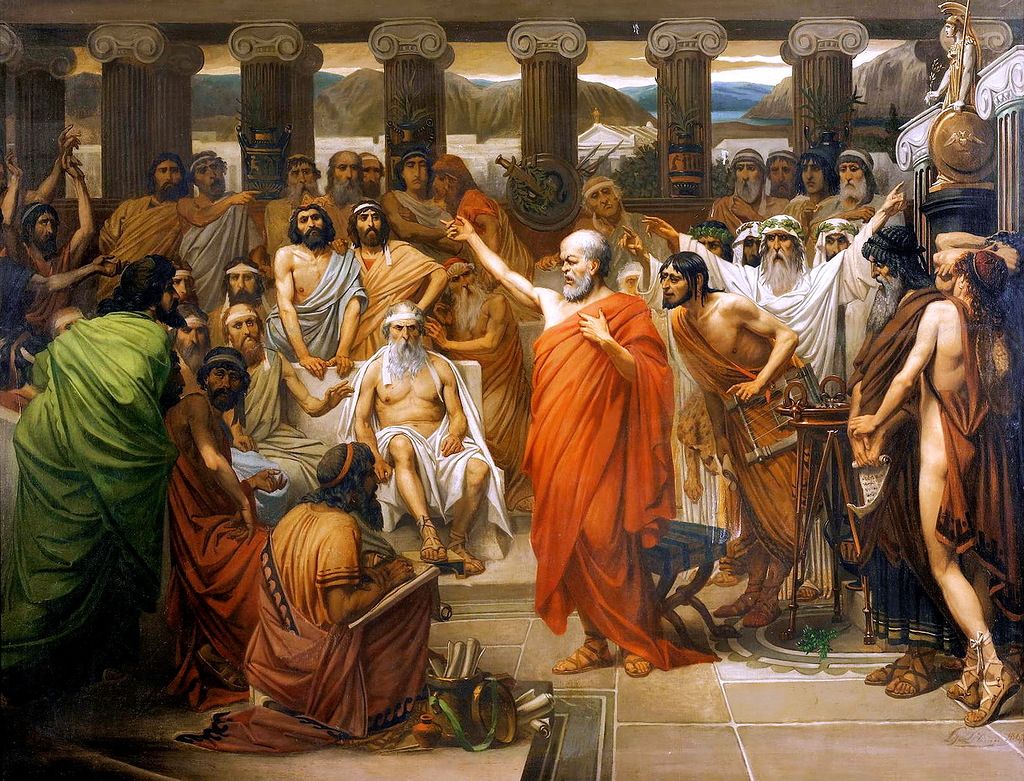
    The political position of Socrates and his disciples

    The only thing to be said about Socrates’ accusation is that you don’t really get executed for such a thing. So in any case the judges were wrong. But it should be understood that they were not “wrong” in the charges themselves, they are not blind and stupid, as the whole scholarly community still says. It’s just that even if Socrates did all the things they charged him with, it wasn’t a violation of the laws of Athens, and so yes, the persecution was purely political. For that matter, we too would have condemned the execution of Socrates and stood in his defense, just as we should have condemned the attempted executions of Anaxagoras and Protagoras. It doesn’t matter that Socrates was a fascist bastard, the law didn’t forbid him to be one. If he had to be put down, it would have been better to do it outside the judicial system.

    Just now we can sort out whether Socrates was a “fascist” and what his political views really were. Here we will look at Xenophon’s Greek History. One of the most interesting events here is the last major victory of Athens over Sparta during the “Peloponnesian War”. The very battle after which all the victorious generals were put on trial and executed. It is this event that Xenophontus and Plato emphasize, showing that Socrates was then almost the only person from the panel of judges who opposed this decision and tried to save the strategists from execution. This example in their eyes proves Socrates’ patriotism. Usually this event (see “Trial of the strategists” on Wikipedia) is discussed in the abstract. The people executed the generals for not even attempting to rescue survivors and pick up the bodies of fallen allies after the battle. The defense usually claims that a storm prevented them from doing so. This is a religious issue because not picking up the bodies of the fallen was considered horrible blasphemy. What is surprising here is that Socrates and Xenophontes, who are always on the side of maximizing religiosity, in this case put efficiency above religious tradition. Here we can suspect that they were not satisfied with the very fact that victorious generals are judged by some blacks, and all other circumstances are secondary. Or we can simply say that they thought here as pragmatists. There are many variants, but the reasons for the execution, and the reasons for the defense of Socrates, hardly had a partisan character.

    Be that as it may, it is important to record that Socrates here was against the condemnation, while one of the accusers was Theramenes. In that campaign it was Theramenes who was ordered to take away the dead, but he could not, referring to the storm. They could hang all the dogs on him, but he justified himself in such a way that it turned out that the generals themselves did not know whether the weather was normal or not, but just went home without a second thought. And Feramen at least tried, and besides, he had a subordinate position, so it was not the highest responsibility. The generals tried to sink Feramen, but in the end he sank them.


    After this event, Sparta was able to gain the support of Cyrus, the prince of Persia, and with his money and fleet — defeated Athens. Xenophontus in his book exults on this occasion and relishes every move of Sparta and every humiliation of the Athenians. The final peace treaty, i.e. in essence capitulation, was signed by the very same Theramenes. How Socrates felt about it, we can only guess. Now the Athenians had to establish oligarchic rule, as elsewhere in the territories subject to Sparta.

    This oligarchic system began in this way: the people decided to elect thirty men to compile a code of laws in the spirit of the old days; these laws were to form the basis of the new state system.

    Thus began the “Tyranny of the Thirty”, at the head of which stood the student of Socrates — Kritias, as well as another uncle of Plato — Harmides, and many aristocrats close to them. The top of the “thirty” included Theramenes. Moderate conservatives, such as Xenophontes, were dissatisfied with the fact that the issuance of “laws in the spirit of antiquity” delayed, and thus, “thirty” indefinitely prolonged their stay in power. And the power was used for repressive purges, both in the camp of democrats and among discontented aristocrats (that is why the tyranny was condemned by Socrates, Plato and Xenophontes). And for their own safety, the “thirty” requested Sparta to garrison Athens at the city’s own expense.

    The next important moment in the “History” Xenophontes — is the image of the opposition that opposed the tyranny of the thirty. It was headed by Theramenes. It should be understood that this character is far from an exemplary ideal, and in addition to the fact that he was among the “tyrants” and appeared in the case with the fleet, he became famous for the fact that he changed parties and ran from camp to camp several times. The same Alkibiades was reviled by everyone for the same behavior. Like many conservatives, Theramenes was in the circle of Socrates, but also in the circle of the sophist Prodicus. He was one of those who led the oligarchic coup of 411, but he also became the one who strangled this coup. And it was Theramenes who made the final peace with Sparta. Just as in the previous coup he was among the leaders of the oligarchy, but was horrified by their “righteousness”, and opposed, the same thing happened in the case of the “tyranny of the thirty”. Theramenes criticized almost every move of Critias. Let us recall that Kritias began arbitrary repression, took away the arms of all citizens, and granted political rights to only 3000 Athenians chosen at his own discretion, not to mention that he introduced a Spartan garrison of his own free will. Resistance on the part of Theramenes began to frighten Critias, so he too fell under the gusher of repression.

    Theramenes was accused, to cut a long story short, of not adoring Sparta enough. From the defense of Theramenes we will cite only the most basic of his personal political position. He is a patriot of Athens, and wanted to see a conservative Athens, not a copy of Sparta. He was particularly incensed that Critias had executed many aristocrats, simply for not being principled enough in their hostility to democracy. Among other things, Theramenes even condemned the exile of such future leaders of democracy as Thrasybulus and Anitus. Yes, the same Anitus who would later judge Socrates. From Theramenes’ point of view — this only strengthened the enemies of the aristocracy:

    Do you really think that Thrasybulus, Anitus and the other exiles would be more eager to see the kind of order that I seek to bring about here than the state of affairs to which my co-rulers have brought the state? No, I think that in the present state of things they are convinced that they meet with implicit sympathy everywhere; but if we succeeded in bringing the best elements of the population to our side, they would consider the very idea of ever returning to their native land almost unfulfilled.

    It is evident that the positions of Feramen and Anita are diametrically opposed. From what has already been said, it is clear that he is not even a moderate democrat, but he is not a supporter of Critias either. This can be called “moderate” or “classical” conservatism. He himself describes his position as follows:

    I, however, Kritias, all the time tirelessly fight the extreme currents: I fight with those democrats who believe that the real democracy — only when the government involves slaves and beggars, who, in need of drachma, ready to sell the state for drachma; I fight and with those oligarchs who believe that the real oligarchy — only when the state is ruled at will by a few unlimited lords. I have always — both before and now — been in favor of a system in which power would belong to those who are able to defend the state from the enemy, fighting on horseback or in heavy armor. Come on, Critias, show me a case in which I have tried to remove good citizens from participation in public affairs by siding with extreme democrats or unlimited tyrants.

    And even within the framework of the laws that the Thirty had enacted, Theramenes was going to be acquitted. But Critias decided to kill Theramenes outside the framework of his own law. The scene of his murder is very long and pathos-laden, but we won’t drag it out. The main thing here is that Xenophontes treats Theramenes with obvious sympathy, despite all the “controversial” sides. It would seem that Socrates, Xenophontes, Plato, and all the members of their circle (among whom, among others, was the same Kritias!), all of them were supporters of Sparta and aristocracy. Why, when their comrade and like-minded Kritias finally took power and began to realize their ideals — they supported Theramenes? What does that mean? They were not supporters of Sparta? No, it means they were moderate conservatives like Theramenes. This politician is a manifestation of their political ideas. The question was only about the degree of radicalism, not the substance of the ideas themselves.


    And here it is interesting to add that of the extant sources, the most praise for Theramenes was given by such conservative-minded supporters of the Socratic/Platonic tradition as Isocrates and Aristotle. Aristotle even called Theramenes the ideal model of a politician. Later, the historian Diodorus would even write a scene that is considered to be not authentic (for Socrates’ disciples would obviously have mentioned it if it were true), but which clearly appeared for a reason:

    Theramenes bore the misfortune courageously, for he had learned from Socrates the deep-philosophical view of things, but the rest of the crowd sympathized with Theramenes’ misfortune. No one dared to help him, however, for he was surrounded on all sides by a mass of armed men. Only the philosopher Socrates and two of his disciples ran up to him and tried to wrest him from the hands of the attendants. Theramenes begged him not to do so. “Of course, he remarked, I am deeply touched by your friendship and courage; but it would be the greatest misfortune for myself if I should find myself responsible for the death of men so devoted to me.” Socrates and his disciples, seeing that no one was coming to their aid, and that the arrogance of their triumphant opponents was increasing, ceased their attempt.

    Suppose, let us say, that this is a fiction. But Diodorus clearly felt that Socrates’ group was ideologically in line with the ideals of Theramenes. It is not surprising (given Theramenes’ own speeches above) that when Anitus returned to power, Socrates’ group fell under the gusher of repression, not immediately, but still fell. They were moderate but still laconophiles.

    Systematic philistine v. Epicurus

    But if even Socrates was rightly accused of corrupting the youth (at least in the paradigm of Athenian public opinion), then from Xenophon’s point of view, Socrates’ bad reputation was to blame for his dialogues with citizens, which were later recorded by Plato. Xenophontus, as we have seen, thought it unfair to judge Socrates only from this side, and tried to show what he was like in his narrow circle of friends. In these conversations Socrates tells us the philistine “base” about intelligent design, i.e. that God created everything for a purpose, and that grass was created for the sake of the cow’s stomach, and her stomach for the sake of grass (teleology). He also talked about abstaining from all pleasures, respecting one’s parents, etc., etc., a general conservative base. In one of many dialogues, Socrates takes the opportunity to reveal his ideas about teleology (target causes), and in the process prove the existence of gods. Teleology itself is a bastardization of thought that doesn’t even deserve criticism (seriously, just read the arguments in its favor). But Socrates is not just stating his views to the ceiling, but by talking to a certain opponent named Aristodemus. It so happens that this man in his argumentation anticipates Epicurus, and for this reason he is worth our attention. Touching upon teleology, they moved on to the more global question of whether the gods take part in our lives at all, and Aristodemus insists that they do not. Here we see the justification of the deism position .

    Noticing that he does not sacrifice to the gods, does not pray to them and does not resort to divination, but, on the contrary, even laughs at those who do it, Socrates addressed him with the following question:
    — Tell me, Aristodemus, are there people whose wisdom you admire?
    — Yes, — he answered.
    — Give us their names,” said Socrates.
    — In epic poetry I admire Homer most of all, in dithyramb — Melanippides, in tragedy — Sophocles, in sculpture — Polycletus, in painting — Zeuxides.
    — Who do you think deserves more admiration, — is it he who makes images devoid of reason and movement, or he who creates living beings, intelligent and self-motivated?
    — By Zeus, much more the one who creates living beings, if indeed they become so not by some accident but by reason.

    And after the standard arguments of teleology in the spirit of “the gods created the cow so that man could have milk”, and the gods gave us reason to compensate for the lack of fur and claws, by which Socrates supposedly proves a constant care for us (and in fact only care during the act of creation, that’s in the best case), Aristodemus expresses a typical Epicurean attitude to the gods.

    — Is there nothing sensible anywhere else? Can you really think so, knowing that the body contains only a small part of the vast earth and a tiny fraction of the vast amount of liquid? In the same way, from each of the other elements, which are undoubtedly great, you have received a tiny particle for the composition of your body; only the mind, which, therefore, is nowhere to be found, by some happy accident, do you think you have taken it all for yourself, and this world, vast, boundless in its multiplicity, do you think it is due to some madness that it remains in such order?
    — Yes, by Zeus, I think so: I see no rulers there, as I see masters in the works here.
    — Nor do you see your soul, but it is the mistress of the body: therefore, if you reason thus, you have a right to say that you do nothing by reason, but everything by chance.
    Here Aristodemus said:
    — No, Socrates, right, I do not despise the deity, but, on the contrary, I consider him too majestic that he needs still reverence on my part.
    — If so, — objected Socrates, — then the more majestic the deity, which, however, dignifies you with his care, the more you should honor him.
    — Rest assured, — replied Aristodemus, — if I had come to the conviction that the gods at least some care for people, I would not treat them with disdain.

    In general, in relatively small texts Xenophont touches directly on a lot of issues. Among them are the issues of art, where Socrates gives evaluations close to the positions of classicism. For example, in a conversation with the artist Parrassius, Socrates proves that the artist is capable of expressing mental qualities by conveying emotions in the movements of statues, in facial expressions, and in the depiction of the gaze. Whereas Parrhasius himself, up until this conversation, believed that “intangible” things could not be depicted. So overall yes, we see a very conservative, idealistic thinker who can even be called religious. Not only does he honor the gods, but literally every action requires to be accompanied by sacrifices in favor of the gods. But it is funny that Xenophontus accuses Plato of giving Socrates a bad reputation, saying that it was he who made the teacher look like a sophist clown. While Xenophontes himself left no less unpleasant examples for Socrates. In some places he does it even more harshly than Plato. Take, for example, the story about the dispute between Socrates and his student, the hedonist Aristippus (it turns out that there are more careless students than just Critias and Alkibiades).

    One day Aristippus took it upon himself to knock Socrates down, just as he himself had been knocked down by Socrates before. But Socrates, having in mind the benefit of his interlocutors, answered him not as people who fear that their words will not be interpreted in some other sense, but as a man convinced that he is just doing his duty. The case was like this: Aristippus asked Socrates if he knew anything good. If Socrates had named something like food, drink, money, health, strength, courage, Aristippus would have argued that these were sometimes evil. But Socrates, meaning that if anything bothers us, we look for means to get rid of it, gave the most dignified answer:
    — ‘You ask me,’ he said, ‘do I know anything good for fever?
    — ‘No,’ replied Aristippus.
    — ‘Perhaps for eye-sickness?
    — ‘Neither do I.
    — How about for hunger?
    — Not from hunger either.
    — Well, if you ask me if I know anything so good that it is not good from anything, I do not know it, and I do not want to know it.

    That is, when Socrates was presented with exactly the same questions with which he himself asks everyone — he answered that either he would give a private definition (like the sophists), or he would not say anything. This is what all his interlocutors do. But only they are dumb, and Socrates is smart. Apparently, Socrates is smart only in that he did not let himself be drawn into this. But already here it becomes obvious that Socrates himself treats the “Socratic dialogues” as a mockery. In another fragment Socrates in general responds identically to the sophists, but according to Xenophontes it is all very wise:

    Aristippus asked him if he knew anything beautiful.
    S: Even many such things.
    A: Are they all similar one to another?
    S: No, as unlike some as possible.
    A: So how can the unlike be beautiful?
    S: And this is how: a man who is beautiful in running, by Zeus, is not like another who is beautiful in wrestling; a shield, beautiful for defense, is as unlike as possible to a throwing spear, beautiful for flying fast with power.
    A: Your answer is not at all different from the answer to my question whether you know anything good.
    S: Do you think that good is one thing and beautiful is another? Don’t you know that everything in relation to the same thing is beautiful and good? So, first of all, about spiritual virtues it cannot be said that they are in relation to some objects something good and in relation to others something beautiful; then, people are called both beautiful and good in the same respect and in relation to the same objects; also in relation to the same objects the human body seems both beautiful and good; equally, everything that people use is considered both beautiful and good in relation to the same objects in relation to which it is useful.
    A: So is a dung-basket a beautiful object?
    S: Yes, by Zeus, and a golden shield is an ugly object, if for its purpose the former is made beautifully and the latter badly.
    A: Do you mean to say that the same objects are both beautiful and ugly?
    S: Yes, by Zeus, as well as good and bad: often what is good for hunger is bad for fever, and what is good for fever is bad for hunger; often what is beautiful for running is ugly for fighting, and what is beautiful for fighting is ugly for running: because everything is good and beautiful in relation to what it is well adapted for, and, conversely, bad and ugly in relation to what it is badly adapted for.

    Xenophontes’ version is an unusual character altogether; his version of Socrates holds that although people are of different qualities from birth (for physiological reasons), education plays a huge role and virtue can be taught. On this point he is again hardly different from the Sophists. And in one of the sketches Xenophontus even shows Socrates interacting with the hetaera Theodotas. When the students began to talk about popular rumors about her beauty, Socrates decided that it is not enough to listen, it is necessary to evaluate it! And he led the whole crowd of listeners to her, and he evaluated her very highly, and, in fact, began to openly flirt with her (!).

    — So how could I arouse hunger for what I have? — Theodota asked.
    — And here’s how, by Zeus, — replied Socrates. — First of all, if you will not offer it, or remember when people are full, until they will not pass the feeling of satiety and will not appear again desire; then, when they have a desire, you will remind them of it only in the most modest form, so that it does not seem that you yourself impose on them with your love, but, on the contrary, that you avoid it, until finally their passion does not reach the highest limit: at that moment, the same gifts have a much higher price than if you offer them while there is still no passion.
    Here Theodotus said:
    — Why don’t you, Socrates, hunt for friends with me!
    — Well, if only you persuade me, — replied Socrates.
    — And how can I persuade you? — Theodotus asked.
    — You think about it yourself and find such a way, if there is a need for me, — replied Socrates.
    — So you come to me more often, — said Theodota.

    In the end, of course, Socrates will turn on the irony and excuse himself from dating, hinting that he has some better “girls” (and by girls he means his friends-students) and therefore it is unlikely that he will have enough time for one more. But the very fact that Socrates quietly visits hetaera, and is not ashamed of their society (Socrates is even proud of his friendship with Aspasia, the wife of Pericles, the leader of democracy and an enemy of Sparta), attends feasts, and behaves there like an ordinary partygoer (see “Feast” by Xenophontes); all this makes him, on the one hand, an ordinary man without the aplomb of an “ascetic philosopher”, but on the other hand, shows him from the side of an ordinary sophist of his time.

    The only thing that makes Socrates special, sharply different from other sophists, is his principled advocacy of the principles of meritocracy. Professional managers should rule, and all things should be done by specialists in their field (whereas the sophists insisted that everyone could do as many different things as possible). Moreover, the notion of “happy life”, which Socrates, like Democritus, makes the central notion of philosophy, is associated with virtue in the sense of “doing good deeds”, i.e. with active civil life on patsan notions (cf. Stoics). Otherwise, he is conservative, traditional, religious, but as a rule “moderately”, without fanaticism. An ordinary patriarchal man, which in modern times are plentiful in every run-down village. I would say that in modern terms Socrates is more of a “right-wing radical” than a fascist; and in the realities of that time, his political representative could be the aristocrat Theramenes.
  • Xenophonte’s “Symposium”: a review

    Xenophonte’s “Symposium”: a review

    Author of the text: Friedrich Hohenstaufen

    Russian and Ukrainian versions

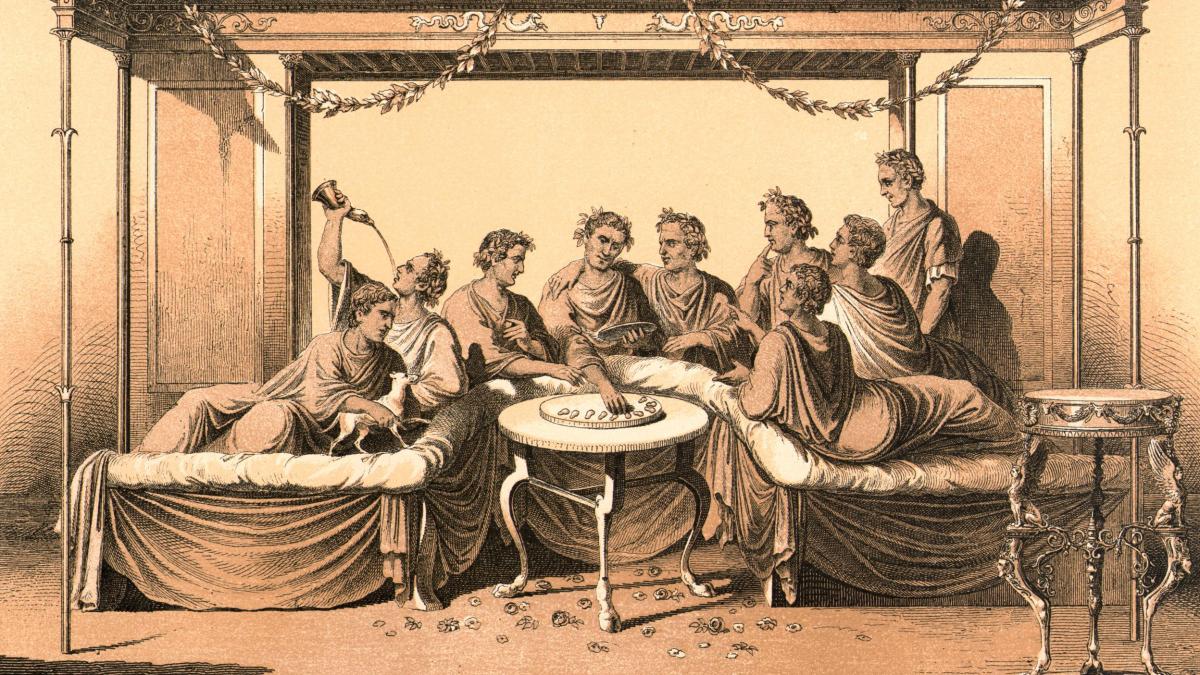
    In general, a set of dialogues called “Symposium” is a story about a group of virtuous friends who get into hilarious situations and make vulgar jokes about each other. Behind the jokes, there is sometimes an irony that points to the virtue of each character. But besides the banal self-glorification of Socrates’ friends, we are interested in the following points. Socrates here is against people using perfumes (as elsewhere in Xenophontes he was against the use of spices for food, cosmetics for women, decorating the home, etc. cf. “Domostroi”). But this in itself would not be interesting if he did not add that the natural odor of people is better, and that it differs from person to person to such an extent that one can distinguish a person’s occupation and origin by smell.

    — So, perhaps, this is true for the young; but for us, who are no longer engaged in gymnastic exercises, what should we smell?
    — Virtue, by Zeus,” replied Socrates.

    To smell virtue is indeed something new. While explaining to us where to find a “perfumer”, Socrates quotes the most “fascist” and conserative-reactionary poet of the past generations, an admirer of aristocrats, Theognides:

    From the noble you will learn goodness; but if with the bad.
    Thou wilt lose thy former wit.

    In addition, it is interesting that Xenophontes paints the founder of the school of the Cynics, Antisthenes, as the most resentful and angry student of Socrates. And, at the same time, the most serious, who promotes the theses of Kinism even in such a humorous setting that it looks quite ridiculous. He even confesses his love to Socrates, almost without irony, and the latter ignores him on purpose. Offended, he pokes fun at the teacher. Including on the subject of “bringing up women”, saying that Socrates teaches everyone this art, but his wife is grumpy. Socrates replies that:

    And people who want to become good riders, as I see, take not the most humble horses, but hot ones: they think that if they can tame them, they can easily cope with all of them.

    The analogies are bombastic, “a wife is like a horse to be ridden”. No less vivid are the examples with dancers, admiring whom Socrates himself wanted to become a dancer. His friends laughed at him, saying that it is not a serious matter for a “real man”, but Socrates insists that in principle dancing is not a bad thing and useful for health, so Socrates’ friends bend in this matter, although they still do not want to dance, because it is shameful. Compared to Plutarch, who condemned and ridiculed dancing without any “buts”, here Xenophontus also does not look like such a rigid conservative as we are used to seeing him.

    In Xenophontes, the character of Socrates even appreciates the beauty of bodies, without censuring it as debauchery, and takes part in all elements of the feast as a very ordinary citizen (in the book “Memories of Socrates” there are even more such “controversial” moments, where Socrates is not a caricature Jesus, but a living person). He makes really ironic jokes, instead of that pseudo-irony in the spirit of “you are all so smart, and I am so stupid”, which we see in Plato. This character is much deeper, and more like a real character than the caricatured Socrates of Plato’s dialogues.

    — What is this? — Socrates said. — Are you bragging like this, thinking yourself more handsome than even me?
    — ‘Yes, by Zeus,’ answered Critobulus, ‘or I would be uglier than all the Silenus in the Satyr dramas.

    His pupils can afford various invectives, from which Socrates has to refuse or joke: “But why, Socrates, do you scare us, your friends, away from handsome men, while you yourself, by Apollo, as I once saw, leaned your head against Critobulus’ head and your naked shoulder against his naked shoulder, when you both were looking for something in the same book at the schoolmaster’s?”. But still, even with all the atypical frivolities that make Xenophon more “liberal” than Plato, his writings are full of the fattest conservatism. His heroes literally memorize Homer by heart, condemn the bourgeois way of life in general, ridicule sophists, adore aristocracy and directly push carts with approval of slavery, racism, etc. This is what Xenophontus is good for, that he combines contradictory traits.

    Characters of the work, political-ideological context

    This is as far as the ideological content is concerned. But other, indirect parameters, i.e. the historical characters used here, are no less important. First of all, the figure of the organizer of the feast is important — it is Callius, the richest man in Greece. The attitude of Socrates’ circle to the “richest” is a well-known thing, so Callius acts as a clown in “Symposium”. Everyone makes fun of him, giving him praise, which he does not deserve, and he does not realize. It was said that he liked to host famous sophists and spent a lot of money on them, wishing to borrow wisdom from them and to be known as a scholar. This theme is played out in the “Pyre”. For example, when Callius invited Socrates to a feast, a dialog immediately broke out between them:

    Socrates: All you mock and despise us, because you gave a lot of money to Protagoras to learn wisdom from him, and Gorgias, and Prodicus, and many others; and you look at us as self-taught in philosophy.
    — ‘Yes,’ answered Callius, ‘I have before concealed from you that I could say many clever things, but now, if I have you, I will show you that I deserve your full attention.

    Needless to say, he could learn nothing good from the sophists, except that one should despise Socrates’ party. This theme is repeated once more in the middle of the text, when Socrates proves that Antisthenes-kinicus was an excellent panderer, he says:

    I know that you drew our Callius to the wise Prodicus, seeing that Callius was in love with philosophy, and Prodicus needed money; I know that you drew him to Hippias of Elida, from whom he had learned the art of remembering, and from then on he became even more in love, because he never forgets anything beautiful that he sees.

    Niceratus, the chief companion of Callius, is no better. He is the son of the famous commander Nicius (a moderate democrat), a lover of Homer, who knew his poems by heart. He was executed during the reign of the “Thirty Tyrants” in 404. At the same time was executed and Autolycus, the lover of Callius, in whose honor he and arranged a feast. But Lycon, Autolycus’ father and an impoverished aristocrat, who is also present at the feast, survived the tyranny, and later, with Meletus and Anitus, was Socrates’ prosecutor in his trial. This is the democratic part of the party, most of whom suffered at the hands of Socrates’ disciple, Critias, during his tyranny.

    But the future murderers of the democrats were also present at this feast. Harmidus was a relative of Plato and Critias, and an accomplice to tyranny. Originally he was rich, but at the time described, as a result of the devastation of Attica by the Spartans at the beginning of the Peloponnesian War, he lost his fortune (nevertheless, he was not offended by the Spartans, he took it with understanding). He was close to Socrates, who persuaded him to take part in public affairs. He was killed in a battle with the democrats in 403, in the process of overthrowing tyranny. Socrates’ friends Hermogenes and Critobulus are also present.

    Hermogenes was the half-brother of Callius, but unlike him he was poor and joined Socrates. In some sources, he is considered a disciple of Parmenides and a teacher of Plato (i.e. a link). Xenophontes’ book with reminiscences about Socrates was written according to Hermogenes’ testimonies. He was engaged in politics and after the execution of Socrates and the return of democracy. Critobulus is the son of Criton, one of Socrates’ best friends. In the dialogues he is portrayed as a man very handsome and proud of his beauty, inclined to hedonism. According to other students of Socrates, he led a bad way of life and learned nothing from Socrates (thus Socrates brought up dubious personalities not only in the person of Critias and Alkibiades, but also at least Critobulus, Aristippus and Antisthenes). However, his father, after Socrates’ death, suddenly disappeared from all radars and stopped practicing philosophy.

    So all these people, in the future enemies of each other, at this time could still communicate in a close circle. These are important moments for us, because they help us to understand both the trial of Socrates and the political views of his circle.

  • A review of Xenophonte’s «Oeconomicus»

    A review of Xenophonte’s «Oeconomicus»

    Author of the text: Friedrich Hohenstaufen

    Russian and Ukrainian versions

    Considering the book called “Oeconomicus”, we will focus mainly on what interests us in terms of revealing Xenophon’s ethical-political and philosophical outlook, and in addition we will consider a very atypical work “On Income”, but first — “Oeconomicus”. Philosophical elements appear here almost immediately. Speaking by the mouth of Socrates’ disciple Critobulus, we are advised to evaluate things as “gain” and “loss” through their benefit and harm, and then Xenophontes introduces a sensualistic criterion. Then he (Socrates) shows that people can be slaves of the passions, and this is worse than physical slavery and clearly harmful to the economy. But the hero, who proves himself to be an honorable man, is not afraid of this danger. Nevertheless, even though he is 100 times richer than Socrates, with his high position in Athens these funds are not enough, and he wants to learn how to better manage the household. Socrates, who has no farm and therefore has no experience, cannot ostensibly help in any way, but will still try to analyze what he has observed from others.

    In essence, he advises being a diligent worker. Work harder — better results. On the other hand, we are clearly advised to moderate our consumption, so that in the end, income exceeds consumption. Simply put, almost from the very beginning, the banal “Protestant” ethic is proposed. The house should be organized strictly according to feng shui, so that all things lie in their places, you need order, discipline, strictness, Sparta. But here he introduces the family, and assigns to the husband the task of a provider, and to the wife… an expendable. And the increase in wealth depends only on the wife. If she is bad, there will be ruin, if she is good, then regardless of the level of her husband’s income, she will be able to leave a profit (it does not matter how much, the main thing is that the budget was in the plus). Thus Xenophont removes from the man all responsibility for the household and shifts it to the woman. As a compensation he only adds that in some cases the husband himself is guilty of bad education of the wife (although it is assumed that the wife is simply unlearned and stubborn), but his analogy is at the level of:

    “If the sheep is bad, we usually blame the shepherd, and if the horse has faults, we blame the rider; as for the woman…”

    It is clear that Xenophon’s «Oeconomicus» is a typical philistine guide in the spirit of conservatism, both ethical and economic. Further it will only be confirmed by a number of examples. For example, it says here that craftsmanship is harmful to body and soul, and in general does not befit a noble man (a false meme, which we challenged in the article “Marx does not understand the Greeks”). And here he also extols farming, the Spartan way of life and condemns the building of defensive walls that create weak and cowardly citizens.

    «Shall we be ashamed to follow the example of the Persian king? He, it is said, considers one of the noblest and most necessary occupations to be agriculture and the art of war, and takes extreme care of both.»

    Xenophontes (through Socrates) uses the state structure of Persia as an example of good economic management at the level of a whole country, but it can also be used by analogy from individual farms. And it is desirable to do farming literally, with your own hands, to be a strong warrior and a real man. A separate block is the instruction “how to bring up a wife properly”, which is reduced to the fact that “God has adapted: the nature of woman for domestic labor and care, and the nature of man — for external”, and to the standard kitchen-children-home, sit and stay down. However, for that time this was the norm for “liberal” thinkers as well; but in the case of Xenophonte, it complements the image of a conservative quite well. Like Prudon in “Pornocracy,” he paints a world where women and men complement each other’s shortcomings. And Xenophontes’ basic analogy for how one should act in domestic matters, just like the socialists of the future, connects with the bees in the hive.

    Basically, he teaches his wife the same things that were discussed above — “Protestant” ethics, order and discipline. His house is not decorated on principle (in the dialog “Gieron” he is still fundamentally against spices for food), and his wife also does not use cosmetics and beautiful things on principle. Everything must be strict and primitive, as in Sparta, justifying it with the advantages of natural over artificial (roughly like the logic of those fighting against GMOs and for the Soviet GOST).

    In addition, Xenophontus tries to describe how to conduct business in agriculture, advises to choose a slave as a manager, who should be taught everything that you know yourself, and by his good disposition almost bring him into the family circle, so that he could perfectly cope with affairs in your absence (such “liberalism” with regard to managing slaves is also found in Roman manuals on agriculture, and to some extent it applies to managed slaves as well). In principle, Xenophontus is even less strict here than the Roman Cato, which is even somewhat surprising. Contrary to all the scaremongering of Marxism, slaves here are called “human beings.” But the analogies he uses to educate women, slaves, and children (and not always with the intent to demean) are analogies to animal training. On the one hand, this is crude Spartan conservatism, but on the other hand, he is not ashamed to put man and animal on the same level, although recognizing the differences between humans. Against the background of Christian morality, even of 21st century people, this could even be seen as an unprecedented level of liberalism.

    With all these means, which I myself apply, expecting to make people more obedient, I teach those whom I want to put in charge, and I also help them with this: clothes and shoes, which I have to give to the workers, I do not make all the same, but some worse, others better, so that it is possible to give to a good worker as a reward what is better, and to a bad one what is worse. It seems to me, Socrates,” he remarked, ”good workers have a feeling of disappointment when they see that the work is done by them and yet the same reward is given to those who are not willing to bear the labor or the danger at the right moment. That is why I myself by no means equalize the rewards of good workers with bad ones and praise the manager when he distributes the best things to the most deserving.

    It is not a fact that we are talking about slaves here (although it is hinted at by the fact that he dresses and shoes them himself, and other fragments where “workers” need supervisors, etc.), but this is not only a bourgeois principle of competition and fair remuneration for labor, but also another example of the “liberal” ideal. And then there are purely technical sections about soil properties, fertilizers, sowing, harvesting, etc. As a result, we see not even the most rigid for antiquity guidelines on household affairs, but clearly different from the recommendations of the Sophists, who were not opponents of walls, were not enemies of craft and trade, were not supporters of aristocracy and farmers, and preached neither moderation nor accumulation of capital (see “Anonymus Iamblichi”, “Dissoi logoi” and in general our cycle on the philosophy of the Sophists).

    On income, or Xenophonte as a liberal

    In his work “On Revenue”, Xenophontes asks whether Athens can maintain its luxurious standard of living without plundering the subordinate cities of its “allies”, purely on its own, in a mode of autarky. And will try to prove that yes, they can. After all, Athens is in a great climate zone and most importantly, has silver mines.

    One might also think that the city of Athenians is not without purpose located near the center of Hellas and even the entire universe.

    As we said in the article “Marxism-Xenophonticism”, this work of Xenophon is designed to offer an ideal plan to overcome the crisis. But in reality this plan was not put into action. Therefore, Soviet reconstructions of the Athenian economy based on this work are obviously wrong. So, according to this ideal plan, Athens needed to seriously expand the rights of metics  (non-citizens), keeping a special tax for them, which would have brought serious revenues. He proposes state patronage for merchants and shipbuilders. He suggests reducing bureaucracy to make business easier and make Athens an attractive center for trade. He also realizes that it takes large investments to establish large enterprises. But he believes that if the Athenians could chip in for large military campaigns, they can chip in for large businesses, so that they can receive a steady income as shareholders (as opposed to a net loss on the army). And even after that he proposes that strange utopian financial “pyramid” of buying slaves for the mines, as discussed in the article about Marx. From the above, it is clear that Xenophontus prefers to invest in business instead of subsidizing war. But he goes even further in terms of praising peace policy:

    It is obvious that, for all revenues to flow in abundance, peace is necessary. But in such a case, should not the office of peace keepers be established? After all, the election of such officials would encourage all people to come to our city more willingly and in greater numbers. If anyone thinks that by constantly pursuing a peaceful policy the state will become less strong, less glorious and less influential in Hellas, I must say that he is mistaken: For it is not without reason that it is said that the happiest states are those which live longest in peace; and of all states Athens has the greatest capacity for development in times of peace.

    Most of these are very liberal measures, as for a conservative, although they do concern public (not private) investment and public revenues. True here as well:

    You see, in the same way, private individuals, by banding together in companies and sharing all fortunes and failures with each other, are less exposed to danger in this risky enterprise. And of course you must not be afraid that with this method of mine development the State will embarrass private individuals or, on the contrary, that private individuals will embarrass the State.

    This is far from the first time that Xenophontes has written things that don’t fit the standard description of him as a hardened reactionary and fan of Sparta (though all of that is certainly true as well). Including economic issues, we have already seen in the work “Cyropaedia” how he proposed an international confederation based on economic grounds, and in the work “Hiero” he proposed to promote competition as much as possible for the effective development of the city’s economy.

  • Pythagoras and the Pythagorean brotherhood

    Pythagoras and the Pythagorean brotherhood

    Author of the text: Friedrich Hohenstaufen
    Written in 2019

    Russian and Ukrainian versions

    The cycle “Ancient Philosophy: Formation of the Canon”:

    • Introduction (Thales, Anaximander).
    • First part (Pythagoras) — you are here.
    • Second part (Xenophanes).
    • Third part (Heraclitus).
    • Fourth part (Parmenides).
    • Fifth part (Summary).

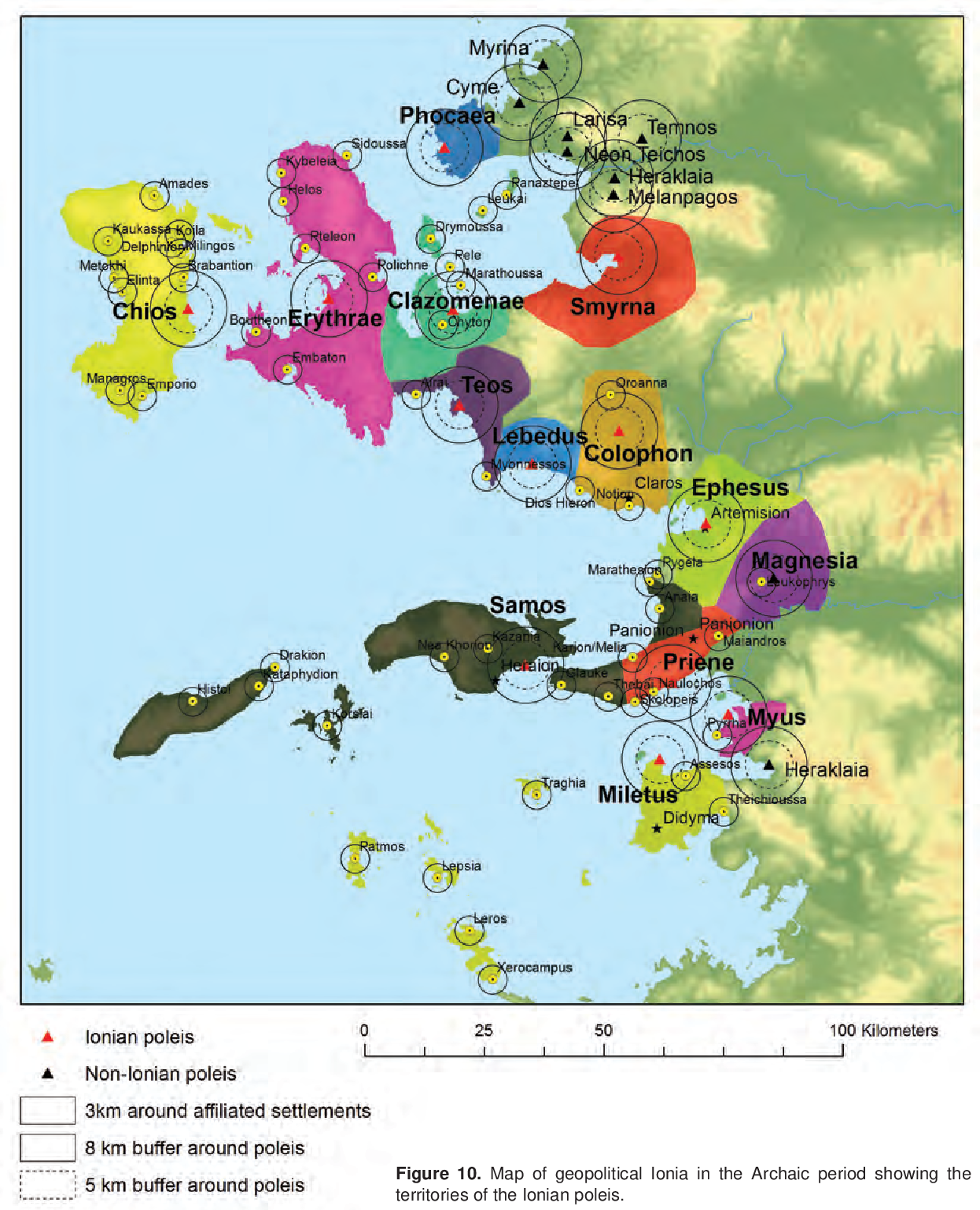
    Now we know that the entire poetic culture, the Greek literary language itself, and with it the richest polities, including Miletus, the main colonial center of the Greeks, are all located on the Ionian coast. It is therefore no coincidence that this is where “philosophy begins”. However, already during the lifetime of Anaximenes, this abundance comes to an end. In 546 BC the Lydian kingdom was destroyed by the Persian king Cyrus, and his famous and sung by Greek poets capital Sardis fell. Croesus himself was most likely burned at the stake, and according to legend, already captured, he said the following words to Cyrus: “If you are victorious and your soldiers are plundering Sardis, they are plundering your property”. With this, Croesus supposedly stopped the plundering of his capital. There are also versions that Croesus was pardoned, and that he went to the court of the king as an advisor. Both versions, of course, are not very plausible, but legends about the fabulous wealth of his grandson (Pythias) — still hint that the family of the king subsequently received recognition from the new power. The Greeks of the Ionian coast also submitted to the new power.

    During this period, the cultural ties of the Near East were seriously expanded. For example, before his defeat, Croesus had time to conclude treaties of alliance with Babylonia and Egypt, as well as a treaty of assistance with Sparta. Organizing an international coalition was no longer a difficult problem (although it had not been a problem long before, even in the Bronze Age); soon the ties between regions were further intensified, now by the incorporation of all the civilized regions of antiquity into the new single state. As for the Greeks, after the defeat of Croesus, the Ionian polities also became part of the Achaemenid Persian Empire. Even shortly before the invasion, the ruler of Miletus tried to reorganize the Ionian union, as it is believed, under the influence of his political advisor Thales, as we have already discussed before. But there was little effect, for the alliance turned out to be purely nominal, and the same Thales advised at the last moment not to oppose Persia in order to keep the city intact. “Loyalism” of Thales can also be questioned, since the last traces of Thales and Anaximander (presumably the years of their death) are almost synchronous in time with the Persian invasion. It is quite possible not only their political influence on the life of the city, but also their attempts to organize resistance, which was followed by retaliatory repression in their direction. There is, of course, no direct evidence of this. But this is roughly how the “Miletian School” left the scene.

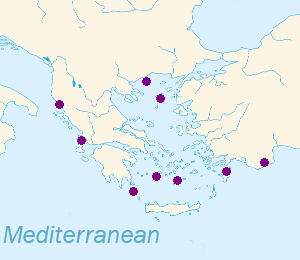
    The Ionian Union of 12 polities (14 on the map), a shaky association that existed under the protectorate of Lydia until its complete destruction by Persia

    The last representative of the Miletus school, and the only philosopher who lived in the region at this time, was the already known to us “philosopher of the air” Anaximenes. For a time, however, two other significant thinkers caught this era, Pythagoras of Samos and Xenophanes of Colophon. It was they, and not Thales or Anaximander, who were destined to lay the foundation for the development of the entire further philosophical tradition. In fact, it is true that Pythagoras and Xenophanes simply continued the ideas of the Miletians, but if we compare them, then even from the scanty passages that have come down to us, we can feel a significant difference. And if we think within the framework of the old Marxist classification — then both Pythagoras and Xenophanes will appear against the background of Anaximander as “idealists” against the background of “materialist” (of course, it is very conditional). Consequently, the foundation on which the further philosophy of antiquity was built was the foundation of the victory of early idealism. On the contrary, materialist philosophy had now to rise from literally nothing, overcoming the resistance not only of mythology and religion, but also of the “philosophical canon” itself. We will try to find out what this “canon” is in this article.

    Journey to the West

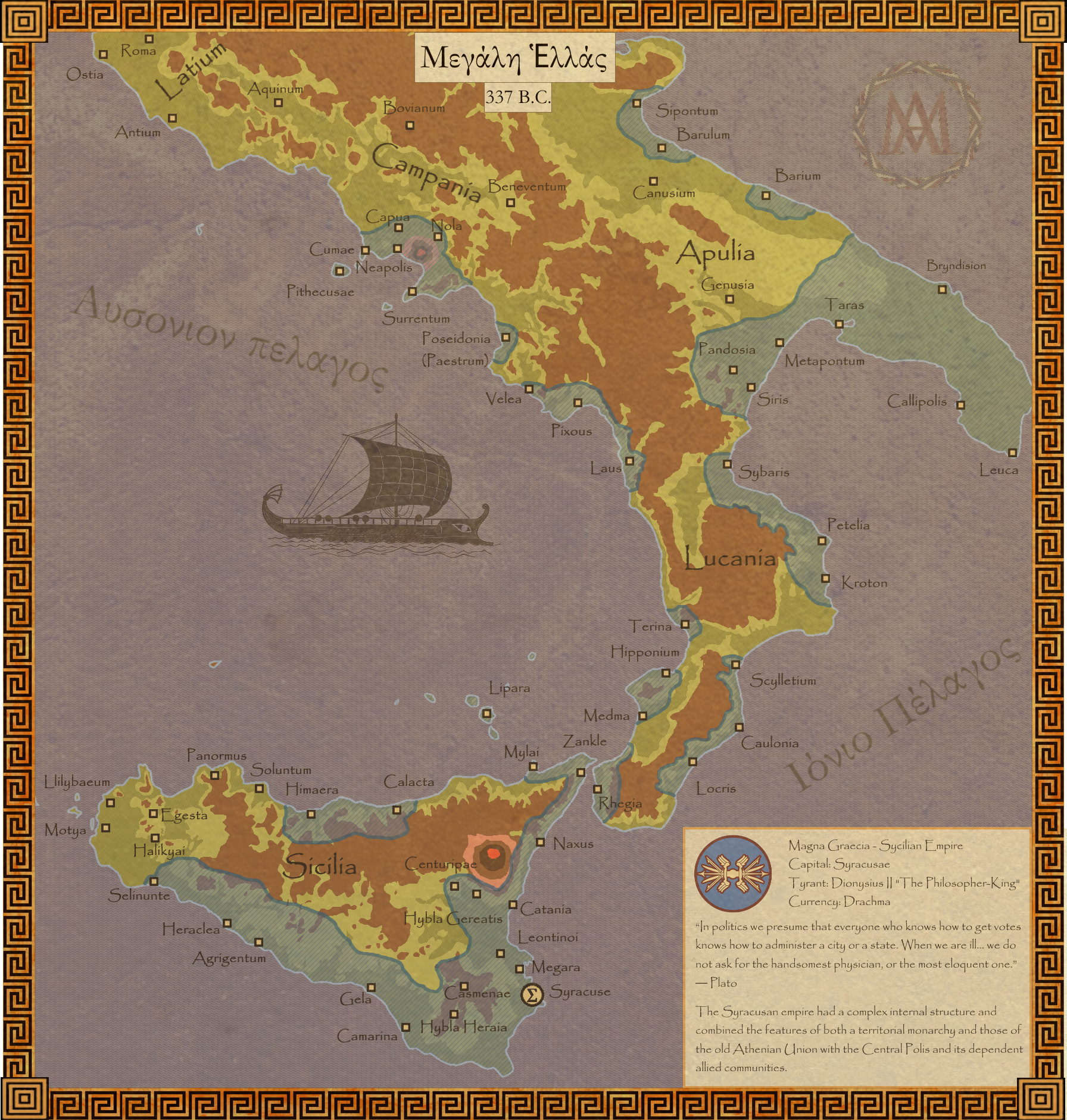
    After the Persian conquest of Ionia, the center of ancient philosophical thought moves to “Greater Greece” (Southern Italy). This was a backward agricultural region made up of colonies and predominantly inhabited by local natives with a more rural and archaic culture. It was here that refugees from the east evacuated. Of course, even here among the new polities there are regional leaders (Croton, Tarentum, Syracuse) capable of competing with the main polities of Greece; but all these exceptions are five-minute colonies that continue to exchange grain for handicrafts from the “center”.

    Just in one such center in Italy, Pythagoras (ca. 570-490 B.C.), the son of a master jeweler, founded his philosophical school. But Pythagoras would not leave the island of Samos until around 530 BC, when he must have been about 40 years old. Obviously, by this time some philosophical positions must have already formed in his mind. And since his home island was not far from Miletus, and the years of his life allow it, we can safely say that Pythagoras became personally acquainted with geometry through Thales. Besides, there is evidence from ancient authors about their personal meetings, and even about the influence of Anaximenes on the question of animating bodies. It is often admitted that the philosophy of Pythagoras was borrowed from the East, first of all from Egypt, where he was allegedly directed by Thales himself. But at that, purely biographically, the voyage to Egypt (and further to Babylon and even India) looks a bit strange, as it does not quite coincide with the dating of his life. But even a trip to India was not something impossible for that time; the only problem is that Pythagoras had a lot of time to do in Europe, and from somewhere he found more time than a man engaged in such distant expeditions could get.

    But, as we see, for acquaintance with Egypt it was not necessary for him to go there physically. Thales knew eastern sciences, and transferred them to Greece. Some elements of eastern cosmogony (the theory of creation of the world) are present in Anaximander. Therefore, in any case, whether he traveled somewhere or not, his knowledge may well have had Eastern roots.

    The Greek colonies in Italy

    The main premise on which we base our consideration of the Pythagoreans is this: by the time Pythagoras decides to leave his homeland, the basic foundation of his knowledge is entirely Miletian in character. In a sense, Pythagoras continues the tradition of the Miletian school, while founding his own. He synthesizes the teachings of Thales, Anaximander and Anaximenes (as we will see further on with specific examples) with the philosophy of Pherecydes and the religious ideas of the Greeks and Egyptians.

    Pythagoras also, like his predecessor philosophers, was interested in politics, even tried to take an active part in it. And if to generalize the political vector of Pythagoreanism — it is an extremely conservative philosophy. Pythagoras himself fled to Italy, because at that time a tyrant ruled on Samos. This can be interpreted as an example of libertinism, as a criticism of tyranny; but in the context of his era, tyrannies were a form of struggle of the townspeople against the large landed aristocracy. The protest against tyranny may indicate that Pythagoras was a supporter of the power of the aristocracy (for the same reason the philosopher Xenophanes emigrates, by the way). He realized that he had no political future in his homeland, and either he was expelled or he left there himself. Note that despite the ethical conservatism of the Miletian philosophers, politically and economically they were not opposed to tyrants; rather, even on the contrary, they catered to their rule. But as in philosophy, Pythagoras proved to be a true innovator even in political conservatism. When he arrives in Italy, he establishes there a special organization, the likes of which had never been seen before; a kind of secret political alliance. We will begin with this episode of his life, especially since he most likely based his philosophical school on the foundation of a political union.

    Pythagorean brotherhood

    Here it is important to emphasize once again that Miletus at that time was the largest city of the entire Greek world, the richest trade and maritime center. Of all the Greek colonies in the Black Sea — 95% belonged to this city. Against this background, Italy was an agricultural and colonial region, a backward province, at least at first. And what are the Orphic and Dionysian cults (well, let’s not forget the mysteries) but agricultural cults originating from the common people? Who is more likely to preach unity with nature — city dwellers or villagers? This is a rhetorical question, the answer to which is obvious. It should always be kept in mind that the question of the difference between the city and the countryside is a very important one, also for philosophy; it is so obvious that not only the ancient Greeks, but even the Sumerians and Egyptians did not avoid this question (see the Sumerian myth of how Enkidu became a man). As lifestyle influences one’s ideas, so too the surroundings of the sages from Miletus (i.e. the leading metropolis) and the life of Pythagoras (i.e. the rural outskirts) — left their imprints on their philosophy. Much of the strange legends about the “religion” of the Pythagoreans may well be the results of a syncretism of Eastern sciences and the common folk beliefs of the Greeks. It remains only to understand why quite educated Pythagoras became a spreader of superstition.


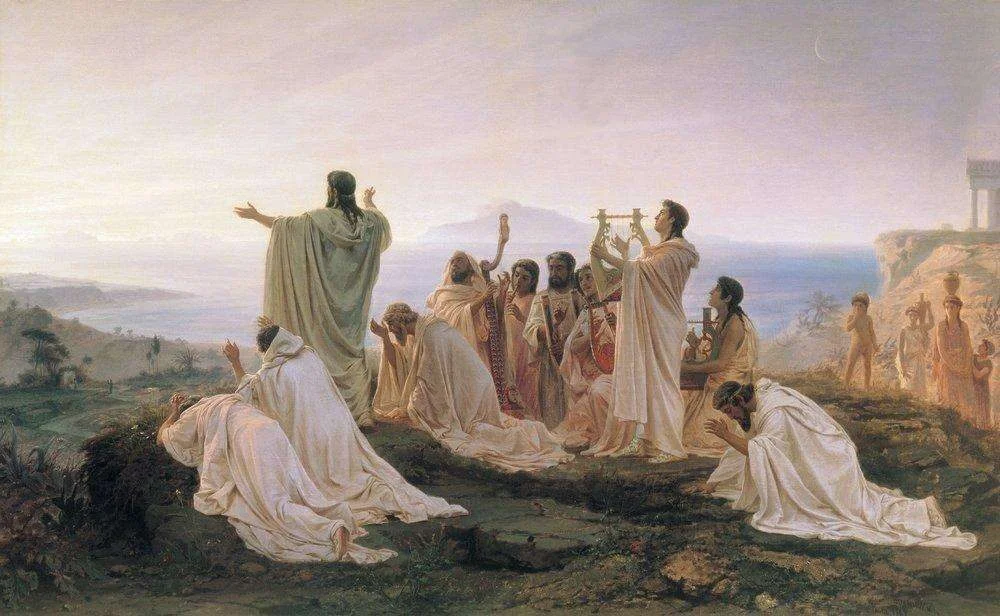
    Early sources, including Aristotle, tell us almost nothing about Pythagoras himself, but speak a lot about the “Pythagorean way of life” and numerous Pythagoreans. Unlike the Ionian philosophers, Pythagoras managed to create a full-fledged mass school, where both men and women were admitted, perhaps even from different classes (but most likely only aristocrats). In this respect his activity can be considered as the first example of Enlightenment. Of course, Pythagoras himself acquired his education while he was living near Miletus; but one must keep in mind that to succeed among the public, one must say what the public is interested in. And if the local population of Italy is interested in religious mysticism, they will have mysticism. If they want fantastic stories, they will have stories. Pythagoras positioned himself to be a constant source of delight and shock for the public. His most famous adventure (more of them have survived, as you can read about in primary sources) was that he built himself a room underground, and ordered his mother to spread rumors that he was dead. In doing so, she was to write down on a slate everything that happened upstairs, noting the time of events, and then bring it down to him. Later he returned upstairs, looking as skinny as a skeleton, and came to the people’s assembly, where he announced that he had come straight from Hades. At the assembly he read out everything that had happened during his absence. All those present were so excited that they rushed to weep and even believed that Pythagoras was a divine being. And he himself later emphasized in various ways that his nature was different from ordinary human nature, and was somewhere between men and gods.

    This calculation for the involvement of the masses could be the reason for the sectarian division of the school into several levels. Such measures are useful to separate the “mass” from the chosen sages, but at the same time not to close access to the uninitiated (otherwise it would be impossible to maintain the mass of the organization). Successful propagation requires inducing a sense of ownership in the followers, and Pythagoras did this successfully. Ancient sources report that the property of the Pythagoreans became common, and their daily routine was clearly regulated and included joint meals, walks, and study (cf. ancient Sparta). The adherents of the school swore that they would strive for the knowledge of truth, which implied, among other things, religious rites, ascetic lifestyle, and the study of philosophy. Knowledge in the community was passed on only to recognized members. Disclosure of information to the uninitiated entailed banishment. Pythagoreans used secret signs, thanks to which they could find fellow believers in different cities. Because of all this, their organization is compared to the prototype of Christian monasteries and Masonic lodges.

    The symbol of Pythagorean asceticism is the cup of Pythagoras

    The School of Pythagoras, founded around 525 B.C. (and destroyed 75 years later, around 450), is divided into ethical-political and scientific-philosophical communities. It is most likely that the latter is based on the foundation of the former, and that Pythagoras originally built something resembling a political party, united by ethics like a religious order. The fact that Pythagoras himself was a conservative in the field of politics, affects the positions of the whole Pythagorean union, and even the internal organization of the party. Explicit borrowings of Spartan orders, as well as a disdain for the lower classes and a love of hierarchical subordination, were dictated by this conservatism. Believing that the masses of people were too stupid — the Pythagoreans proposed, instead of the old democracy and monarchy — the rule of a group of wise men (i.e. themselves). Although in fact it was little different from aristocratic rule, Pythagoras was the first theorist of an enlightened meritocracy. And what is more important, unlike Plato, he succeeded!

    The first important event for the Pythagoreans was the war between Croton and Sybaris (later known for its legends of corruption and wastefulness). After the tyrant Telis seized power in Sybaris, his opponents fled to Croton. The Crotonian council under the influence of Pythagoras refused the embassy from Sybaris to extradite the fugitives and started a war to restore order. The Crotonian army, under the command of the Pythagorean Milon, about 510 B.C. defeated the Sybarites, and their city was sacked and destroyed with the utmost cruelty. After the victory, Croton became the most powerful among the cities of southern Italy, and the other polis became its forced allies. The role of the Pythagorean Union also increased. However, the power of the secret society of Pythagoreans caused discontent. Therefore, a certain Kilon used the discontent with the authoritarian policy of the Pythagoreans and, perhaps, the unfair division of the land taken away from the Sybarites (or perhaps it was simpler, as later with the Jews — people were not satisfied with the closedness of the sect, which led to rumors about eating babies, etc. things). Together with his supporters, Kilon attacked the Pythagoreans during their convention in Crotona, burned down the meeting place and killed many of them, and many fled for their lives. According to another, less widespread version, Kilon attacked the school after it had experienced an internal split, as a result of which the “democratic opposition” won. In this case, Kilon opposed democracy. Pythagoras himself, according to some versions, at the time of the congress was already absent (which may indicate the correctness of the last version of the split), he moved to the Italian city of Metapont, where he died around 490 BC.

    But this was only the beginning of the problems, because at first the Pythagoreans continued to hold good positions in most cities, and could hope for revenge even after the loss of their charismatic leader. And yet the internal crisis, splits between supporters of paternal customs and supporters of popular participation in politics — weakened the school. For reasons unknown to us, about 450 BC in Italy began mass pogroms with the subsequent expulsion of the Pythagoreans. This led to an exodus of the Pythagoreans to mainland Greece, after which their school disappeared for a while, dissolving into Platonism. Thus we can see that not only Thales and Anaximander, but also the Pythagorean school — took an active public position. Even in such early times philosophy was not a pure and abstract science of knowledge of the originals.

    Acusmatics and mathematics

    The purely philosophical school of the Pythagoreans was in close connection with the political school. There is no reason to believe that they were organizationally separated. We know that the philosophical school was divided into a lower and a higher level of initiation, known as akusmatics (“listeners”) and mathematicians (“disciples”). They, too, may have been closer to each other than it seems at first glance, especially if the mathematicians necessarily passed the akusmatikos stage. After Pythagoras’ death, two currents formed among his followers — the Pythagoreans proper (based on the mathematicians) and the Pythagorists (akusmatics). What Pythagorists-Akusmatics did later became the most famous part of Pythagoreanism, the so-called “Pythagorean way of life”. They built their lives with the help of “akusm” (verbal precepts), and all their teaching consisted in the repetition of Pythagoras’ sayings, which they treated as divine commandments. It was a school of worldly wisdom that was guided by aphorisms of the level of the Seven Sages, and if you think about it, even an order of magnitude worse. For example:

    “You shall not rake the fire with your knife; you shall not step over the scales; when you leave, you shall not look back; you shall put your shoes on your right foot first, and mine on your left foot first.”

    Since it was a mass part of the school, such “Pythagoreans” were much more common, and their extravagant behavior attracted more attention and became a kind of “meme”. Most of the legends about the Pythagoreans are connected explicitly with them. And if the akusmatics dealt with the religious and ritual aspects of the teachings, the mathematicians dealt with the studies of the four Pythagorean “math”: arithmetic, geometry, harmonic and astronomy. When we speak about Pythagorean philosophy, we always mean these last ones: i.e. the few elite of the Pythagorean club.

    The akusmatics did not strive to create something new and develop the doctrine, but considered as wise those who have learned and can apply in everyday life the greatest number of sayings attributed to Pythagoras. Besides, akusmatics did not consider mathematicians as “real Pythagoreans”, but said that they originated from Hippas, who changed the original Pythagorean tradition, revealed the secrets to the uninitiated, and began teaching for a fee (i.e. instead of sectarianism Pythagorean mathematicians were engaged in what would later be called sophistry). Most likely, the principles of the Acusmatists were also accepted to varying degrees among mathematicians, especially if these are two stages of development within a school. The only question is to what extent the Pythagoreans were dogmatic and religious in each case.

    This is the history of the emergence of the Pythagorean Union, their internal subordination and the political history of their rise and fall. But if the Pythagoreans were remembered by the ancient Greeks more by memes about eating beans, they entered the history of philosophy thanks to their mathematical teachings, to which we now turn.

    Mathematical philosophy

    If to believe the late Pythagorean Yamvlichus, Pythagoras once noticed, passing by the forge, that the coinciding blows of hammers of different weights produce different harmonic consonances. But the weight of the hammers can be measured, and thus a qualitative phenomenon (tonality of sound) is precisely determined through quantity. Hence he concluded that in general “number owns things”. Thus was born the view that the phenomena of nature can be translated into quantitative terms (or that quantitative changes pass into qualitative differences), and that these phenomena can be studied with the help of a mathematical language. This language itself was still very primitive at the time of Pythagoras, and many generations would pass before its application would begin to bear meaningful fruit. But it was thanks to Pythagoras that mathematics not only gained a new meaning for cognition of the hidden nature of things, but also received a new meaning as a discipline that exists separately from things. Thanks to this, Pythagoreans and mathematical scientists began to develop mathematics no longer as an empirical, but as an abstract science.

    After the story of the hammers at the forge, Pythagoras realized the importance of number in music. Due to the close connection with music, an aristocratic aestheticism was embedded in the very foundation of Pythagorean teaching. With the help of the philosophy of numbers Pythagoras undertook to explain not only the visible world, but even abstract concepts of beauty and love. Such mathematical expressions as “harmonic mean” and “harmonic progression” still remind us of the connection he established between music and arithmetic. The Pythagoreans even believed that music could purify people’s souls. The Pythagorean doctrine of the harmony of the spheres is also peculiar: the transparent spheres to which the planets are attached (cf. Anaximander’s cosmology) are separated from each other by gaps that relate to each other as musical intervals; the individual celestial bodies sound in their motion (due to friction against the etheric wall), and if we do not distinguish their consonance, it is only because it is heard incessantly. Hence we can conclude that in his theory of cognition, Pythagoras insisted on the importance of differences/contrasts for the possibility of perception. Such aestheticism applies not only to music, but to any matter at all. In Pythagoreanism, harmony and beauty affect absolutely everything. Through these concepts, justice, equality and many other purely political concepts are also defined. An important fact is that Pythagoras was the first thinker who called himself a philosopher, that is, a “lover of wisdom” (but not a sage, because wisdom belongs to God alone). He was also the first to call the universe a cosmos, that is, a “beautiful order.” And although music and aesthetics play a significant role in terms of the form of Pythagoras’ teachings, but the core of his philosophy was pure mathematics, and the main contribution to philosophy he made in this field.

    An introduction to the philosophical teachings of Pythagoras was well done for us by Aristotle in his Metaphysics, so we will cite his testimony in its entirety (important passages are highlighted):

    The so-called Pythagoreans, having engaged in mathematical sciences, first moved them forward and, having been educated on them, began to consider their beginnings as the beginnings of all things. In the field of these sciences numbers occupy from nature the first place, and they saw in numbers, it seemed to them, many similarities with what exists and happens, — more than in fire, earth and water. For example, such a property of numbers is justice, and such a property of the soul and mind, another — luck, and, we can say, in each of the other cases exactly the same. Besides, they saw in numbers the properties and relations inherent in harmonic combinations. Since, therefore, everything else was explicitly likened to numbers in its whole being, and numbers occupied the first place in all nature, they assumed the elements of numbers to be the elements of all things, andrecognized the whole universe as harmony and number.

    And all that they could show in numbers and harmonious combinations agreeing with the states and parts of the world and with the whole world order, they brought it together and adapted one to another; and if they lacked something or other, they endeavored to add it so that the whole structure was in perfect connection. Thus, for example, in view of the fact that the ten (decade), as it seems to them, is something perfect and contains in itself the whole nature of numbers, they count ten bodies carried in the sky, and since the visible bodies are only nine, so in the tenth place they place the opposite earth …. In any case, and at them, apparently, number is taken as the beginning and as matter for things, and as an expression for their states and properties, and the elements of number they consider even and odd, of which the first is indefinite, and the second definite; the one consists of both, it is both even and odd; the number itself is formed from the one, and the various numbers, as has been said, is the entire universe. Others of these same thinkers accept ten beginnings, going each time in the same row — limit and limitless, odd and even, one and many, right and left, male and female, resting and moving, straight and crooked, light and darkness, good and bad, quadrilateral and versatile. The Pythagoreans specified both how many opposites there are and what they are. In both cases, therefore, we learn that opposites are the beginnings of things; but how many of them — we learn from some Pythagoreans, and also — what they are. And as it is possible to reduce the beginnings accepted by Pythagoreans to the above-mentioned causes, it is not clearly dissected at them, but, apparently, they place their elements in the category of matter; for, according to them, from these elements, as from the parts inside, the essence is composed and formed.

    The Pythagoreans maintain that things exist by imitation of numbers; seeing in sensuous bodies many properties which are in number, they caused things to be numbers,-only these were not numbers endowed with independent existence, but, according to them, things are composed of numbers. And why was this so? Because the properties which are inherent in numbers are given in musical harmony, in the structure of the sky, and in many other things. Meanwhile, for those who accept mathematical number alone, there is no possibility, in connection with their premises, of asserting anything of the kind… And it is clear that mathematical objects do not possess a separate existence: if they did, their properties would not be found in concrete bodies. If we take the Pythagoreans, there is no fault on them in this matter; however, since they make physical bodies out of numbers, out of things that have no gravity and lightness, such things that have gravity and lightness, one gets the impression that they are talking about another heaven and other bodies than sensuous ones.

    In the above fragment, however, Aristotle has exaggerated. Yes, in the end everything does indeed come down to number, but physical processes are also explained by physical elements; and this is done in exactly the same way as with the philosophers from Miletus. If we turn away a little from the numerical dimension of Pythagoreanism, what we get next is a quite typical naturalistic system with material elements and tiny particles scattered in the void. In one of the extant retellings, Pythagoras says that there are five bodily figures, which are also called mathematical figures: from the cube arose the earth, from the pyramid — fire, from the octahedron — air, from the icosahedron — water, from the dodecahedron — the sphere of the universe (i.e. ether). Though it is clear that even Miletians operated with all elements, at least it is known that Anaximander and Anaximenes did it, but nevertheless innovations of Pythagoras here are obvious. He not only introduces the element of ether (it may be a special element for the very “sphere” on which the stars are attached), but actually concretizes apeiron. After all, mathematical numbers, from which all elements are distinguished, and now also all immaterial properties like nobility and love, are the literal analog of the “limitless” apeiron, which can now be handled with the help of the language of mathematics. Of course, mathematics has a supersensual character, and it is far from what Anaximander tried to do, but the logic here is roughly the same. It is likely that the theory of opposites was also internalized by Pythagoras through Anaximander. The idea of opposites plays a significant role in both of them, and against the background of the further development of this theory (see Heraclitus), they find much in common.

    It also reminds us of the old natural philosophy that according to Pythagoras everything that happens in the world repeats itself again after certain intervals of time, and that nothing new happens at all. This idea (if we are to believe in the authenticity of the passages of the poet Orpheus) — Pythagoras directly borrowed it from Orphic mythology, although he could also have found it in Anaximander. The cyclical nature of the world may hint at some ideas about determinism, but we can only learn about this from Pythagoras’ followers, not from him himself.


    But if Pythagoras simply developed the teachings of the Miletians, then why do many generations of researchers insist that he created a fundamentally new branch of philosophy? Of course, there are grounds for such an opinion. His rethinking of the role of aesthetics and mathematics alone would be enough to designate him as a separate school. But still the main feature of Pythagoras among philosophers was his mysticism, which perfectly overlaps with the classical “sectarianism” with special degrees of initiation of neophytes. Most importantly, he for the first time radically opposed soul and body, calling the latter a prison for the immortal soul. It was already pure idealism, and so mystical in nature that even allowed belief in rebirth (in particular, this is one of the reasons why the Pythagoreans practiced vegetarianism; suddenly your dead friend was incarnated in an animal?) The theory of the rebirth of the soul may also have been borrowed from the legendary Orpheus, as one of the variations of thoughts about the cyclical nature of the world. The very concept of rebirth already carries with it the idea that the soul can continue to exist after the death of the body, which means that it is independent of the body. In ancient Greece, it was this, the mystical side of Pythagoras’s teachings that caused the most discussion, and so he was associated with it in the first place. As Bertrand Russell quite rightly said about this idealism:

    With Pythagoras begins the whole conception of an eternal world accessible to the intellect and inaccessible to the senses. Had it not been for him, Christians would not have taught of Christ as the Word; had it not been for him, theologians would not have sought logical proofs of the existence of God and of immortality.

    Landscape with allegory of the four elements (1635) — author Frans Franken

    But even in spite of all the innovations and this special, mystical character of his teaching, Pythagoras and his disciples did not merely attempt to give a convenient interpretation of old ideas, but also provided answers to problems unsolved by their predecessors. They clearly see these problems, and correctly establish the main ones. Their focus is still the same problem of whole and parts, of god and nature (or theology and naturophilosophy), and of those opposites which contradict each other, and which, according to Pythagoras, must at the same time end in the establishment of harmony.

    «Researchers try only to indicate what the soul is like, about the body, which must receive the soul, they do not give any more explanations, as if it were possible for any soul to put on any body, as they say in the Pythagorean myths. It is the representatives of this view that say that the soul is a kind of harmony, and harmony is a mixture and combination of opposites and that the body is also made up of opposites.»

    (Aristotle — “On the Soul”).

    Of all the opposites, which Pythagoras puts at the basis of everything, the first pair are the limit and the limitless (apeiron). But the “limitless” cannot be a single beginning of things; otherwise nothing definite, no “limit” would be conceivable. On the other hand, the “limit” also presupposes something that is defined by it. Even here it becomes clear why it is number that is the basis of everything. For in speaking of the limit and the limit, we are already de facto engaged in counting scales. We meet these two basic principles in the Pythagorean cosmology. Here the world appears as a limited sphere, carried in the limitlessness (by the way, the Earth itself is spherical in Pythagoras). “The primordial unity, having arisen unknowingly from what,” says Aristotle, “ draws into itself the nearest parts of the limitlessness, limiting them by the force of the limit. Breathing into itself the parts of the limitless, the unity forms in itself a certain empty space or certain gaps, fragmenting the original unity into separate parts — extended units”. In order for the limitless to form a limit, it is necessary for chaotic matter to be organized into a harmonious order. Each of the worlds where instead of chaos we observe an intelligent organization of things has finally been explained. But the organization of order leads to the fact that individual objects are clearly separated from other objects, and this is only possible because of empty space. Breathing in the infinite void, the central unity gives birth to a series of celestial spheres, and sets them in motion. The doctrine that the world breathes air (or emptiness) into itself, as well as something of the doctrine of the celestial luminaries, the Pythagoreans learned from Anaximenes. The concept of emptiness was necessary to justify the motion of the elements “within something,” it also better explains the workings of contraction and expansion introduced by Anaximenes, and is necessary even at the level of geometry, as a space for the arrangement of points and lines. We have seen various hints of recognizing the void before, but never before has this issue become conceptually important. At last the void has received its full expression. Thanks to it, the picture of interaction of the elements acquires a character extremely close to the atomistic theory (each element consists not just of figures, but of tiny particles, whose figures set the “tone” of each element).

    The natural philosophy of the disciples of Pythagoras

    Pythagoreanism was certainly the most grandiose attempt to create a “theory of everything” that existed at the time. It is not surprising that we will find traces of Pythagorean influence throughout the history of philosophy. The Pythagorean school itself, in the broad sense of the word, lasted as long as the whole of ancient philosophy. It therefore embraces dozens of names in no way connected with Pythagoras. Here we will speak of “classical” Pythagoreanism, still bound by a direct chain of succession leading back to Pythagoras himself. And the major figures on our list are:

    • Hippas — Pythagorean apostate, leader of the “democratic opposition” and scientific line of Pythagoreanism. A philosopher who synthesized the views of Pythagoras and the Miletian school.
    • Alcmaeon — Physician-surgeon who empirically established that the brain is the center of concentration of the mind.
    • Philolaus — Pythagorean, systematizing the teachings of Pythagoras, Hippas and Alcmaeon, who later passed on the knowledge to Plato.

    Some of what we have said above about the philosophy of Pythagoras — we learn only from the writings of his disciples. We have selected only what seems most similar to the fundamental theses of the school, without which it is impossible to imagine either the teachings of Pythagoras himself or the opinions of his disciples. We shall now set forth the specific characteristics of each of the disciples separately, and summarize the results for the Pythagorean school taken as a whole.

    Hymn of the Pythagoreans to the Sun (1869) — by Fyodor Bronnikov

    The Pythagorean Judas

    As already mentioned, at some point Pythagoras had a “democratic” opposition within the sect. Some guy named Hippas of Metapontus (c. 530-480) violated the prohibition against non-disclosure of secrets, for which he was expelled from the elite club. Subsequently, the Pythagorean tradition used this name as a synonym for essential evil and treason. We have already mentioned this when we talked about the attitude of the Acusmatists to mathematicians as sophists who sold the wisdom of Pythagoras for money. In that case, not only “enlightenment”, but even sophistry, and the typical attitude towards it — arise within the Pythagorean union. Of course, this sounds strange, given the fact that the Pythagorean school was the largest school in Greek history, a massive school with extensive regional representation. This already automatically implies a great deal of openness. But most likely, the school admitted only people of noble origin (though not only specialized scholars), which was already a significant step forward; and Hippas brought this enlightenment trend to the next stage of development. Hippas was notorious in later centuries, but even the ancient Greeks suspected that most of Pythagoras’ achievements were actually Hippas’ discoveries, so powerful was he supposedly as a philosopher. Sometimes Hippas was even called the founder of the “mathematical” (i.e., purely scientific) branch of the school. But if this is true, then Pythagoras himself really belonged rather to the “akusmatists”, and all the best achievements of the school are the fruit of the activities of apostates.

    In addition to participating in the schism and “divulging secrets” Hippas became hated also because, besides proportions and commensurability of things, he revealed to the public the doctrine of incommensurability (or even irrational numbers). The Pythagoreans carefully concealed this phenomenon in mathematics, for they saw the source of the world’s orderliness and reasonableness in numbers. Numbers consist of identical units, and the world is based on a unit. And suddenly it turns out that at least two different units, irreducible to each other, are at the basis of the world. So the irrational, the irrational now finds itself at the heart of the world. The Pythagoreans did not know what to do about this; the phenomenon of incommensurability was destroying their worldview. Therefore, after the exile, Hippas was even cursed, and according to the legend of the Pythagoreans themselves, he sank in a shipwreck, allegedly as a punishment from the gods.


    Hippas is known as a democrat not only because he spread knowledge to all comers. He is also listed among the leaders in the political division of the Pythagorean community. As the later Pythagorean, Yamvlichus, writes about it:

    When they initiated the schism, the other inhabitants of Croton immediately began to join the distribution. From among the most oligarchic “thousand” Hippas, Diodorus and Theagus were in favor of all citizens of Crotona to participate in public office and the national assembly, and that the archons reported in their activities to the people’s representatives, elected by lot from among all citizens. They were opposed by the Pythagoreans Alkimachus, Dinarchus, Meton and Democedes, who opposed the overthrow of the fatherly system. Those who spoke in defense of the masses won.

    And so, the subsequent persecutions can be connected with the reaction of the local aristocracy against the attempts to introduce a democratic system. Perhaps the traditional Pythagoreans were able to resist at the expense of the alliance with the aristocracy, and the democrats became victims of the first wave of pogroms, as a result of which they were “expelled” from the ranks of the school, and as a result of which Hippas himself died. Otherwise, it’s hard to understand how the winner in an internal schism was suddenly victimized. Then it would appear that the conservative branch survived the first wave of pogroms, and was expelled from Italy after the second wave. It is extremely difficult to reconstruct the actual version, due to the lack of additional sources.

    In his philosophy Hippas is also sharply oppositional. As if returning to the bosom of the Miletian school, he taught that the beginning of all things was elemental, and that element was fire. At the same time, he agreed that number was also at the heart of nature, conducting quantitative experiments with sound in much the same way as Pythagoras did (only instead of hammers — iron disks). Apparently, for Hippas, number is not the beginning itself, but only a manifestation of the divine nature. Mathematics is the language God used to create the visible world. Or, as Hippas himself put it, “the distinguishing tool of the creator god.” His God, then, has reason and discernment; he is a creator in the most literal sense of the word “creation.” The creator god himself, as well as the soul of all beings, and even as the material universe, are all inherently fire. In opposition to Pythagoras, Hippas teaches that the universe is one and spatially finite (which does not invalidate its emptiness or its perpetual motion). The fire of which it is composed is transformed by densification and rarefaction. This synthesis looks as if it were an answer to the teaching of Pythagoras, its inner opposition, and an attempt to pass from the speculative beginnings to the unconditional material primary basis.

    Pythagorean medical school

    One of Pythagoras’ most famous disciples became the founder of the first medical school in Greater Greece (the Crotonian School). He is known as Alcmaeon (ca. 515-460 BC), and is listed as one of the first serious scientists in the modern sense. But it should be noted here that there was a major medical man named Calliphon who lived in Crotona even earlier, and who after the appearance of Pythagoras became a supporter of his teachings. Apparently he was the chief priest of Croton and a man of great importance in civil affairs. He also had a son who became a major medical man, whom Herodotus later called “the most skillful physician of his time,” his name was Democedes, probably a contemporary of Alcmaeon. In his youth he came to the island of Aegina, where, thanks to his talent and diligence, he soon gained fame as a skillful physician. Leaving Aegina, he went to Athens, and then worked at the court of the Samosian tyrant Polycrates. After his overthrow was sent to Sardes, then to his court he was summoned by Darius I. Having cured the king of a disease of the legs, and the queen Atossa — from a chest disease, Demoked got into great favor with the Persian king, who generously rewarded him for curing his ailments. From there he returned to his homeland, despite Darius’ entreaties to remain with him as his life-medic. Returning to his native Croton joined the party of aristocrats. There he joined the society of Pythagoreans, married the daughter of the famous Greek athlete Milon of Croton. However, during a revolt against the Pythagorean oligarchy, Demokedes died. Demokedes, along with Alcmaeon, was at the head of the oldest flourishing medical school in Greece. But we do not know the details of the teachings of Demokedes and his father, but we do know the details of Alcmaeon’s teachings.

    Alcmaeon’s theory of medicine was based on Pythagorean harmony and the theory of opposites. In the theory of opposites itself, Alcmaeon also made an important step forward. Whereas previously the set of opposites had always been limited and concretized (equally in both Anaximander and Pythagoras), he now speaks of an infinite number of very different opposites. Any idea about the simplest subject can give rise to its own antithesis. And by saying the phrase “most human things are binary ‘ — he not only took a step towards the future teaching of Heraclitus, but also opened the road towards sophistry (see ’Binary Speeches”). In the lists of philosophers who proposed different quantities of “beginnings” of things, it is said of Alcmaeon that he assumed two beginnings. What they are, we do not know, but we can assume that they could be “positive and negative”, well, or, following his theory of equilibrium, these beginnings could even be “democracy and monarchy”. The latter is of particular interest, because it allows us to conclude that, like Hippas, Alcmaeon belonged to the “democratic opposition” within the Pythagorean Union (and then he was hardly an associate of Democedes). According to his theory, human health is preserved through balance, for the domination of one opposite acts perniciously on the other, and therefore disease arises. If we believe the book “Opinions of Philosophers” (Pseudo-Plutarch), Alcmaeon called this equilibrium of the elements of the organism “democratic equality”, and called “monarchy” among them the cause of disease. It is curious to compare the theory of balance with ancient Chinese ideas about medicine, which also appealed to the balance of “yin-yang”, and made the same conclusions about the origin of diseases.

    Probably in Greek philosophy he was the first to say that man differs from other animals by the fact that only he thinks, while other animals feel but do not think (even now, when we know that this is wrong, the same division is given, for we still distinguish between “thinking in general” inherent in animals and thinking specifically human). According to his views — the primordial part of the soul is in the brain. He came to this conclusion through research (the same “empiricism” as Thales’ conclusions about magnetism) on the nervous system and tracing the sensitivity of impulses from the endings and closer to the center. This is the more interesting because the influence of Egyptian medicine on Greek medicine is obvious to us; Egypt was inordinately more advanced in every respect. However, the Egyptians considered the heart to be the center of emotion, personality and intellect. For this reason, in mummification, the hearts of the dead were preserved, while the brain was scraped out and discarded as a useless organ. This example illustrates the advantages of the emerging Greek empiricism.

    One might think that Alcmaeon, even more learned than any of his predecessors, a supporter of progressive views in politics and the enlightenment of the masses, should himself be less superstitious than the Pythagoreans. Except that in reality we see a metaphysician like Thales, Pythagoras, or Hippas. He holds that truth is available only to the gods, and that men are left to “the things of men,” which, as we saw above, can only be judged in two ways. He also separates the divine and human world (i.e., the whole and the parts), and logically he joins the Pythagorean dualism of body and soul. Alcmaeon’s understanding of the soul itself is typical for his time. Like his predecessors, he calls the soul self-moving by nature and possessing eternal motion; for this reason, it is immortal and godlike. Alkmeon directly compared the properties of the soul with the properties of the “supralunar” world, because the stars also have eternal motion. And from the divine nature of the luminaries he made a typical conclusion that the gods and the luminaries are one and the same.


    But still, as a physician, Alcmaeon was obliged to deal not only with philosophy, but also with natural philosophy. Not only the world above the moon, but also the world of the earth. From such reasoning, except for what has already been said about the location of the mind in our brain, he writes in a naturalistic sense about the five sense organs (we quote Theophrastus’ work “On Sensations”):

    Hear, he says, with the ears, because there is a void in them: it sounds (and the sound is produced by the cavity) and the air echoes. They smell with the nose, drawing pneuma to the brain at the moment of inhalation. Tastes are distinguished by the tongue: being warm and soft, it melts food by its warmth [= mellows out its “flavor juices”], and through its porosity and tenderness absorbs them, and transmits them through the pores to the brain. The eyes see through the surrounding moisture. That the eye contains fire is evident, for when the eye is struck, fire flashes [“sparks fly”]. They see by means of the shiny and transparent body in the eye, whenever it glows, and the clearer it is, the better. All the senses are in some way attached to the brain, and are therefore injured by its concussions and displacements, as it plugs the channels through which the sensations are transmitted. About touch, however, he said nothing.

    There are other descriptions of Alcmaeon’s opinions similar to this, which also include theories about the conception of a child, typologizations of animals according to the way in which offspring are born and fed, speculations about how gray hair arises, etc. But they are all described in a similar naturalistic sense. If we combine the positions of Hippas and Alcmaeon, and contrast them with Pythagoras himself, the result of consistent criticism is a de-mystified version of Heraclitus’ philosophy. This fact is extremely important for understanding the whole genesis of the history of philosophy.

    This is how Pythagoras taught his followers in terms of AI.

    Heirs of Pythagoras

    Of the minor Pythagoreans we can mention, for example, a woman named Theano, who wrote the works: “On Pythagoras”, “On Virtue to Hippodamus of Fury”, “Women’s Exhortations”, “Utterances of the Pythagoreans” and “On Piety”. Moreover, in this last one, strangely enough, she acts as an interpreter of Pythagoreanism in the physical sense! Namely, she says:

    «Many Hellenes, as I know, think, as if Pythagoras had said that everything is born of number. But this doctrine is perplexing: how is that which does not even exist thought to be generating? Meanwhile he said that everything does not arise from number, but according to number.»

    It turns out that even for Theano numbers do not really exist! But she saw Pythagoras personally, and in some versions is even considered his wife and mother of the next head of the Pythagorean school — Telawg. By the way, the latter was even considered to be Empedocles’ teacher before he left the school. Various surviving letters of Theano are devoted to domestic concerns: how a woman should bring up her children, how she should treat her servants, and how she should behave virtuously towards her husband (rather primitive recommendations about the necessity of obedience). Theano’s father named Brontine, who according to some versions was her husband (rather than her father) instead of Pythagoras, is believed to be the author of some Orphic poems, among them “On Nature” and “The Veil and the Net”. Various Orphic poems have also been attributed to many other Pythagoreans, which either confirms their direct dependence on the Orphics or means that Orphism was indeed fabricated by the Pythagoreans. But more likely, of course, is the former.

    It is also worth remembering the philosopher Hippon (c. 490-430 B.C.), who bore the nickname “godless”. According to one account, Hippon considered water to be the beginning of everything, according to others — water and fire, according to others — earth (note that in all versions these are not numbers); but the most authoritative version is considered to be the version with fire and water beginnings; at the same time they were considered to be synonymous with hot and cold, the struggle of which created everything in the world, which brought Hippon’s teaching closer to such philosophers as Anaximander, Anaximenes (and even Hippas, Xenophanes and Heraclitus). In this section, he complements “elemental” philosophy by standing between Thales and Heraclitus. Hippon devoted considerable attention to questions of biology and medicine, in particular to the problems of embryology, the origin of boys and girls from different kinds of sperm (in which he directly continued the themes touched upon by Alcmaeon); he tried to explain the origin of twins. He wrote also on matters of botany. Like Alcmaeon, he emphasized the significance of the number “seven” for the stages of human life (e.g. twice seven is the age of human adulthood). He identified the soul either with the brain or with water, since semen, which is accessible to our observation, is also composed of moisture, and meanwhile from it, he claimed, the soul is born. Hippon proved to be a very authoritative writer on embryology, and his opinions would long enter the canon of philosophy. In the example of Hippon we can see both the influence of Alcmaeon and that of Hippas. But still he appeared more interested in biology as a science, and did not develop the tendencies laid down into a doctrine analogous to the later philosophy of Heraclitus. He apparently tended to synthesize Pythagoreanism and the teachings of the Miletians, developing Hippas in this particular, “spontaneous” direction. Among the major Pythagorean biologists, whose opinions we will not describe in detail, there was also Menestor, and a rather original version of the argumentation in favor of emptiness (adopted by Democritus) was put forward by Xuphus.

    Such a number of “apostates” from the official line of Pythagoreanism, suggests that this is nothing more than a myth, and that Pythagoreanism was originally very heterogeneous, and has much more in common with the Miletian school than it appears. Hippon thus appears to be an exceptional case, for he is the only one of the whole group of pious philosophers who is called “godless.” The reasons for this appellation are unknown, and it may well be that they have nothing to do with real atheism, but in any case this characterization is not insignificant.

    A systematizer of Pythagoreanism

    The most famous Pythagorean, who goes much farther back in chronology, is Philolaus (ca. 470-400 B.C.). We are already getting a little ahead of ourselves by bringing out his figure; we will refer to Philolaus later when we talk about Plato and Democritus. To realize how far ahead we are, we may note that it is from Philolaus (or from his pupil, which is more likely) that Plato buys the Pythagorean books, and begins to form his own philosophy. Almost all of what we have stated as the philosophy of Pythagoras himself was actually stated by Philolaus, and therefore we will not recount the things we have already mentioned before (such as the reasoning about the limit and the limitless, the body as the tomb of the soul, etc.). Let us assume that the main line of Pythagoreanism is borrowed by Philolaus in full, being orthodox. But of the new opinions this one stands out particularly vividly:

    “In his view, everything is accomplished by necessity and according to the law of harmony.”

    Philolaus turns out to be the first Pythagorean to express strict determinism (this does not mean that others did not hold the same opinion). It is true that in different forms we have seen this thesis in literally all philosophers from Miletus. Despite being considered the main source on authentic “numerical” Pythagoreanism, and being, shall we say, a Pythagorean dogmatist, Philolaus (just like Hippas and Hippon), places fire in the middle of the universe, which no longer looks like a mere coincidence. This fire was placed around the center, which he calls Hestia (the hearth) of the universe, the house of Zeus, the mother and altar of the gods, the bond and measure of nature. But he also recognizes another fire — lying above everything and encompassing the universe. Something similar was already found in the fire philosophy of Hippas, where fire appeared in different hypostases, but here, however, Anaximander’s “fire” is clearly visible. The same fire that was outside the “celestial sphere” and seeped through the openings of the firmament as the visible stars. But Philolaus’ concept is important and even original, as the first image of a cosmology where the Sun would be at the center of the world, instead of the Earth. The abundant use of metaphors with the names of the gods, which has not yet been seen in the rest of the Pythagoreans, is striking.

    It is thanks to Philolaus that we still speak today of the figures of numbers (square, cube), and it was Philolaus who first clearly distinguished not only between body and soul, but also between God and nature, in terms of the hierarchy of power and subordination between them. If later sources are to be believed, he could even distinguish between form and matter, naturally considering matter as the subordinate element and form as the higher, incorporeal, eternal and divine. Of course, all this may be a Platonic hoax rather than an original source; but we will not deny such a possibility altogether. The subject matter of Philolaus’ treatise is extensive: from ontology he passes to gnoseology, cosmology and astronomy, touches upon other exact sciences, and ends with physiology and medicine. The latter he deals with in a very generalized sense, but nevertheless, it can be considered the completion of the systematization of the entire Pythagorean heritage, including even the teachings of the oppositionalists.

    Summarizing

    Alcmaeon, Theano, Hippon, and Philolaus are perfectly consistent with each other, and yet none of them, as we can see, look like what the Pythagoreans must have looked like according to common patterns. They all engage in classical natural philosophy, continuing the themes begun in Ionia, but attempting to use mathematics to understand the essence of the world. Yes, this led them essentially to a conscious idealistic interpretation of the dualism of soul and body, but we can easily find all the prerequisites for this among the Miletians as well. Of course, it is their idealistic side that they are remembered as a “meme”. Besides, Philolaus, systematizing the teachings of Pythagoras, laid special emphasis on idealism, and our subsequent ideas about the school are based primarily on Philolaus’ writings.


    Generally speaking, of the so-called “Dosocratics” it was Pythagoras and the Pythagoreans who were so influential that we will find their followers right up to the end of antiquity, even in the Roman Empire. But even in the early epoch the Pythagoreans were so numerous that it was impossible to do philosophy in Italy without crossing paths with them. Not only in Italy, but even in mainland Greece, their fame was immense and their influence truly omnipresent; and such traditionally hostile figures as Plato and Democritus could equally be considered half-Pythagorean. Still later, as we may have noticed, Aristotle had to argue with them. And in the course of further exposition we will constantly notice the influence of Pythagoras on almost every philosopher. Even Herodotus called Pythagoras “the greatest Hellenic sage”, and Hippocrates used Pythagorean medicines. About exclusive popularity of Pythagoras and his doctrine in ancient Hellas testify and data of numismatics. In 430-420 BC in the city of Abdera (the birthplace of Democritus and Protagoras) minted coins with the image of the philosopher and the legend “ΠΥΘΑΓΟΡΗΕ”. The case is unprecedented for this period, as it represents the first portrait on a coin, at least the first signed portrait.

    If we try to outline the place of Pythagoreanism on the level of the scheme, we see how this school, trying to solve the problem of the bifurcation of the world, in fact, only aggravated this bifurcation. The pantheism of the Miletians may not have been true pantheism, but they still tried to pretend that the world was essentially one. The Pythagoreans do not even doubt that the world is dual, but they hope to patch up this problem with the doctrine of “harmony”. By introducing a colossal number of innovations, they opened the way for the creation of numerous new schools of philosophy, and armed them with the tools to discover more contradictions in the pantheistic view of the world as a whole. It was from this angle that they were perceived by all contemporaries who attempted to recover the Philosophy of the Whole. But taking into account the influence of Pythagoras himself, all these attempts were built on a pronounced idealistic basis, in contrast to the still uncertain positions of the original Miletian school. In the scheme of Hegelian triads, this looks like thesis (the uncertain idealism and pantheism of Miletus) — antithesis (the certain idealism and dualism of Pythagoras) — synthesis (the certain idealism and pantheism of Pythagoras’ critics).


    Next part.

  • The formation of classical theology

    The formation of classical theology

    Pre-Philosophy Cycle:

    • The beginnings of philosophy in India and China.
    • Eastern influence (Phoenician, Egyptian and Babylonian philosophy).
    • Mythological stage (compressed mythology).
    • Heroic stage (compressed stories about heroes).
    • Homeric period, Cyclic poets and Orphism.
    • Context, role of tyrants and kings.
    • Nine Lyrics.
    • Seven Sages.
    • Formation of classical theology — you are here.
    • Pre-philosophy (final paper).
    • The Conflict of Pindar and Simonides (taken out of the series, will post elsewhere).

    As we have seen, the author of the “Telegonia”, Eugammon of Cyrene, was a contemporary of Thales, and thus a contemporary of a full-fledged philosophy, the so-called “Canon”. Some of the Cyclic poets developed at the same time as the early “Nine Lyricists” or “Seven Sages.” All of them, from Homer to Eugammon, systematized Greek mythology and religion. However, their works were disparate; they were written by different people and at different times. Moreover, if we accept that Homer did not exist as a real person, then the work of many wandering poets had to be collected, recorded and systematized into a unified whole by someone. The ancient Greeks even gave the names of these systematizers. We call the result of their work “classical theology.” In the following sections we will deal mainly with metaphysical, i.e., philosophical theology, but “classical” will always be implied somewhere in the background as the most traditional form of worldview in Greece.

    The Theology of Wonderworkers

    Philosophy in Crete, where all Greek civilization actually began, was represented by Epimenides (ca. 640-570), who is also sometimes listed as one of the “Seven Wise Men”. He was born in Festus, and later lived in Knossos; ancient tales portray him as a favorite of the gods and a successful soothsayer. According to Aristotle’s already rationalized interpretation, it is believed that Epimenides did not predict the future, but only clarified the dark past (i.e., he was a historian). He was considered the author of the books “Genealogy of the Curetes and Corybantes”, a large book “Theogony” (5 thousand verses), “The Construction of the Argo” and “Jason’s Voyage to Colchis (6.5 thousand verses together). In addition, he wrote a prose book “On Sacrifices”, historical and political work “On the Cretan polity” and “On Minos and Radamantes”. When the Athenians after the rebellion of Kylon wanted to cleanse themselves from “Kylon’s curse”, they invited Epimenides to offer purification sacrifices (596 BC); and then Epimenides performed the sacrifices, and as a reward took only a branch from the olive tree dedicated to Athena, after which he concluded a treaty of friendship between the Knossians and the Athenians. That is, he acted as a Cretan diplomat and politician. It is believed that he became friends with the sage Solon and influenced the reforms of the Athenian state system, and taught the citizens of Athens to be more pious and moderate in their lives, for which he was highly respected by ordinary Athenians.

    In short, Empimenides fits perfectly into the context of the work of the Cyclic poets and Orphic theology. Stories of miracles are also associated with him. According to legend, Epimenides fell asleep as a young man in the enchanted cave of Zeus on Mount Ida and awoke only after 57 years (and somewhere around this time he was visited in the cave by the philosopher Pythagoras, in the process of his move to Italy). This myth formed the basis of Goethe’s “The Awakening of Epimenides”. According to another version, while in the cave, he fasted and stayed in prolonged ecstatic states, being on a special diet, which was so simple that from such food he did not even have excrement. Epimenides was therefore often cited as an exemplary ascetic. In any case, he left the cave in possession of “great wisdoms.” Among such wisdoms, Epimenides is credited with a verse on the deceitfulness of the Cretans (quoted in the New Testament from the Apostle Paul in Titus 1:12), cited long ago in logicians as an example of a vicious circle; it reads “All Cretans are liars.” Since Epimenides was himself a native of Crete, this statement becomes problematic. If we assume that the statement is true, then it follows that Epimenides, a Cretan, being a liar, told the truth, which is a contradiction. Thus we can see the rudiments of dialectic and sophistry as early as in “pre-Phalesian” literature.

    It is also reported about a special cosmogonic doctrine, which terminologically and in its meaning adjoins the cosmogony of the Phoenicians; for example, according to Epimenides, the world had two beginnings — Aer and Night (which, if we believe the extant evidence, were considered important beginnings by such Phoenicians as Sanhunyaton and Mochus). And according to one version, Epimenides is also credited with the words quoted by the Apostle Paul in his speech in Athens (according to other versions, Paul quotes the philosopher Cleanthes, or the poet Pindar): “for by him we live and move and exist, just as some of your poets said, ‘we are his and his kind’.” In principle, the ideas about “air” and “night” converge perfectly with Orphic theology, represented also by Pherekides, whom we will consider a little below.


    Besides Epimenides, another poet who was a little more than a generation older than him came from Crete, Phaletes of Gortyna (ca. 700-640), a contemporary of such lyricists as Tirtheus, Semonides, and Callinus. He was invited to Sparta as the founder (or reformer?) of the Hymnopedia festival, and as a teacher who prepared Spartan choirs to perform at this most important festival for the Spartans (traditional dating: 665 BC). Already at the end of antiquity, Boethius in his work “Fundamentals of Music” reports that the Spartans preserved beautiful music for a long time thanks to the activity of Phaletes, who taught their children the art of music, having been invited from Crete for a great reward. In other words, Phaletes laid the foundations of Spartan musical education, the very existence of which explains the long and stable Spartan superiority in the musical sphere throughout the Greek world. Some ancient testimonies have been preserved that Phaletes, using music, pacified the internal turmoil in Lacedaemon. These are, first of all, Fr. 85 of the Stoic Diogenes of Babylon and the Herculaneum papyrus with the text of the treatise “On Music” by the Epicurean Philodemus of Gadara; it is also mentioned in Plutarch’s “Moralia”. All this is very similar to the activities of Epimenides, which he allegedly conducted half a century later, so perhaps the myths about them simply intermingled. By the way, the already mentioned conservative poet Tirtheus lived in the same Sparta at the same time as him, which brings these early poets very close together.

    Similar to Epimenides and Phaletes is also Aristeas of Prokonnese (c. 7th century BC), a traveler and “miracle worker” about whom Herodotus tells. He wrote the «Arismapic Poems”, an account of the Hyperboreans and Arimaspes in 3 books (and thus was a historian and geographer). He also rewrote Hesiod’s Theogony, in prose form. This moment is not unimportant, because it shows the freedom in dealing with the “great” authors, having almost religious significance for the ancient Greeks. In addition, prose translations always hint at the fact that the text has a wide mass reader; as we know, the aristocracy is quite comfortable with reading the verse form. The primitiveness of the Orphic and Pythagorean worldview is symbolized in some way by their belief in the existence of Abaris , another diviner and priest of Apollo. Abaris is thought to have come from Scythia, or directly from the land of the Hyperboreans. According to legend, he did without food, and flew on a magic arrow given to him by Apollo himself, which is why the Pythagoreans called Abaris “Air-breathing”. He allegedly traveled all over Greece, where he healed diseases with a word alone. He also built the temple of Kora the Savior (Persephone) and composed all kinds of sanctifying and purifying incantations, so that once stopped the plague raging in Sparta (this again coincides with the same stories of “purification” associated with Epimenides and Phaletes). Such an early belief in itinerant hermit miracle-workers, against the background of the primitive folk theology of the Orphics and Dionysians, makes the appearance of Jesus seven hundred years later not so surprising.

    Theology in the poems of Pherekidus

    Adjoining the Orphic cosmo-theogony is the worldview of Pherekides of Syros (c. 580-499). This contemporary of the philosopher Anaximander was the author of a book called Cosmogony. His home island of Syros, near Delos (the center of the Greek cult of Apollo), was in relative proximity to Athens, and judging from his years of life he may well have been personally acquainted with many of the region’s figures, such as Simonides. Authors such as Clement of Alexandria and Philo of Byblos state that “Pherekides received no instruction in philosophy from any teacher, but acquired his knowledge from the secret books of the Phoenicians.” It is stated that he then became a disciple of Pittacus and lived on Lesbos. It is also mentioned that he traveled in Hellas and Egypt. This makes him yet another Greek who was simply transferring knowledge from the East to Greek soil.

    Pherekides is considered one of the first Greek prose writers (Aristeas, Epimenides and Anaximander could argue with this). Pherekides’ largest book, entitled Cosmogony, adjoins Orphism in its content and resembles the work of Epimenides. In his Cosmogony, Pherekides recognized the eternity of the initial trinity of gods: Zas (a variation of Zeus, the etheric heights of the sky), Chthonia (the maiden name of Gaea, the subterranean depths), and Chronos (time). Zas becomes Zeus as the bridegroom of Chthonia, who as Zeus’ bride takes the name of Gaea (hence another title of his work, The Confusion of the Gods). And in other words we can say that under the action of time in the marriage of earth and sky all our visible world came into being. Pherekid proclaimed the eternity of the originals of the universe. It is known that Pherekid’s work began with the words “Zas and Chronos were always, and with them Chthonia”. Therefore, in his “Metaphysics” Aristotle not in vain calls Pherekidus among those ancient poets-theologians, “whose presentation is of a mixed character, since they do not speak of everything in the form of myth.” Pherekid also distinguished between three basic elements: fire, air, water — which Chronos created from his seed, and which further break down into five parts (according to Gompertz: the spaces of stars, sun, moon, air and sea), from which supernatural beings, a new generation of gods, arise. These are the Okeanides, Ophionides, Cronides, demigod-heroes and demon-spirits. Ophionides personified the dark chthonic forces. They are led by the serpent Ophion. They oppose Zeus, who after a brutal cosmic war overthrows them into Tartarus. In this struggle Zeus was supported by the Kronids, i.e. the Titans led by Kron. Obviously, Pherekid’s conception is more reminiscent of Orpheus’ work than Hesiod’s Theogony. The Theogony of Pherekidus also shows similarities with Orphic theogonies, such as the Orphic Hymns (created parallel to the Homeric Hymns, with the same purpose and similar content, but in a particular, “Orphic” style of telling the story of the gods). Both the Pherekid and Orphic hymns depicted primordial serpents and eternal Time as a god who creates from his own seed through masturbation. Such Orphic aspects also appear in Epimenides’ Theogony. Pherekid probably influenced the early Orphicists, or perhaps he was influenced by an earlier sect of Orphic practitioners; more likely Pherekid acted as one of the first systematizers of Orphism and the classical Olympian religion into a unified whole.

    Like many other of the poets and “sages” of the early period, Pherekidus is considered to be the author of “gnomes,” i.e., short sayings of wisdom, which in fact turn out to be rural sayings, and are most likely attributed to all these authors much later. Several of the most interesting ones can be distinguished from those of Pherekid:

    • Whoever wants to be virtuous is partly already virtuous.
    • Stupidity, laziness and vanity forever go hand in hand.
    • The best is the enemy of the good.
    • If poverty is the mother of crime, laziness is its grandmother.
    • Idleness is the mother of all vices and diseases.
    • Patience and labor give more than power and money.
    • Trusting your intuition is the first condition for great endeavors.
    • Instinct and reason tear the soul in different directions.
    • Knowledge not born of previous experience leads to mistakes and unnecessary suffering.
    • The diamond is polished by the diamond, and the mind is polished by the mind.
    • Geniuses stand on the shoulders of titans.
    • He who does not appreciate eternal life does not deserve it.

    Pherekides was famous for predicting the fall of the city of Messenia in the war with Sparta, shipwrecks, and especially earthquakes. Allegedly, he could predict an earthquake three days before it started, by the taste of water from a deep well (it was recently discovered that before the earthquake in the underground water really changes the concentration of gases and isotopic composition of chemical elements). Interestingly, earthquakes could also predict Anaximander of Miletus, and the structure of his cosmogony, according to Damascus, reveals similarities with the cosmogony of Anaximander. Indeed, in both of them the firmament breaks up into a number of autonomous spheres. The sundial (heliotropion) supposedly made by Pherekidus, according to Diogenes of Laertes, “survived on the island of Syros” even in his time. Finally, Heracles is said to have visited him in a dream and told him to tell the Spartans not to value silver and gold, and on the same night Heracles is said to have told the king of Sparta to listen to Pherekides in a dream. However, many of these miracles were also attributed to other legendary philosophers, such as Pythagoras or Epimenides.

    Pherekides was highly honored by his contemporaries (especially the Spartans) for his purity of life; and a “ήρωον” (“heroic” shrine) was erected near Magnesia in his honor. He is also known for having advanced the doctrine of metempsychos (transformations of souls). According to Cicero: «As far as is known from written tradition, Pherekides of Syros first said that the souls of men are eternal.” In connection with this teaching, he abstained from meat food, which also brings him closer to the Orphic tradition. This is why he was considered the teacher of Pythagoras, as noted by Diogenes of Laertes. It is claimed that after the death of Pittacus, Pythagoras’ uncle invited Pherekides to move to Samos and become the young man’s teacher.

    There are many conflicting legends that supposedly tell of the death of Pherekides. According to one story, the Spartans killed Pherekides and skinned him as a sacrifice, and their king kept the skin out of respect for Pherekides’ wisdom. However, the same story was told about Epimenides. Claudius Elianus in his “motley tales” wrote the following about the demise of Pherekidus:

    “Pherekides of Syros ended his days in terrible agony: he was infested with lice. Since it was terrible to look at him, Pherekid had to refuse to socialize with his friends; if anyone came to his house and asked how he was doing, Pherekid would stick his lice-ridden finger through the door slit and say that his whole body was like that. The Delosians say that their god, in anger at Pherekid, inflicted this affliction on him. After all, living with his disciples on Delos, he boasted of his wisdom, and especially of the fact that, never having made sacrifices, he nevertheless lived happily and carefree, no worse than people who sacrifice whole hecatombs. For these impudent speeches God punished him severely.

    The bust of Pherecydes on his home island of Syros

    Acusilaus and Theagenes

    One of the earliest systematizers of Hesiod’s theology was the historian and compiler of speeches, Acusilaus of Argos (c. 590-525). Although he was of Dorian origin, he wrote in the Ionian dialect. He was sometimes counted among the list of the “seven sages.” He wrote the book Genealogies, a prose historical work, which, however, already in antiquity was considered by many to be not authentic; it has not survived to this day. As the author of genealogies, Acusilaus is mentioned in the Byzantine dictionary “Suda”. The source of his genealogies was, according to the “Suda”, some bronze tables, which his father found in the ground. According to Clement of Alexandria, the historical work of Acusilaus was a prose transposition of Hesiod’s verses (cf. the miracle-worker Aristeas of Prokonnesos), but Josephus Flavius notes that Acusilaus made numerous corrections to Hesiod’s genealogies. Pseudo-Apollodorus refers 9 times to the versions of Acusilaus, noting both similarities with Hesiod and divergences with him. From the theogony of Akusilai, according to Dils-Krantz, only 5 testimonies and three fragments have been preserved, which in addition contain contradictions. Thus, very little is known about the teachings of the sage. According to Eudemus of Rhodes in the transmission of Damascus, Acusilaus believed the original to be the unrecognizable Chaos, from which Ereb (male) and Night (female) emerged. From the union of Erebus and Night were born Aether, Eros and Metis, and from them — many other gods. According to Plato, Acusilaus followed Hesiod in saying that Gaia and Eros were born after Chaos. Another source states that Aksusilai called Eros the son of Night and Aether. Be that as it may, it is obvious that Acusilaus was another systematizer of Hesiod’s and Orphic theology.

    Much later lived another writer and philosopher, Theagenes of Rhegium (c. 550-490), known as the first explorer and interpreter of Homer’s poetry, and the first to engage with Hellenic diction. Theagenes employed an allegorical method in explaining Homer’s poems and myths, defending his mythology against more rationalist attacks, perhaps in response to criticisms of early Greek philosophers such as Xenophanes. It has also sometimes been claimed that Pherekides of Syros anticipated Theagenes. And here is what the late antique Neopythagorean Porphyry says about it:

    The account of the gods is utterly embarrassing and unseemly: the myths which he [Homer] tells of the gods are obscene. Some find justification against this charge in the manner of expression, believing that it is all told allegorically about the nature of the elements. For example, by the antitheses of the gods [the antitheses of the elements are allegorically expressed]. Thus, dry, according to them, fights with wet, hot — with cold, light — with heavy. In addition, water quenches fire, and fire dries up water. Similarly, there is an opposition [~ hostility] between all the elements of which the universe is composed, and they are partly subject to annihilation at some point, while the whole endures eternally. Their [the elements’] “battles” he [Homer] and sets forth, calling fire Apollo, Helios and Hephaestus, water Poseidon and Scamander, the moon Artemis, the air Hera, etc. In a similar way he sometimes gives names to the gods and to the states [of mind]: reason (φρόνησις) is named Athena, folly Ares, lust Aphrodite, speech Hermes, and assigns them to them. Such is this way of justifying [Homer] on the part of style; it is very ancient and originates with Theagenes of Rhegium, who was the first to write about Homer.

    If indeed Theagenes reasoned about Homer in this way, then this allegorism is already entirely philosophical in character. And when Pherecydes is compared to him, this is what is meant, that even in Pherecydes simple philosophical elements and forces were hidden behind the images of the gods. And here it is really difficult to say whether Theagenes was systematizing Homer’s theology, or was turning Homer’s poetry into pure philosophy of nature. But we can clearly see that taking a step from Homer to philosophy was not at all difficult even for the ancient Greeks of the archaic epoch.

    Systematizing the theology of Onomacritus

    Probably shortly before the death of Theocritus, a compiler of oracle predictions named Onomacritus (c. 530-480), who lived at the court of the Athenian tyrant Pisistratus, prepared an edition of Homer’s poems, where they were first systematized and divided into “books” on the principle we still use today (so Theagenes of Rhegium probably did his research afterwards). The historian Herodotus tells us that Onomacritus was hired by Pisistratus to put together the prophecies of Museus, but Onomacritus allegedly inserted false predictions of his own composition into the text. This forgery was exposed by Las Hermiones (teacher of Pindar and opponent of Simonides), after which Onomacritus was banished from Athens by Pisistratus’ son, the tyrant Hipparchus, but he later reconciled with Pisistratus. According to the report of Pausanias Onomacritus was the first Orphic theologian and poet. His predecessors may be considered Epimenides, Abaris, and other mystics, as well as the work of Pherekides. Next to Onomacritus, Zopyrus of Heraclea, Nikias of Eleia, and the Pythagoreans Brontinus and Kerkops are mentioned in a similar role. All of them were considered to be the compilers of such mystical poems.

    Onomacritus in the Orphic verses [believed the beginning of all things] to be fire, water, and earth.

    It is true that the fact that he was engaged in publishing a corpus of Homer’s works makes him something more than just another systematizer of Orphic theology. He may be considered a systematizer of all Greek theology in general.


    In later times of Hellenistic Greece and Rome, the works of Orpheus, Museus and Linus were considered to have been created by the hand of Onomacritus (well and prolific Onomacritus in this case, whose works are searched for by the score of dozens, and the sources show that these three authors also refer to each other, which required an elaborate hoax). Therefore, there is a high probability that Orpheus and Linus are a solid modernization. At least, for the sake of saving the honor of Parmenides, any researcher will defend this point of view to the last, and otherwise most of the major philosophers of pre-Socratics will turn out to be banal relayers of Orphism ideas, and it will devalue the whole “breakthrough” of future philosophers. Yes, of course, the stories about the “seventh day” look too much like Christianity, and all the above about Linus looks like a retelling of Parmenides or Empedocles — and one can decide that the author of the forgery knew Christianity and early Greek philosophy.

    So it is officially believed that the “Orpheus” available to us, as well as the familiar to us “Homer” — is a generation of the era of Pisistratus, i.e. contemporaries of Heraclitus and Parmenides. Hence the great number of similarities. There is also an interesting testimony that “Heraclitus and Linus defined the great year as 10,800 years”. It is impossible to prove that Onomacritus, Zopyrus, Heraclitus and Parmenides did not use the same source. Nor is it possible to prove that philosophers copied from court theologians, or vice versa, that court theologians copied from philosophers. Therefore, we assume that a common source from the time of Homer — could well exist. We shall proceed on the presumption of confidence in the sources, and moderately admit the existence of the philosophy of Linus and Orpheus, just as in the case of Mochus of Sidon. As to what this common primary source might have been, we assume it to be the generalized philosophical views of the Phoenicians, Babylonians, and Egyptians.


    In any case, Onomacritus’ writings became a boundary, a “slice” in the development of ancient Greek religion. It is quite possible that to this “slice” the philosophical concepts already known at that time were added, strengthening some aspects of the original religion. But it is highly unlikely that literally all archaic sources were written by a single deceiver. Thus, sages named Epimenides, Aristeas, Pherekides, Acusilaus, Theagenes, and Onomacritus (and maybe Zopyrus, Nicius, Brontinus, and Kerkops) became systematizers of the theology of Homer, Hesiod, and the Orphics. It is quite obvious that most of the Nine Lyricists, the Seven Sages, and the philosophers of the Canon— shared their views, though the further we go into the future, the less influence of theology and the more common are secularized views, especially among philosophers.

  • Pre-philosophy: the influence of the East

    Pre-philosophy: the influence of the East

    History begins in the East

    The Greeks themselves believed that philosophy, as well as other varieties of high culture, came from the more ancient and developed Middle East. It was considered very prestigious if you are connected with something more ancient, because as it is known “it was better before”, and veterans should be respected. The reason for this lies not only in the archaic view “ancient means good”, but also in the very genealogy of Greek civilization. The origin of philosophy in the East is by no means a mythologem of the Greeks. We already know the examples in Egypt and Babylonia; but the question of the importance of ancient Phoenicia in the genesis of Greek civilization is still very little touched upon, or rather underestimated and even depreciated, in historical science.

    Of course, we know, and it is constantly said, that the Phoenicians before the Greeks monopolized navigation and began the colonization of the West; including, incidentally, the Phoenician colonization of Greece itself. We know that these colonies, as well as the “metropolis” of Phoenicia itself, were always located on the seashore and were commercial in character. All this applies equally to the Greeks, but the Phoenicians began their maritime expansion much earlier. In addition to what has already been said, the Phoenicians also had a state-city structure (by the way, this structure at an early stage of development had the cities of Babylonia, and for some time even in Egypt, and probably, in general, all over the world), again, earlier than the Greeks. Already here one would think that the influence on the Greeks must be undoubted; and as we shall see further on — it is even much deeper and stronger than it is usually considered.

    Phoenician colonies in Greece during the Dark Ages

    This “Phoenician question” is not emphasized much, if only because all of the above is considered to be the reason for the unique development of Greece. Considering Phoenicia itself from this point of view, as it were, forces us to conclude that the reasons for the success of the Greeks are different from the generally accepted ones. Such an approach forces us to take all the overlapping places out of the brackets of our equation. And this deprives us of most of the usual and very reasonable explanations. And then in our investigation of the “phenomenon of the Greeks” we lose the trail, we are left almost empty-handed, which is extremely inconvenient.

    But one could go the other way, and insist that the Greeks’ explanations of success still work properly; in that case, the Phoenicians must have at least started down the same path that the Greeks started a little later. And if Phoenicia had rich trading and maritime polities, had alphabetic writing, etc., which is certain — where is their high culture? Where are their philosophers? Why do we know so little about the Phoenicians? I will not answer these questions, as I myself do not know the final answer to them; there is very little information about the Phoenicians.

    We know that even in their heyday they were monarchical and oligarchic states with a large property stratification. The degree of their proximity to ancient civilizations, which set the tone of social life in the entire eastern region, is of no small importance in explaining the failure of the Phoenicians. Such proximity rather inhibited cultural development. We can only hope for future archaeological discoveries that we will find at least a few authentic Phoenician literary works. On the basis of what is available now, little can be said for certain. In my opinion, however, it seems to me that all evidence points to the Phoenicians having a very advanced culture (if only because of the probable influence of Minoan Crete), ahead of Egypt and Babylonia, or at least not inferior to them.

    In this article I only want to briefly characterize the circumstantial evidence for Greek-Phoenician connections, without regard to exactly how advanced the culture of the Phoenicians was.

    “Phoenician” myths

    The most interesting for us are the legendary characters that Greek mythology itself associated with its origins. Phoenicia’s own history, religion and mythology are a second order matter, given their fragmentary nature and lack of a prescribed connection with the Greeks. The Greeks, however, see the matter this way. The king of Tyre and Sidon (the largest cities of the Phoenicians) named Agenor was the son of Libya, the daughter of the king of Egypt named Epaphus (and the son of Zeus from Io). Thus the Phoenicians are painted as “grandsons of the Egyptians and children of Africa”. Agenor’s father was the sea god Poseidon himself, from whom Livia gave birth to a second child, Agenor’s twin named Bel. Bel later became king of Egypt, like his grandfather Epaphus. The whole myth is one continuous reference, speaking of the Egyptian origin of Phoenicia and Greece. This Agenor had many children, but for Greek mythology the most famous and significant were Cadmus and Europa.

    Once Zeus having turned into a bull kidnapped Europa, who liked him, and lay with her on the island of Crete, where she remained to live further, becoming the mother of Minos, Radamanthus and Sarpedon. As a whole, her destiny has developed even well, in fact it has taken in a wife the tsar of Crete, and as there were no children from this marriage, the further governors of island became descendants of Zeus and Europe. However, Phoenician relatives knew nothing about it, so worried Agenor sent four of her brothers in search of his daughter, forbidding them to return home without their sister.

    The brothers, by the way, never found her, but in the process of searching they traveled all over Greece.

    After an unsuccessful search, the chief of Agenor’s sons, the Phoenician Cadmus, was forced to settle in Greece. Legend attributes to him the founding of the city of Thebes in Boeotia (where Europa was also honored). In his wanderings Cadmus also visited Rhodes, also bearing traces of Phoenician colonization, where he offered sacrifice to Athena Lindia. “The Arabs who crossed with Cadmus» settled on the island of Euboea, which is also interesting, because it is the same island from which the history of Greek colonization will begin, the location of the famous trading polities of Chalcis and Eretria.

    The Greeks associated the advent of the Copper Age with the appearance of Cadmus; he is also the legendary inventor of Hellenic writing (historical fact, the Phoenicians brought the alphabet to the Greeks). Sailing from the East to Greece, he stopped on the island of Santorini (Thera, Fira) and left some of his companions there. Later, Teras (Thera) arrived on this island, after whom the island was named. This island is known today as the brightest place of preservation of cultural monuments of the Minoan civilization. It is here, on Teras, the oldest (XVIII century BC) Greek writings were found. And recently (in 2003) a letter from the king of the state of Ahhiyawa (that is, apparently, the Mycenaean power) to the king Hattusilis III (c. 1250 BC) was found. This Greek king mentions that his ancestor Cadmus had given away his daughter to the king of Assouba, and certain islands came under the control of Ahijava. The king of the Hittites responded by claiming that the islands belonged to him. This conflict over the Asia Minor coast chronologically coincides with the dating of the Trojan War. And if this is so, the Achaeans directly derived their descent from the Phoenician Cadmus.

    In general, the role of the figure of Cadmus for the Greeks cannot be overestimated. Cadmus was not the only one who went in search of Europe and continued to live outside of Phoenicia. Having made sure that it was impossible to find his sister, his brothers settled in different countries, founding other royal dynasties.


    The first of the brothers (Thasos) settled in Thrace, founding there the city of Thasos on the island of the same name (the colonization of this area is historically confirmed, there is also the Phoenician colony of Abdera nearby). Another brother of Cadmus, Phoenix , is the founder of “Phoenicia” (a certain united Phoenician kingdom); according to another version, he went to Africa and stayed there, which is why Africans are called Punyans (mythological explanation of the colonization of Carthage). Cilicus, in the manner of his brother Thasos, called the land he conquered Cilicia. Earlier its inhabitants were called Hypacheans. According to the later philosopher Eugemerus (a fan of “grounding” myths), this is the ruler of Cilicia, defeated by Zeus. Sometimes his children are called Phasos and Thebes (a reference to Thebes?).

    So there is a brother and a sister, both Phoenicians, and both of extraordinary importance to the genealogy of the Greeks. Cadmus is the ancestor of the Achaean kings, and Thebes is one of the most important cities of antiquity. Europa is the queen of Crete, the mother of the first of the most powerful “Greek” kings. The Minoans and Mycenaeans, as we know, were in conflict; but for later Greeks, they are almost one culture, their great past, and both appear to be linked to Phoenicia.


    Now, for completeness of the context, let’s go a little on the “line of Europe”. One of the sons of Zeus and Europa was Rhadamanthus, who was famous for his justice, as it was he who, according to legends, gave the Cretans laws. At some point, he probably killed his brother (Minos), for which he was banished from the state. While in exile, Rhadamanthus settled in Ocalea in Boeotia (near Thebes, which is obviously not accidental) and married Alkmena, the mother of Heracles (already the widow of Amphitryon). The name of Rhadamanthus became nominal as a strict judge. So it is not surprising that after his death he, as a reward for his justice, became, along with Minos and Eak, a judge in the afterlife (according to another version — on the “Islands of the Blessed” together with the titan Kronos). His instructions were set forth in Hesiod’s poem “Great Works” (by the way, Hesiod came from Boeotia, and Phoenician roots are not excluded). Later Hellenistic rationalization of myths already stated that there was a historical ancient Rhadamanthus, who first united the cities of Crete and civilized it, established laws, claiming that he received them from Zeus. And Minos, who ruled later, only imitated Rhadamanthus.

    The story of Heracles’ mother is also not accidental, because the kings of Sparta traced their ancestry back to him, and the Spartans themselves believed that they owed their laws to Crete (so we see here a triangle of Crete-Sparta-Thebes). Later, archaeologists found recorded laws on Crete, but not from the Minoan period — and those actually turned out to be similar to the Spartan laws. The philosopher Socrates, according to Plato, considered these laws to be the best, and put Sparta and Crete on the same level in this matter. So, perhaps it is not accidental that the Spartans did not want to build walls, as it was accepted long before them in the Minoan civilization.


    King Minos is the most famous of the sons of Europa — he is the legendary founder of the Minoan civilization and the father of “thalassocracy” (maritime hegemony, as Samos or Athens would later be). He is father to Androgeus, Deucalion, Glaucus, Catreus, Eurymedon, etc.

    Minos drove the Carians out of the Cyclades and established colonies there, placing his sons as rulers, and succeeded in capturing Megara and extending power to the mainland. When his son Androgeus was murdered in Athens, Minos forced King Aegeus to pay tribute, 7 young men and 7 maidens every year, or every nine years. It was believed that these captives were condemned to be eaten by the Minotaur who lived in the Labyrinth. This lasted until the hero Theseus (son of King Aegeus) killed the Minotaur. Archaeology has confirmed that the palaces of the Cretans were built with a labyrinth-like layout; and not only was the Bull their religious symbol, but there were traces of ritual cannibalism of children.

    Crete and the spread of its cultural and political influence.

    Subsequently, the great-grandson of Europe and grandson of Minos — Idomeneus, will be one of the main allies of Agamemnon and Menelaus in the campaign against Troy, and put up one of the most significant flotillas. It turns out that even in Trojan times — Crete is one of the strongest parts of Greece. But all these ruling dynasties raise themselves to the Phoenicians, and according to mythology it was the Phoenicians who showed the Cretans the beauty of the state system, established laws (the good for which the Greeks later called even mediocre fools “Sages”), and the Greek alphabet was quite consciously raised by the Greeks themselves to the Phoenicians.

    Phoenician pre-philosophy

    Diogenes of Laertes has a lengthy mention that philosophy could theoretically have arisen much earlier in the East. He himself, however, does not think so, for he feels contempt for barbarians; but he says about the existence of Eastern doctrines that were older than Greek ones (not worthy of the name of philosophy, apparently), and he himself trusts this information. The general picture is approximately as follows:

    “… the Persians had magicians, the Babylonians and Assyrians had Chaldeans, the Indians had Himosophists, the Celts and Gauls had the so-called Druids and Semnotheans (Aristotle [probably his student] writes about this in his book On Magic and Sotion in Book XXIII of the Successions); the Phoenician was Oh, the Thracian was Zamolxis, the Libyan was Atlanteus.”

    Mochus of Sidon was an ancient Phoenician philosopher from Sidon, who lived at the end of the 2nd millennium B.C. The exact time of Moh’s life is unknown, Greek authors usually define it as “the era of the Trojan War”; but this is most likely just one of the synonyms for the phrase “long ago”. Only the recognition of Mochus as the oldest of the Phoenician sages is certain — Diogenes of Laertes calls him a proto-philosopher, placing him next to the legendary Atlantean.

    Mochus was an astronomer and historian (as were members of the Greek school in Miletus), but is best known as a “physiologist,” that is, a researcher into the nature of things (the main theme of all early Greek philosophers). Moss formulated his own conception of the creation of the world, according to which the “primary elements” were Aether and Air. He also believed that, like language, which consists of letters, the world also consists of indivisible particles, thus becoming the “father” of the atomistic theory, later revised in different versions by Pythagoras and Democritus.

    In addition to these achievements, Mochus is considered the founder of a philosophical school, the first in his time, which included Chalcolus and Darda, mentioned in the Bible. According to the late antique philosopher Yamvlichus, Pythagoras also communicated with representatives of the school of Mochus, which means that it continued to exist at the same time as the school in Miletus. Unless, of course, all this is not one continuous modernization of late antique authors, which is very, very likely.

    Mochus is mentioned in his works by Strabo, Josephus Flavius, Sextus Empiricus, Diogenes of Laertes, Tatian, Eusebius of Caesarea, and Suda; i.e., this is by no means an isolated mention, although all of them probably simply depend on the Stoic Posidonius, who first mentioned the Phoenician from the sources available to us, and he did so probably because Posidonius himself came from the same Sidon.


    The “Libyan” Atlante, not a titan but the first king of Atlantis, is also associated with Phoenicia. He was the son of Poseidon and the mortal woman Cleito. Similar versions are found in the works of Eusebius and Diodorus; in these accounts Atlanteus’ father was Uranus and his mother was Gaia. His grandfather was Elium “king of Phoenicia” (this was the name by which the Phoenicians called the Most High God), who lived in Byblos with his wife Berut (a hypostasis of Baal). Here Atlanteus was raised by his sister, Basilia (the legendary first queen of Atlantis). Most of the information about the thought tradition of the Phoenicians has come down through the text of an ancient Phoenician author from Beirut named Sanhuniaton, who lived, according to Eusebius, “when Semiramis was queen of Assyria”.

    Major Phoenician cities

    In three books he expounded the main points of the Phoenician religion, which he drew from the columns of the sacred temples before they were perverted by the priests of later ages. The content of his work in Phoenician was transmitted in Greek by Philo of Byblos in his History of Phoenicia, fragments of which are quoted by the church historian Eusebius in his Chronicle. In particular, Eusebius cites Sanhuniaton as evidence that most pagan gods were based on real historical figures. It turns out that already in those times Phoenician historians were grounding mythology and engaging in rationalistic interpretations.

    In Sankhuniaton’s account all titans, including Cronus, come from Phoenicia, and they, the titans, founded it themselves. This surprisingly lies on the Greek legends about the war of gods and titans, for then we get a version of the interpretation of the myth, where the gods (Greeks) are children of titans (Phoenicians), against whom they soon rebelled and defeated their fathers in the struggle (maybe an illustration of conflicts for colonies?). The most important thing for us is that this Phoenician writer also existed before Greek philosophy, and if Moh’s atomism can be deduced from his texts (and this is theoretically, with a stretch, possible) — then Greek philosophy loses a lot of its originality. Although it is always possible, of course, to doubt the authenticity of Sankhuniaton’s texts and all the testimonies about Moha, and to see in them the modernization of the Hellenistic era.

    “These Phoenicians, who came to Hellas with Cadmus, settled in the land and brought to the Hellenes many sciences and arts and, among other things, a written language, previously, I believe, unknown to the Hellenes.” (c) Herodotus

    In addition to the Phoenicians, Diogenes of Laertes mentions the sage Zamolxis, the main deity of the Thracian cult. The most characteristic elements of the cult of Zamolxis (andreon and feasts, occultation in the “underground dwelling” and epiphany after four years, the “acquisition of immortality” of the soul and the doctrine of a happy life in the afterlife) bring it closer to Greek mystery. It was from Thrace that came the Greek cults of Dionysus, associated with the Eleusinian Mysteries, so prevalent among conservative rural farmers, and generally recognized as having influenced the philosophy of Pythagoras. According to Strabo, Zamolxis himself was a slave of Pythagoras, from whom he learned “certain celestial sciences.” It was also believed that Zamolxis (like Pythagoras) traveled to Egypt, then known as the land of magicians, and learned “some things” from the Egyptians. Back in his homeland, Zamolxis managed to convince a ruler to take him on as an advisor (much like the Pythagoreans convinced rulers in Italy) because of his ability to communicate the wishes of the gods. At first Zamolxis was a priest of the most revered god of the Dacians, but later he succeeded in getting himself honored as a god (which also reminds us of Pythagoras).

    In the dialog “Charmides,” Socrates describes his meeting with one of the herbalists of “the Thracian ruler Zamolxis, who possessed the skill of conferring immortality,” and reports:

    «This Thracian physician narrated what he had learned from his ruler, who was a god. Zamolxis, the physician reported, taught that one should not treat the eyes without curing the head, and the head without paying attention to the body, and the body without making the soul well. Therefore, concluded the Thracian healer, the remedy for many diseases is unknown to Greek healers, because they do not pay attention to the body as a whole.»

    And even this maxim strongly resembles the philosophy of Pythagoras and Pythagorean physicians such as Alcmaeon.


    I will not go into more details, but it is obvious that Egypt and Babylon had a direct influence on (->) Phoenicia, which itself had an influence (->) on Greece. All early Greek wisdom is just repeating what had already existed centuries before them, there is virtually nothing new there. The first worldview revolution took place around 900-700 BC in Babylonia and Phoenicia, the Greeks had already adopted it in a ready form around 650-600 in the person of the same Thales. All Greek historians almost unanimously attribute the invention of geometry to Egyptian surveyors (from where Pythagoras’ voyage to Egypt came), but they immediately separated geometry and theoretical mathematics, and also separately distinguished astronomy.

    Thus, mathematics was attributed to the Phoenicians, and astronomy to the Chaldeans (Babylon). But later Hellenistic historians considered the practical origin of all sciences to be a more reasonable explanation. Therefore, for them the development of astronomy by the Phoenicians looked much more logical, since they surpassed everyone in navigation to such an extent that they sailed at night in the open sea, and for this they needed developed astronomy (unlike mainland Babylon).

    If all this is true, then the development of astronomy and mathematics (here the argument also went through the practical need of traders in bookkeeping) should coincide with the heyday of Phoenician colonization, and this is 900-700 BC, and here also lies another argument. After the Macedonian conquest of Persia — Greek scholars had access to many temple archives, and they compiled a regular calendar of lunar and solar eclipses (what so progressed Thales of Miletus). The calendar starts around 760, arguing that the Babylonians began regular accounting only from that time (in fact, such things could have been done much earlier). Thales made his eclipse prediction in 585, just a century and a half later. Also, it was Thales who was considered the founder of Greek mathematics, and it was only later that the young man Pythagoras learned from him.


    But the most interesting thing is not even this, but the fact that the ancient tradition itself considered Thales a Phoenician by blood, and Pythagoras, who studied under him, was also a descendant of Phoenician merchants, and even the more generally recognized teacher of Pythagoras, the poet Pherekides, was also considered, if not a Phoenician, then a man who “got his wisdom from the secret Phoenician books”. As mentioned above, Thebes (Boeotia) was proud of its Phoenician mythological history, but it was from Boeotia that the poets Hesiod and Linus originated. Here is what Diodorus of Sicily wrote about Linus:

    «It is said that Linus was the first of the Hellenes to discover the laws of rhythm and singing, as well as to apply for the first time to Hellenic speech the special scripts brought by Cadmus from Phoenicia, while establishing the name and defining the lettering for each sign. These letters are commonly called Phoenician, because the Hellenes borrowed them from the Phoenicians … Linus reached extraordinary heights in the field of poetry and melody, he had many pupils”.

    The remnants of Linus’ writings fit very well into the cultural context of Thales and Pherekides, and even go beyond them, even touching on the philosophy of Parmenides. Other legendary hero-poets, Orpheus and Museus, were considered contemporaries of Linus (incidentally, this is around 900-800 BCE, just when the Phoenician cultural upheaval began), and they also have passages highly reminiscent of Parmenides’ philosophy (which greatly devalues his innovation). As mentioned above, even atomism may have been invented in Phoenicia, though this is no great tragedy for Democritus, for before him atomism was actually preached by Pythagoras as well. But as in the case of Moh of Sidon — all this can be safely denied, seeing here late antique insertions and modernization.

    The other eastern influences

    We have only to mention Diogenes of Laertes’ excerpts on the philosophy of Egypt, Persia and India to finish our cursory review of the pre-philosophy of the East: «The hymnosophists and druids spoke in mysterious sayings, taught to honor the gods, to do no evil and to exercise courage; the hymnosophists even despised death, as Clitarchus testifies in Book XII. Nothing special, except a slight hint at the importance of ethics and, perhaps (but not fact), a philosophical solution to the problem of death, which is considered an achievement of early Hellenism. And here we see practically Stoicism in embryo.

    «The Chaldeans practiced astronomy and divination. The magi spent their time in the service of the gods, sacrifices and prayers, believing that the gods listen only to them; speculated about the essence and origin of the gods, considering fire, earth and water as gods; rejected images of the gods, especially the distinction between male and female gods. They composed works on justice, asserted that to give the dead to fire — unholy, and cohabit with mother or daughter — not unholy (so writes Sotion in Book XXIII), engaged in divination, divination and asserted that the gods are to them in person, and in general, the air is full of visions [mystical theory of Democritus], the flow or soaring of which is discernible to the keen eye. They did not wear gold and jewelry, their clothes were white, their bed served them the earth, food — vegetables, cheese and coarse bread, staff — a reed; with a reed they pierced and brought to the mouth pieces of cheese at meals. They did not practise sorcery, as Aristotle testifies in “On Magic” and Dion in Book V of the “History”; the latter adds that, judging from the name, Zoroaster was a star-worshiper, and in this Hermodorus agrees with him. Aristotle, in Book I of “On Philosophy,” holds that the Magi are more ancient than the Egyptians, that they recognize two primordials, a good demon and an evil demon, and that the former are called Zeus and Oromazd, and the latter Hades and Ahriman; Hermippus (in Book I of “On the Magi”), Eudoxus (in “A Tour of the Earth”) and Theopompus (in Book VIII of “The History of Philip”) also agree with this, and the latter adds that, according to the teachings of the Magi, people will rise from the dead, will become immortal and that only by the spells of the Magi and the creature is kept alive; the same thing is told by Eudemus of Rhodes. And Hecataeus informs us that the gods themselves, in their opinion, had a beginning. Clearchus of Sol in his book “On Education” considers the Gymnosophists to be disciples of the magicians, and others raise even the Jews to the magicians”.

    Here already very striking is the knowledge of all the above-mentioned Greeks that Persian and Indian philosophy have the same roots (Vedic religion), and strangely enough, they consider the Indian offshoot as later, or less “orthodox” from the point of view of the Proto-Indo-Iranian religion. It is not difficult to see that this description alone is worth more than what the Greeks themselves enthusiastically tell us about their “seven sages.” But the Persian “magicians” are not inferior to the Egyptian priests.

    «The Egyptians in their philosophy reasoned about the gods and about justice. They maintained that the beginning of all things is substance, from it are distinguished the four elements , and in completion are all kinds of living beings. They consider the sun and the moon as gods, the first under the name of Osiris, the second under the name of Isis, and the beetle, the serpent, the kite and other animals serve as allusions to them (so say Manephon in “A Brief Natural History” and Hecateus in Book I of “On Egyptian Philosophy”), to which the Egyptians and erect idols and temples, because they do not know the appearance of the god. They believe that the world is spherical, that it is born and mortal; that thestars consist of fire , and this fire, moderating, gives life to everything that is on earth; that eclipses of the moon come from the fact that the moon falls into the shadow of the earth; that the soul outlives its body and moves into others; that rain is obtained from transformed air; these and other of their doctrines about nature are reported by Hecataeus and Aristagoras. And in their concern for justice they have established laws at their place and attributed them to Hermes himself. They consider animals useful to man as gods; it is also said that they invented geometry, astronomy and arithmetic. This is what is known about the discovery of philosophy.»

    So Linus, Hesiod, the philosophers of Miletus, Pherecydes and Pythagoras all belong to plus or minus one tradition, the roots of which are partly in the Phoenicians and partly in Egypt and Babylonia, if we are to believe the doxography. As time goes on, the version of eastern influence finds more and more confirmation, and hopefully all these strings will still be tied together at some point on the basis of more convincing sources than we have now.

    What does all this mean?

    At least, all the early Greek wisdom (the so-called pre-Socratics) — only repeats the already existing before them for centuries, there is almost nothing new. But, in any case, in defense of the Greeks we can say that their lag is minimal. And since there are no names left from the Eastern sages, nothing has changed for us in fact; our heroes are still heroes, just deprived of the title of discoverers.

    Heraclitus is striking and stands somewhat apart. The East was too focused on the Whole, on unity; so were the ancient Greek sages. But Heraclitus outlined a conceptual breakthrough (although in a general sense he also shared the concept of the Whole), and in this case, Parmenides’ reaction to him is nothing more than an archaic attempt to “return to the roots”. A separate achievement is the effect of scale. The wisdom of the Near East and Greece is one, but in the East the sages perceived it as a whole, while in Greece this unified “wisdom” was broken into parts and cultivated by “schools”. As a result, there was a total concretization of essentially the same material (Empedocles, Anaxagoras). And when all this mountain of additions tried to cover again as a whole, somehow to systematize — there appeared encyclopedic doctrines (Sophists, Democritus, Aristotle), which had never existed before. Such emergence of separate schools and new systems occurred synchronously with the Greeks in India and China, but the Greeks, nevertheless, were able to go further than their competitors, and this phenomenon still requires clarification of the reasons.


    The futility of trying to go further in the knowledge of physical and logical theories leads to a focus on ethics. In fact, the primacy of the Greeks in this area is also called into question. There is evidence that well-developed ethical systems could have existed in pre-Socratic times, or even earlier (if we take into account the “teachings” of the Old Kingdom, etc.). To a great extent this question also depends on the decision about the historical dating of the book of Ecclesiastes and the book of Job. But, in any case, “Eastern Ethics”, even in its most radical version, is still more conservative than Hellenistic ethics, so we can say that the Greeks are still innovators in this matter.

    Besides, it is the division of the “whole” wisdom into parts, and the subsequent view of the “whole” from the parts’ side, that sets a quite unique specificity. From a purely formal point of view, even the teachings of the Stoics and Epicureans do not differ much, and sometimes even coincide verbatim. But precisely because of the different starting points, in fact, the “same thing” in its form, and subject matter, leads to quite different worldviews. Such elaborate detail and subtlety of difference clearly could not have been available to philosophers in the pre-Socratic era.

    And yet, the picture of early Greek philosophy is seriously altered. It changes seriously, even if we want to consider the history of Greek philosophy in isolation from the world context, in and of itself. And this is what we will try to talk about in the following essays.

  • The Philosophical School of Miletus

    The Philosophical School of Miletus

    This article is a kind of bridge between the «Prephilosophy» series (the previous article in the cycle) and the «Formation of the Canon» series (the next article). In a way, it touches on both of them.

    Thales, the first empiricist

    “To begin philosophy with Thales” has long been a good tradition, and even in antiquity itself it was considered that Thales of Miletus was the first philosopher, and the first to reason about nature. But after excursions in history of the East and the analysis of poetic tradition, we already understand that everything is not so simple, in fact even in antiquity itself which has created habitual to us image of Thales as the first of philosophers, in cohort of philosophers many of his predecessors were included. We ourselves have seen that Thales was in the context of the activities of the “Nine Lyricists” and the “Seven Sages”, who are no longer classified as philosophers. And this ancient idea of Thales as a man equal to the “Seven” was in many respects justified, because from what we know about Thales — his level of thinking barely went beyond the simplest notions, which had already Solon or Pittacus (notions at the level of mother should be respected, honor should be cherished, friends should not be deceived, etc.). In cultural and world outlook Thales is an open conservative. But we have already considered the fables about Thales, and if we speak about him as a philosopher, the only thing in which he really made his mark as a unique personage was the creation of a special philosophical “school”; or rather a chain of succession of thinkers. This group of sages is now called by us after their place of residence: the “Milesian School”, or even more broadly, the “Ionian Philosophy”.

    Certainly, all it is so, only if to consider as a fiction existence of school Mochus from Phoenician Sidon (one of applicants for udrevlenie atomistic philosophy). If Mochus existed, then Thales borrowed the concept of the philosophical school from the Phoenicians. As we shall see further, the most part of views of Thales perfectly lays down in a context of occurrence of views of Phoenicians (earlier we have already told that Thales on blood was rather Phoenician, than Greek), and ancient biographers insisted that he has transferred many knowledge from Egypt. The years of Thales’ life are known presumably (c. 630-548 BC). He is about the same age as Sappho, Alcaeus, Mimnermus, Stesichorus, Solon, Pittacus, and many others. At quite a conscious age his life must have been caught even by the Athenian tyrant Pisistratus. Therefore, we should not think that the “Milesian School” opens some fundamentally new era in Greek culture, it arises synchronously with other cultural phenomena. Up to our days almost no authentic passages have survived, where the philosophy of Thales “in the first person”. Literally few passages have survived, as presented below:

    “The primary element Thales supposed to be water» (1). “The earth is held on water, like a plank or ship on the sea, surrounded on all sides by the ocean” (2). “Thales hypothesized that the soul is something that moves. Stone has a soul because it ‘moves’ iron” (3). “Thales was the first to proclaim that the nature of the soul is such that it is in perpetual motion or self-movement” (4). “According to Thales, mind is the deity of the universe, everything is animated and full of daemons” (5).

    And what is important to note here is that Thales is interested in the problem of motion; and this is a very important problem in the history of philosophy. Now we are not talking about the physics of any particular motion, but about the independent motion of the whole Universe, about motion in the broadest sense, almost about “motion as such”. From this another theme inevitably develops; that since the cause of motion is the soul (it is also the cause of the will of our body, and it is the will that pushes us to motion), then it follows that since the whole universe is in motion, the soul is not only in living beings, but absolutely everywhere. This view would later be called “hylozoism”; although it is obvious that Thales was not its discoverer; it is a pre-philosophical, primitive and ancient view, observed even among Stone Age people or in the Greek Olympic religion. The main feature of Thales in this context is that he calls Mind the world god. We do not know how this relates to the rest of Thales’ ideas, but in the next generations philosophers will deal with this very thing: the harmonization of nature and Mind. The hypothetical fragments of Thales from the collections of statements of the “sages” say more about it, and we will take them into account in the further presentation.

    The theme of “water” as a primary element, strange as it may seem, is not so interesting at all, and even trivial. Already if only because the ideas about philosophical elements existed both before Thales and during his life — and these ideas were already then more developed. Thoughts about the “water beginning” simply repeat mythology, both Greek and Eastern, where at the beginning of time there was no land on earth yet, and the whole world was “Chaos”, or more often “Ocean” (the ancient poets themselves, the same Homer, could consider them synonyms). The cosmogony of his contemporary Pherekid, which is considered much less philosophical and more mythological, is fuller and freer to operate with all the elements at once, and therefore Thales still looks somewhat weak even for his time. If we believe Aristotle, the other reasons for choosing the water element are also taken from everyday observations.

    • Dying organisms literally “dry up”;
    • plants need water to grow;
    • all food is soaked in juices;
    • and all living things need water;
    • and even the sperm of all creatures (the beginning of life) is moist.

    His very life in the main commercial and maritime center of Greece simply had to inspire him with analogies to ships, and the opinion of the great role of water in the world. Such a life may well have inspired many of the astronomical and mathematical observations, for these sciences were then of an applied nature. From all that we know about Thales, he was most likely primarily an astronomer (as can be seen from the titles of his extant books, e.g. “Marine Astronomy”, ‘On the Equinox’).

    So maybe the Neoplatonist Proclus was right when he reported that it was Thales who was the first Greek to start proving geometric theorems. Therein lies his main philosophical contribution. So, for example, Thales learned to determine the distance from the coast to the ship, for which he used the similarity of triangles. And according to one of the legends, being in Egypt, he amazed Pharaoh Amasis that he managed to establish exactly the height of the pyramid, having waited for the moment when the length of the shadow of a stick becomes equal to its height, after that he measured the length of the shadow of the pyramid and received its height. It is not accidental that even centuries after his death, in literary works the image of Thales was accompanied first of all by indications of astronomical interests, and his main attribute was a circlet. All this shows us that already in the time of Thales there were some rudiments of scientific, empirical, or practical approach to the matter. Here separately it is necessary to mention that according to Aristotle, except for a magnet Thales has found out attractive force of amber which is impossible to find out, without that to electrify amber by friction, for example about wool. Hence, Thales could conduct an experiment with electricity, and discover its magnetic properties. What conclusion Thales draws — we already know (motion = animatedness). But now we can assume that the action of the soul was directly connected with electricity. And it sounds already in spirit of modern images about Dr. Frankenstein. Certainly Thales hardly understood that deals exactly with electricity in our sense of this word, therefore his discovery had absolutely no value, neither theoretical, nor practical. But nevertheless we can say that we have before us the rudiments of the experimental method.

    Thales’ hypothetical positions on philosophy

    In the list of sayings of Thales, as a representative of the “Seven Sages”, there are philosophical lines. But they should be used very carefully, because a significant part of the heritage of the “sages” is a late antique fanfic. Here we may be interested in such statements:

    The oldest of all things is god, for he is unborn.
    The most beautiful is the cosmos, for it is God’s creation.
    The greatest of all things is space, for it contains everything.
    Fastest of all things is thought (nous), for it runs without stopping.
    Strongest of all is necessity, for it overpowers all.
    Wisest of all is time, for it reveals all.

    When asked what is difficult, Thales answered, “to know oneself.”
    To the question, what is deity — “that which has neither beginning nor end”.
    To the question whether a man can secretly commit iniquity from the gods — “not only can he do it, but he cannot even conceive of it”.

    We will assume that these statements could have belonged to Thales, and if so, we learn many new details here. It turns out that Thales thinks as a strict monotheistic philosopher, and asserts that God is not born (and probably not subject to changeability), he has neither beginning, nor end, and therefore most likely he is infinite. God clearly pervades the entire universe, and it is impossible to hide even his own thoughts from him. He has strictly determinized the world, for “necessity overpowers all.” And this world created by God is in an indeterminate state, because God seems to permeate it everywhere, but he is also its creator (hence, the world, unlike God, is created, and the existence of the world is not necessary for the existence of God himself; their identity in fact turns out to be quasi-identity). In a fragment from the “Refutation of All Heresies” of the writer Hippolytus there is a statement that, according to Thales:

    Everything is formed from water by its solidification as well as evaporation. Everything floats on water, from which earthquakes, whirlwinds, and star movements occur.

    This makes him the first author of the notion of the transformation of the elements by changing aggregate states. But the most interesting point is the recognition that space includes the concept of space, and objects are in that space. He explicitly derives this notion as a special “reservoir” for objects, and it is possible that he already implies emptiness here. This means that emptiness is also included in the definition of the nature of God. Why all this is significant, we will see next, through the example of Thales’ disciples and followers. But again, this is the most hypothetical part of his philosophical heritage, and it should be kept in mind.

    Thales as a politician

    To summarize his philosophical positions — Thales does not stand out at all from the thinking context of his epoch, he stands out only as a man who first voiced these ideas on the Greek cultural field, and with a claim to philosophy as a special kind of wisdom. All the strong points of Thales’ philosophy would be developed by his followers (including Pythagoras), and what is much more interesting in his story is that this “first philosopher” immediately shattered the notion that philosophy was incompatible with politics — i.e. practical and social activity. One of the popular fables about Thales tells how he foresaw a future harvest year, so he rented oil mills while the price was low, and then collected a huge income from the sales of olive oil. The story was meant to show that a wise man, if he wished, could easily acquire wealth that he did not need, and so wise men live in poverty of their own free will (this was a response to claims that philosophy is useless). But we also see in this an example that the image of the philosopher was easily incorporated into everyday practice. Most likely, Thales was a personal advisor to the ruler of Miletus; we even have information about two of his recommendations:

    • In the first, he advises the 12 cities of Ionia to unite into a single federation, the center of which was to be the city of Theos. But this recommendation remained in the drafts.
    • The second piece of advice concerned joining the coalition against Persia during the Lydian-Persian War. Thanks to Thales, Miletus was the only one who did not fight against the Persians, thus saving itself from destruction.

    Even the most famous story in Thales’ life, namely the prediction of a lunar eclipse in 585, had significance on the scale of the entire Lydian state, directly affecting its fate, i.e. this event links him to political history. His ties to seafaring, his story of the oil trade, and his service to a tyrant of Miletus (and tyrants led the fight against the landed aristocracy) make Thales an economic progressive. But his statements as one of the Seven Wise Men — show him as a domestic conservative. In the context of his time, it is still worth considering him as a progressive thinker, given that he made a great contribution to the establishment of philosophy and popularization of Eastern knowledge.

    In the end, it turns out that Thales is a court counselor, astronomer, and navigator who believes in mythological ideas about souls and promotes a prototype of monotheistic religion. A conservative in socio-cultural views, but a progressive thinker overall. He is of Phoenician rather than Greek descent, and his main historical achievement and contribution was the development of geometry. All of this is somewhat different from the image that has already managed to be stereotyped.

    Anaximander and his Apeiron

    A disciple of Thales named Anaximander (610-546 B.C.) was also no stranger to social and political activity. It is known, for example, that he led the eviction of people to another Black Sea colony called Apollonia (today’s Sozopol in Bulgaria). But as a philosopher he is known primarily for being one of the first to write in prose, and for creating the first known map of the world; although this is more geography and literature than philosophy. At least two of the four known titles of Anaximander’s works (On Nature, Map of the Earth, Globe, On the Fixed Stars) suggest that the basis of his work, like that of Thales, was astronomy, and it is likely that it also had applications for sea travel. It is even possible that it was the fruit of their joint labors. It is believed that Anaximander wrote his works not just in prose, but in flamboyant prose, which gave away his love of all things luxurious. Thus, for example, it is said that he aspired to theatrical posture and dressed up in pompous clothes on purpose.

    Anaximander World Map

    Anaximander (like Thales), borrowed much from the Near East, especially in matters of cosmology and the numerical calculations that depend on it. From astronomical achievements it can already be noted that Anaximander considered the Sun and the Moon larger in size than the Earth, and had a whole theory of lunar and solar eclipses, although again, some sources attribute these achievements to Thales. But it is undoubtedly Anaximander who is credited with the creation of astronomical instruments, particularly the gnomon, as well as models of the celestial sphere (i.e., the globe). And if Thales was evaluated by descendants as a “predictor of eclipses”, then Anaximander over and above this allegedly predicted an entire earthquake.

    Speaking of Anaximander’s natural philosophy in detail, he believed that «the beginning of all things is apeiron. It is neither water, nor earth, nor air. It is nothing but matter itself.» This mysterious word is translated literally as “infinite” (or “limitless”), so we can consider that Anaximander’s universe is infinite. Apeiron itself is also indestructible, eternal, not created by anyone, and, most likely, also qualityless. As Epicureans, we are attracted by the fact that such a set of characteristics makes apeiron almost a complete analog of the atomistic theory, with the only difference that apeiron was not concretized as “the smallest particle” (and can be perceived as spatially infinite “matter as such”). Perhaps this happened because Anaximander did not even imply the existence of absolute emptiness; or perhaps simply because it is extremely poorly preserved for us. At least emptiness can be easily deduced from his theory on its own, which means that it was not something impossible, especially since other parts of his philosophical system, or Thales’ possible ideas about space in the cosmos, hint at it. On the other hand, apeiron can also be considered within the framework of the continuum theory. The set of its properties is quite consistent with the ideas of God as a Whole; besides, there is a lot of evidence in favor of this version. And among the hypothetical expressions of Thales we find that God had the quality of the infinite.

    What is this magic apeiron, from which everything in the world is born? One can imagine many things, but there are only a few basic versions: (1) it is a pantheistic idea of God-Nature, who, having all the attributes of divinity, “creates from himself” our visible world; (2) or, following Aristotle’s version, it is not a qualityless prime matter, but a banal “mixture” of all elements, which would later be used by such philosophers as Empedocles and Anaxagoras; (3) or, more likely, both are true, that it is both a divine nature and a “mixture of elements” that the deity has produced “in himself.” From this may arise the notion of dualism, which was expressed in the words of Anaximander the parts change while the whole is unchanging”. The analysis of what happens in the material apeiron (in the parts) is naturphilosophy, and the analysis of what happens in the original apeiron (in the whole) is theology. At the same time, it is obvious that naturphilosophy must be subordinate to theology. One can argue about these versions, it is no longer possible to prove anything for sure. Therefore, many will insist that Anaximander is the purest materialist. However, in such a case it would be strange that his followers do not pay any attention to this and develop his ideas in a theological way (e.g. Xenophanes).

    Speaking about such an important category as motion, Anaximander believed that it is eternal, and that motion is even more ancient than moisture (and perhaps this is another property of apeiron). After all, it is due to motion that one thing is born and another perishes. And moreover, from this chain of reasoning Anaximander comes to the conclusion that the opposites (parts) united in it are separated from the one (the whole), and that the birth of things is not due to changes within the four elements (i.e. not by solidification or evaporation), but by means of their separation from this one. Of the opposites, the most basic are warm and cold, wet and dry. They influence the undefined “matter/apeiron”, resulting in different elements, combinations of substances, etc. The pair of dry and cold forms earth, wet and cold forms water, wet and hot forms air, dry and hot forms fire. Yes, it is possible to assume that here there is also a change of aggregate states of each of the elements, but this change also occurs due to the action of some of the opposites. In general, all world processes, which can only be imagined, occur due to the eternal movement of opposites. And here we have before us a ready-made theory of dialectics, which explains the principle of “motion as such”; and at the same time we have before us also a theory of determinism:

    «From what all things derive their birth, to what they all return, following necessity. They all punish each other in due time for injustice.»

    As far as the sources allow us to judge, apeiron is in rotational motion. If this is transferred to a single solar system, we can imagine how the mass of matter, due to this vortex motion, begins to stratify, and the heaviest of the elements (earth) is in the center, and the lightest — surround it with three rings. First comes water, then air, and then, as the lightest element, fire. Somewhere between air and fire, Anaximander depicts three spheres that cover the sky like an onion. In this conception, all visible celestial objects are essentially one object, i.e., celestial fire; and the only differences are that at different locations in the different “spheres” are different sized “holes” through which this light reaches us, in case the holes from the different spheres cross each other (these representations can also be found in Eastern cosmology). In this interpretation, celestial bodies for Anaximander are not even bodies at all, but only light, and then eclipses are the result of overlapping holes.

    Geology and the theory of evolution in the system of Anaximander

    Of some value is also the way in which he justified the immobility of the Earth. As mentioned above, he proceeds from the fact that the Earth is at the center of the world, which is proved by the vortex motions observed empirically in water and air. He transfers these observed motions to the whole world, and it turns out that the heavy elements are pulled toward the center of the world, and the heaviest element of the four basic elements was the earth. In addition, this explains why objects in the heavens revolve around us. Based on this premise, one could already understand why the earth is immobile; the center of the world automatically implies immobility. But Anaximander put forward an additional argument. For this purpose, he invented the principle of «no more this than that” — a principle actively adopted in the future by the atomists Democritus and Epicurus. Located at the very center of a strictly symmetrical universe, the Earth has no reason to move in one direction or another: up or down, in one direction or another. All directions are equally preferable, and therefore it is unrealistic to make a choice; there is no basis for a verdict as to why one direction is better than another. Hence, the Earth is stationary. And as we can see, it does not move for reasons of logical order, and is naively endowed with its own reasoning.

    If we assume here that the earth is spherical, then the universe is also a sphere (and Anaximander is known as the compiler of some kind of “sphere” that was most likely a globe of the earth). The only thing that contradicts this is the vast amount of ancient evidence that Anaximander envisioned the earth as a cylinder, or drum, with two planes. In that case, the “no more this than that” argument loses its beauty. The contradiction here is on the face of it, and which interpretation is wrong, the sphere or the drum, is unknown. It may be a contradiction of Anaximander himself. But the contradictions do not end there. Despite his tendency to reason about the universe as an unchanging whole, Anaximander argued that the worlds (which for the Greeks was synonymous with the Galaxy) are many. In Augustine we find this passage:

    «And these worlds … are then destroyed and then born again, with each of them existing for the time possible for it. And Anaximander in these matters leaves nothing to the divine mind.»

    While Thales says quite differently: “mind is the deity of the universe”. Perhaps in this we can see the internal divisions of our conventional “school”, which does make Anaximander a more materialist-oriented thinker. This issue would later take center stage for the next generations of philosophers. Many will fall into confusion, and assume that the world (and on the universe) = god. Which means Anaximander is saying that gods can be born and die. Cicero and many others believed so (which is already more similar to Thales’ concept, but only allows for polytheism). But this view is opposed by writers such as Aecius, who defends Anaximander, and stands on the point of the inactivity of Anaximander’s “mind”. A perfectly reasonable assumption, especially since Cicero elsewhere tries to make almost all ancient thinkers (pan-)theists. But this does not in any way cancel the fact that Anaximander could be a pantheist within the whole universe, and consider the individual worlds as its numerous parts, which can be subject to change.

    Worst of all, if the world and the universe were one and the same (i.e. if the plurality of worlds were not allowed), then the argument about the vortex motion of apeiron would work quite well. But now it turns out that all the above arguments about elements concern only a single world. The nature of apeiron now becomes unknown, and in what relation to each other are the worlds, whether they also move in a circle relative to some center — it is impossible to understand. All these contradictions and confusions will be solved by subsequent generations of philosophers.


    And the most original development of Thales’ ideas was a completely new idea of Anaximander about the origin of life, and, in particular, the origin of man. In his account, the earth was originally completely covered with water, but the “heavenly fire” evaporated some of the moisture, lowered the sea level, and thus the earth emerged, and the vapor itself became the personification of the “element of air”, which also set in motion (air = motion = soul) the celestial objects. Here the transformations of the elements, beginning with water, come full circle. Thunder, lightning and storms were explained with the help of physics, where no mythological allegories with Zeus’ feathers were allowed, and stars were simply manifestations of a single fire. In such a scheme of spontaneous transformations, life originates somewhere on the boundary between earth and water (in a swamp). But even here Anaximander allows another contradiction, because in this case life arises only after the earth has emerged from under the water. But in separate passages he says that since originally there was no land, the first creatures were exclusively sea-dwellers, who only later had to adapt to life on land. And so even the first humans were fish. It turns out that life arises before the earth rose out of the water. So Anaximander has the first systematic ideas about the evolution of species. From the presentation of the elemental “cycle” of transformations it becomes clear to us why the philosopher represented consciousness, the human soul, in a very ordinary way, as a “water-like essence” (the element in its very essence represents movement).

    Anaximenes and meteorology

    The importance and further influence of Anaximander on posterity was enormous, far surpassing that of his teacher Thales, for two succeeding generations of philosophers drew from Anaximander. Alas, but the preservation of his works is too low, and this influence can be understood only indirectly, comparing the available passages with later authors. Still, we see that Anaximander’s system already contains all the later problematics, while he has these problematics relatively uncontradictorily united, and in his “apeiron” he was already one step away from atomism. The worse all this affects the evaluation of the subsequent representative of the “Milesian School”, who bears the name Anaximenes (approx. 585/560 — 525/502 B.C.), who already looks mediocre and weak against the background. Most likely he still caught the living Anaximander and even was directly trained by him. All sources agree that the main difference between the two is that Anaximander’s apeiron acquired qualitative certainty as the element of air. And that all further arguments almost completely duplicate Anaximander, including even the idea of cosmic spheres and the nature of stars. There is no way we can agree with this. Therefore, having depicted all the similarities, we will emphasize the more important, the differences.

    In general, Anaximenes reduced all causes to the limitless (apeiron) air. The reasons why he did this can be different. For example, speaking about the question of motion, Anaximenes directly continued the logic of his predecessors, following Anaximander he recognizes air as a kind of allegory of motion, and from him he borrows the thesis that motion is more important and older than all other origins. But if so, then motion = air, and so it is the first element, which by its property is infinite. This reasoning may directly stem from a consistent reading of Anaximander. Besides, air could have been chosen because of a more universal and convenient explanation of phenomena of a complex order, the same questions of animation of bodies, their movement (there is no need to invent how the soul and movement arose, if these are already properties of air, which is the basis of everything). It is not clear, of course, why he did not like Anaximander’s universalism, but going back to the elements, the choice of air seems a very logical step.

    «Just as our soul, being air, binds each one of us together, so breath and air encompass the whole of creation.»

    Speaking of the cosmos, here Anaximenes also has a few refinements to Anaximander’s system. For example, there is only one cosmic sphere (not three), and it is an ice wall with fire leaves attached to it (not holes drilled in it). Like our earth itself, the cosmic objects are flat like leaves, which is what allows them to float in the air. If the principle remains the same (flat circles on an invisible sphere far above), the explanation is already somewhat different. In addition, Anaximenes stated that the Sun and Moon are of a special nature; that they are burning blocks of earth that are lower than the sphere of stars (according to Anaximander it is the stars that are on a lower tier). So it can be said that Anaximenes was more accurate in his teaching. This can be suspected even in terms of the stylistics of their writings. Readers complained that, unlike the “pretentious” Anaximander, he wrote very dry prose without artistic embellishments.

    However, despite all this “scientificity”, according to Anaximenes, air is a god (Aecius, who had already defended Anaximander’s atheism before, calls to understand also under this “god” — the forces pervading the elements and bodies). The fact that air pervades the whole world and animates it, quite logically leads to the conclusion that it is God, in this we can see a clear borrowing of Thales’ ideas. As we said above, it is quite possible that apeiron was a god for Anaximander. Following his predecessors, Anaximenes considers motion as eternal; thanks to it all things turn into each other. But he entered the history of philosophy by the fact that, unlike his predecessors, the element of air is distinguished by the density or rarefaction of its essence. At rarefaction fire is born, and at densification — wind, then fog, water, earth, stone. And from this everything else already arises. From the degree of “thickening” its substance can change several times in succession, but at all stages it is the same substance. Even in the form of earth, air remains air. This is not a cycle of transformations of the four elements, but as if to postulate air as some special element standing above and including them all. It is also the first detailed expression of the idea of the transition of quantitative changes into qualitative differences.

    “Out of air, when it is condensed, fog is formed, and when still more condensed, water is formed; still more condensed, air becomes earth, and the greatest condensation turns it into stones.”

    Of course, we observe the transition of aggregate states even in Thales (not to mention Anaximander, where this view is also present). His predecessors, too, used opposites to explain such transitions. One significant difference here is that Anaximenes does not want to recognize “dry and wet” or “warm and cold” as substantively important elements from which the elements are generated. It seems absurd to him, because it should be just the opposite, such properties are consequences of material elements, not their cause (of course, if apeiron was a qualityless matter, then it also had consequences of the material substrate, but Anaximenes has already rejected pure apeiron). In this respect Anaximenes is even more materialistic than his predecessors. His pair of opposites concerns the properties of matter itself, not the effect we evaluate with the senses.

    Here we may suspect that Anaximander also knew this, for he believed that the earth is heavier than fire; Anaximenes literally explains why this is so. Therefore, either Anaximander could also have used a similar explanation, or he proceeded from trivial obviousness without offering an explanation. In the latter case, Anaximenes made a significant addition explaining the difference in the weight of the four elements. More importantly, in order for the density of matter to change, we must allow for its porosity, some semblance of “emptiness,” the displacement of which increases the density. Although it is impossible to prove this with precision, Anaximenes is at least in extreme proximity to the discovery of elementary particles and the void. Certainly such detail helps to interpret meteorological phenomena more correctly. Anaximenes himself is considered primarily a meteorologist. That is, he explained all the phenomena of nature; not only thunder, lightning and hail, but also, for example, the phenomenon of rainbows and the causes of earthquakes.

    So, speaking about the “secondary character” of Anaximenes, we cannot condemn the pupil of Thales and Anaximander for a huge number of borrowings, for he was their pupil. This is not surprising at all, especially since he introduced a number of innovations. What is surprising here is that he even needed to return to the level of Thales’ ideas, choosing one of the four elements as the central one, and talking about “divine Providence”. And yet, with that said, it is believed that it was Anaximenes who directly influenced philosophers such as Anaxagoras, Diogenes of Apollonia, and even the atomists. Therefore, it cannot be said that he was secondary within the Milesian school.

    The Milesian school taken as a whole

    Since we are already talking about the “Milesian” school, it is worth remembering about Hecataeus of Miletus (c. 535-476 BC), who was even scolded by Heraclitus in his time, accusing him of stupidity along with Xenophanes and Pythagoras. This Hecataeus was an active politician who participated in the Ionian revolt against the Persians, and was also almost the same age as Parmenides. The sphere of his professional activity was history and geography (he improved the map of the world created by Anaximander); and until the appearance of Herodotus’ “History”, it was Hecataeus who was considered the best of the authors on this subject. Like the rest of his contemporaries, including Heraclitus, he was most likely extremely arrogant, since the phrase: “I write this as it seems to me true, for the accounts of the Hellenes are manifold and ridiculous, as it seems to me”. That said, almost all of his writings are heavily influenced by mythology; he even engaged in a critical evaluation of mythology, attempting to “ground” that very mythology.

    If the myth says that King Egypt and 50 of his sons came to Argos, Hecateus says: “Egypt himself did not come to Argos, but only his sons, who, as Hesiod composed, were fifty, but as I think, there were not even twenty”; and when it was necessary to explain what Cerberus was, he decided that it was a snake, and also began to diminish the scale of mythological pathos: “I think that this snake was not so big and not huge, but [just] scarier than other snakes, and therefore Eurystheus ordered [to bring her], thinking that it is not possible to approach it”. Skepticism as a methodological principle is evident throughout. Not so big, not so much, etc. If someone would say that the pyramids in Egypt are huge, here too, Hecateus would probably say that they are not so huge since ordinary people were able to build them. The subject of geography, the occupation of politics, the scientific approach to business — all this we have already seen above, and it is possible that Hecateus did not pass by the philosophers of his city, and is also worthy to be considered part of the “Milesian school” of philosophy. In addition to Hecataeus, the life of Cadmus of Miletus, another historian-logographer, who, like Anaximander, was regarded as the progenitor of literary prose, was around the same time. He wrote “The Founding of Miletus and All Ionia” in 4 books, and because of his name was later considered the man who adapted the Phoenician alphabet to Greek (the mythology of a hero named Cadmus is known to speak of this). But because of the connection with the mythological character, there are reasons to doubt that Cadmus existed at all. The noble families of Miletus often painted themselves as descendants of the Phoenician Cadmus, and this character may simply be an attempt to justify that “that” Cadmus was a resident of this city.

    Besides Cadmus, one more woman can be attributed to the “Milesian” school, in connection with which there are also few convincing arguments, but nevertheless, it is worth to mention it so that the article about the “Milesian” school would be as exhaustive as possible. Cleobulina of Rhodes, daughter of the tyrant of Rhodes Cleobulus, one of the “Seven Sages”, became famous as a poetess and compiler of riddles. In some sources (Plutarch) she is considered to be a “companion” of Thales, which means that it can also be considered that she was significantly influenced by Milesian philosophy. Plutarch even wrote that Thales characterized her as a woman with the mind of a statesman. But Laertes generally claimed that she was the mother of Thales, which is not at all plausible, but at least confirms that her name was perceived as part of the story of Thales.


    All distinctions made by us between Thales, Anaximander and Anaximenes can be made only on the basis of very scarce extant materials. Most likely, all philosophers of this school complement each other, and everything that Thales and Anaximander knew was also present in some form in Anaximenes (even if it is not directly in the fragments that have survived). Conversely, something of Anaximander’s ideas may have been shared by Thales. It is just that all this cannot be learned directly from the sources. If we consider the “Milesian School” taken as a whole, several common points can be traced here:

    1. Recognition of the elements as the beginning, which ideally, with maximum abstraction, reaches apeiron.
    2. The soul is the cause of motion, and it is almost the universal God Himself. Everything in the world is animated, because the whole world is in motion (and the whole world is in motion, because everything is animated).
    3. Motion (= soul?) is the result of various opposites making the transition from one to another, and this motion is eternal. Contradictions are distinguished from unity, for in reality the world in the Whole is one.
    4. In addition to the unity of opposites, Anaximander has the idea of “Whole and parts” where all changes occur in the parts. In other words, in spite of all this struggle of opposites within the universe, it still remains “as a whole” the same as it was, nothing is added to it.

    Here we see all the necessary ideas for an exhaustive understanding of the next generation of philosophers. For as it is said — “nothing arises from nothing”.

  • Against Logic

    Against Logic

    Researchers of ancient culture widely know that in the Epicurean school of philosophy there is practically no «logic» section. It is replaced by a certain «Canon«, which is a set of recommendations for the proper conduct of the conversation, so that no unnecessary difficulties arise (strictly speaking, logic was developed by Epicureans, especially inductive logic in the school of Philodemus of Gadara, but this does not cancel their general negative attitude to logic, as such). Epicurus, armed with the theory of the sophist Prodicus, advised a clear definition of the meaning of all words, so that no ambivalent interpretations would arise. More precisely, he advised defining the varieties of the same word according to the different contexts; each time the meaning changed, it should be spelled out. The simplest example is the notion of pleasure, which can be bodily, mental, active, and passive; or it can have related words that differ in meaning (pleasure, bliss, joy, etc.). If such a distinction is made, there will be no room for unnecessary sophisms in arguments. Conversely, if this is not done, every other disputant will try to use the same word in different contexts, deliberately creating confusion and false problems (as Cicero, Plutarch or even Aristotle often did). Basic information about this «Canon» can be found in Diogenes of Laertes and in a letter to Herodotus:

    «Canonics is an approach to the subject… usually canonics is considered together with physics: canonics is the science of criteria and beginning in their very foundations… Epicureans reject dialectics (rhetoric, logic) as a superfluous science — in physics, they say, it is enough to use words corresponding to the subjects… All subjects were called by their names, which the grammarian Aristophanes considered a reprehensible feature of his script. His clarity was such that even in his essay «On Rhetoric» he did not think it necessary to demand anything but clarity. And in his letters he addresses not «I wish to rejoice», but «I wish well-being» or «I wish for good»» (c) Laertesian.

    So, first of all… it is necessary to understand what is behind the words, so that all our opinions, investigations, perplexities could be reduced to them for discussion, so that in endless explanations they would not remain unexamined and the words would not be empty. In fact, if only we want to reduce to something our researches, perplexities, opinions, it is necessary for us at each word to see its first meaning, which does not need a proof. And then we must cling to sensations in everything, cling to the present momentum of thought or any other criterion, cling to the experiences we undergo, and this will give us the means of judging what is waiting and what is unclear. And once this is settled, we must move on to the consideration of the obscure.

    (c) Letter to Herodotus

    At first glance, one might say that here the Epicureans are proposing the development of a new, more complex, philosophical language that would remove all ambiguity by creating new concepts for each individual subject. However, this is not the case. On the contrary, it is a question of simplifying and rather using ordinary language. Ambiguities must be resolved, not by creating new terminology (for this is absurd, making language more complicated will only create more problems of understanding), but by first grasping all possible ambiguities, to avoid incorrect syllogisms and sophisms. By the way, of all antique schools the Stoics were the most prominent in creating a new philosophical language («Newspeak»). Already from here it is almost obvious that because of the principal inter-school conflict, the Epicurean position had to be at least somehow different. And this is indirectly confirmed by the complaints of famous Roman rhetors that the language of Epicurus and his followers was crude and simple, and that in matters of rhetoric the Epicureans were in principle ignorant.

    A few excerpts are appropriate here.
    Quintilian says (II 17, 15) that he is not at all surprised about Epicurus, «who shunned all teaching, judging from what he wrote against rhetoric». Believing that rhetoric is «the sophistic science of making speeches and creating proofs» (frg. 49 Us.), Epicurus considered oratory a bad art (cacotechnian, frg. 51 Us.), and if political speech is acceptable, then here «nature itself is what guides speech, not any art» (frg. 55 Us.). Plutarch on this point says (Adv. Col. 33) that: «they write so that we do not oratory.» Moreover, the position on the simplicity and clarity of speech was so strict that Epicurus seems to have claimed the natural origin of language. This was a very precarious position, since language (like logic and mathematics) is generally regarded among empiricists as an instrument artificially created by men to facilitate communication. In the question of the origin of state and law, Epicurus stands on just this ground, defending the theory of the Social Contract (i.e. an «artificial» agreement, although «naturally» created); but in the question of language, he suddenly takes a position close to that of religious thinkers (i.e. a fundamentally «natural» origin). Of course, he means «naturalness» as a result of human interaction with the environment, which occurs as if «by itself,» in all parts of the world in the same way, and precisely because of secondary differences in climate conditions we have differences in the languages of the peoples of the world. But it is still a noticeable dissonance, because Epicureans recognized that language is not created by contracting; and this dissonance is hardly accidental. In our opinion, this is the result of a principled position on the Canon, which required special reservations about the origin of language as well.


    Everything seems clear with «Canon»; there is «good» and there is «good» (e.g., good as action and good as character, or good as wealth). But why is logic itself considered superfluous and harmful? Let’s try to figure it out.

    Epicurus, following the sophists, accepts the separation between «nature» and «art». Logic by its very definition is a description of the thinking process, i.e. it is an artificial construction. This thinking process itself appears before its description; this means that already on the substantive level thinking does not need «logic». Similarly, and more generally accepted, human speech does not need the rules of syntax. Converging thinking (living, real thinking) with its description on drawing paper is as silly as preferring a painted lobster to a bucket of real crayfish.

    One could argue that without the creation of the science of philology, we would not have a literary language either, and then everyone would be talking at the vulgar level of the common folk. Or that the study of the laws of nature (physics/chemistry/biology) retains enormous utility, and while nature would work just as well without them, our goal is to use them non-naturally. Even more than that—we can say that these laws have always existed, just have not been discovered and described (so we go into Platonism and are already succumbing to religion). Applied to logic, this means that it can exist unnoticed by us, and in us ourselves; yes, it also retains the right to develop thinking «artificially,» the ability to go beyond its natural limits.

    This all sounds good in theory. Only in practice, even after 2000 years, numerous «logicians» cannot reach a consensus on anything beyond the rules of logic themselves (but even here there is no consensus either). If everything worked as it should — people would quickly acquire an equally calibrated mind, thinking according to strict and universal rules of thought. And as a result, all human preferences and avoidances would become about the same. In practice, we do not see this, and never will (even in the separate caste of scientists). Again, in theory it all sounds so good that one can become a smart person after reading just a few textbooks on how to «think correctly. But that never happens in practice. It is an oxymoron to become intelligent by reasoning strictly according to a textbook scheme. As a rule, such schematism is considered a model of the absence of intelligence. If it were possible, the smartest creatures on earth would now be computers; but we all know that this is not the case, and that machines are devoid of intelligence.

    There are only two options here:

    1. Either logic cannot in principle be an adequate reflection of the essence of thinking (just as kinematics can never fully reflect all the nuances of motion and «merge» with real motion, and a tree drawing can never become a three-dimensional tree with bark texture), and then attempts to reshape reason by its standards = conscious dumbing down.
    2. Either logic still hasn’t evolved enough, and when it finally does, machines (even in their current form) will quickly become the smartest creatures in the world.

    In any case, modern forms of logic, as deployed, are too enormous to be used in everyday life, and the question concerns only machine consciousness. The first option promises mankind no advantages; and the second would even belittle us before our own creatures. And even with all the cumbersomeness of the modern logical apparatus, if we arm a machine with it — it (at least today) is still stupider than any human who has never held Aristotle or Frege in his hands at all. And then we either have to work with this logic, which is extremely inconvenient; or we have to work with logic in simpler, antique forms, which we are capable of using in our lives. Except that these «old logics» have invariably led, have led, and will continue to lead to empty verbiage, which in practice is still the case today.

    Systematic thinking

    What is offered instead? Against this easy path, which offers the hope of becoming a genius immediately after mastering a dozen basic laws and a couple of guidebooks (which should already look unreliable), is the demand for systematic thinking. For the mind, as for a parrot’s beak, it is not so important what to hone it against. To become intelligent, to think correctly, can be done in different ways. But all of them, one way or another, will require broad erudition and further systematization of the accumulated facts. The more information from different spheres of life we accumulate, the more often this information contradicts each other. The more we accumulate, the more precisely we understand which contradictions are the most absurd. This «tangle of information» to some extent «calibrates» itself. So Heraclitus was not quite right when he said that knowledge does not teach intelligence. To a certain extent, it does, although, of course, there are differences depending on the basic vector that any given philosopher arms himself with in advance, i.e. depending on his «school,» on the path chosen for further systemic formation.

    «Intelligence» has always consisted in man’s being able to put together a system of views out of a «mess» of facts. As the practice of different regions of the world over thousands of years has shown, there are fewer than a dozen such «systems». People invent them everywhere, just as people everywhere invent stabbing weapons and a roof over their heads. We are not surprised by the universal development of material culture, knowing that all people have the same needs and the same number of limbs. Why should we be surprised that possessors of the same tool (the brain) create the same products («systems of thought»)? A person with Heraclitus’ approach would be able to call a bearer of almost any of these thought systems «smart» (let us forget that the historical Heraclitus considered almost everyone in the world dumb). And then there is the question of the legitimacy of choosing exactly «that, and not another» system. And the main criterion of their suitability is their consistency under the pressure of more and more new facts from more and more diverse spheres of life.

    Incidentally, amateur logicians themselves are also one of the «basic schools,» and they can also create their own systematic philosophy. But this does not mean that they will necessarily be less contradictory; the essence of systematic thinking is precisely that within their system — there will be fewer and fewer contradictions, regardless of the accepted basic postulates. At least this is the case in the simple, initial stages of the history of thinking; for example, in the same ancient Greece. But over time, under the pressure of new facts, all naturally educated «schools» are forced to readjust, responding to new questions. This is where all the weaknesses of each line of thought are revealed.

    On Philosophy and Science

    From the above, it becomes obvious that these «external» facts, which are the touchstone for philosophical systems, are themselves separate from philosophy. And then the question arises — what is philosophy itself, and what is separated from it? We share the practice developed in the course of history of distinguishing the natural sciences from philosophy (though not entirely). Positivists and Marxists usually conclude from this that only logic or dialectical logic remains in philosophy. Psychology, which is also the offspring of «mind»-has also supposedly found its own «science» (and science, as we know, is not philosophy, yep). Why, then, logic cannot become a science and thereby kill the very notion of philosophy in general is another question. Only in fact, this is a false dilemma, and the title «science» does not solve anything. At one time, communism was also called scientific, and this label can be applied to anything.

    So, philosophy works with everything that does not have a strict factual explanation, as well as with the interpretation of the facts obtained. What we call science works with the facts themselves, with their extraction by means of the experimental method. Pure «theorists» within the individual sciences are, in principle, philosophers themselves, but of an extremely limited type (immersed exclusively in their scientific sphere). They are not aware of their kinship with the archetypal traditions of thought, and so they do not fully fit into the chain of professional «philosophers. They do not seek a way out of the deadlock for thought in general (and this deadlock is already in the very fact of the pluralism of systems, while the truth must be unified), but only seek a way out of the deadlocks of their individual science.

    In order to get out of the crisis of the history of thought, we need to overcome pluralism, and for this purpose we need to realize it, see all schools, understand their strengths and weaknesses, take a clear position, and test it with criticism. Modern philosophical traditions either take pluralism itself as a given and do not seek any way out; or they do not recognize it at all, and call philosophy — logic and philology (the same concrete sciences as physics). At the present stage, one might even say that philosophy is in such a deep crisis that it hardly exists at all.

    That philosophy is not only about reason, and that it affects the way of life, and thus the way of life itself affects reason and the way of thinking, is not the place to say here. But in brief, the basis of philosophy is ethics, the criteria of evaluation for preference and avoidance, the ways of being in society. Human character is a complex concept, and character can be changed. Determining a relatively more correct way of reasoning thus coincides with determining a relatively more correct assessment of one’s place in society and choosing the right strategy for everyday behavior. But we are talking about reasoning here, not about ethics in general, so let’s move on.

    So, the most «bad» of the basic postulates create systems (of both reason and ethics) of such poor quality that they simply die under the weight of artificial crutches that have time after time saved the dead system from unsolvable contradictions. And that system is considered preferable, which at all times, in all eras, shows the best consistency with «external» phenomena. The task of correct thinking is to choose the «first among equals» system of thought, and working with it further — to strive to the status of the Universal Man to the best of one’s ability.

    Homo Universalis

    The question naturally arises here. What else is a «Universal Man» in an era of overabundance of information and narrow specialization in the scientific field? And with it another question — why would an epicurean with a modest goal of a happy life need all this?

    The answer to this is basically one — alienation (a Marxist concept). Under conditions in which everything created by man is alienated from man, including both individual objects and concepts of thought; under conditions in which the individual man understands almost nothing of what is created by «man in general,» and when this ignorance puts the real individual man in a subordinate position relative to his own creations — no freedom, no peace of mind, no escape from fear is possible. And the main way to overcome alienation is the knowledge of the entire experience of humanity and the abolition of the strict division of labor. These tasks are partly utopian, but we shall see why only partly.

    There is no need to know on which «cultural layer» of the earth Troy was found specifically from the Mycenaean era, and on which layer Troy from Roman times was found. It is enough to know that Troy existed, was described by Homer, and after that rebuilt and continued to exist. There is no need to know all the haplogroups in order to understand how paleogenetics works and why it is needed. Simply put, it is enough to have a broad erudition, even without detailed knowledge of all the minutiae, to be free of all insecurities and to earn the status of Homo Universalis. A superficial knowledge of all the sciences (it is quite achievable, to reduce each science to 2,000 page folios, and later for new generations to master it all in some 10 years) will benefit everyone. It will save all of us from professional cretinism. After all, no one demands that the modern Da Vinci is necessarily the best specialist in every field and its specialties. But to know everything in general terms is quite possible. Every person on earth (with the exception of the disabled) can know the basic principles of the bus in which you are riding, without being particularly burdened. And certainly people of science are capable of it.

    And this is what Epicurus writes about in his letter to Herodotus.

    Who cannot, Herodotus, carefully study all that we have written about nature and delve into our more lengthy writings, for them I have already compiled an overview of the whole subject, sufficient to keep in mind at least the most important things. I wanted it to help you on important occasions whenever you have to take up the study of nature. And those who have already succeeded in examining the whole should remember the main features of the appearance of the whole subject: the general movement of thought is often necessary to us, but the details are not so often. To these general features we have to refer constantly remembering as much as it is necessary both for the general movement of thought on the object, and for all possible accuracy of details, that is well having learnt and having remembered the most basic features. In fact, the main sign of perfect and complete knowledge is the ability to quickly use the throws of thought, [and this happens when everything] is reduced to simple foundations and words. For whoever cannot, in brief words, cover all that is studied in parts, cannot know the thickness of all that is covered. And so, since such a path is useful to all who have mastered the study of nature, I, who have devoted my constant efforts to the study of nature and achieved the world of life primarily through it, have also compiled for you the following overview, which contains the basics of all the teachings.

    So the claims of the Epicureans are simple.

    Knowledge, reasonableness, is necessary for «ataraxia» (peace of mind), or, similarly, to overcome alienation. True knowledge is achieved by striving for universality, and in the process of accumulating knowledge, erroneous concepts will themselves be excluded from the «system. The system is based on the theory that, other things being equal, always produces the least failures; and the original set of these theories is given to us by the history of the development of human thought itself. All of these theories arise «naturally,» but only one of them will be closest to the truth. To identify erroneous concepts, «logic» is not necessary (and it is already enough to discard it). In fact, it is either useless to people, or harmful and stultifying. But here it is important to note that when we say that logic is useless, we mean that it is useless only for the use of one’s mind. Logic is more than useful in programming and engineering; it is a tool, just as any other descriptive system of signs (mathematics, languages). All of these are useful, but they are not absolute and all-encompassing. According to the principle of universality itself, all this must be studied (at least in general terms), but one should not expect any panacea for all problems and the easiest way out. The road to correct thinking cannot be too easy, and even if logic can find its complete form, if it can be reduced to a textbook of 200 pages, even such a miracle will not make anyone smart until this «somebody» has processed the same huge body of information that we are talking about.


    A private conversation with the average logician is always a conversation about words. A conversation with a person who does not understand analogies, does not understand a sentence if a mistake is made somewhere or a word is mixed up. Being a pedant, he cannot grasp the logic (here it is, the obvious (!) ambiguity of the word «logic», which would already be tripped over) of his opponent’s presentation of thought. No sane person would call such a biological machine a rational being. Much more reasonable is someone who can understand that «a snowy cold box» most likely implies a freezer or refrigerator, and can quickly obtain clarification with leading questions. But intellectuals from the world of logic are not — they will simply declare that they do not understand what is being said, and will not even try to understand. It is not enough for them to say «most likely. They want absolute accuracy. So such people have only to read David Hume and abandon cognition altogether, playing with numbers for the sake of the game itself, because at least there they will get their coveted accuracy.

  • On the Differences in Epicurean and Stoic Ethics

    On the Differences in Epicurean and Stoic Ethics

    In the course of our ongoing polemic with the «Stoicism and Stoics» group, a crucial question was raised about the difference between philosophical systems in their very essence. After all, from the outside it may seem that we are talking about practically the same thing, but described in different words. Russian philological scientists of the 19th century were also prone to this, and we have already given an example of them in publications of our community, and this is especially perceptible in the article of V.I. Modestov. Why does this happen, and why do people try not to notice the differences? And what are these differences, we will talk about this in the article attached below.

    P.S. — Probably not the final version of it, but you have to start somewhere.

    I. What is ethical philosophy

    Let’s start with the most important one: with which of the sophist tricks did stoicism manage to earn most of its popularity and appeal? This trick is a kind of substitution of concepts. Stoicism’s most popular «trick» has been its system of views on ascetic «practices» of self-control. In Stoicism our attention is actually drawn to the demonstrative asceticism itself, the cultivation of qualities of moderation, restraint, equanimity, equanimity, and, shall we say, spiritual strength. The main «trick» here is that all these qualities, long before Stoicism, were inherent in every (!) philosophical system in general; and even in the non-philosophical views of various traditional societies. The image of the courageous man who overcomes difficulties and achieves his goal, trying to be «the best» in everything, and especially to fulfill his role as an exemplary father of the family — it is older than philosophy itself and is common in absolutely all continents of the planet. Even the central term in this system of views, namely «arete» (or as it is more commonly translated, virtue, valor), which is regularly used by the Stoics was used in roughly the same connotations even before the battle of Thermopylae. Take at least the ancient poet Hesiod, when he says:

    «Vice is attained easily, but mastering arete is difficult.»

    It is no secret that Plato and Aristotle, as well as virtually all philosophers before them, including, «even,» most of the sophists, were against vice and for virtue. Therefore, we will not argue in detail these almost self-evident things, as well as the fact that every man strives «for all that is good and against all that is bad» — we will not here. The interested reader can independently search for information on Plato’s ethical views; they are publicly available.

    It is better to say that «practices of self-education» are a central part of any philosophical system, precisely because philosophy has always transcended a kind of «commonplace». Philosophers themselves have dealt with questions that seldom occupy ordinary cultivators; and in order to deal with these questions (often of no practical-material utility), one must at least indoctrinate oneself in the importance of these abstract questions. And to do this, it is always necessary to re-evaluate values, to separate all the secondary from the self-evidently important virtues; and, most difficult of all, to relate one’s views on the «important and unimportant» to those of one’s own community. The philosopher has to overcome the resistance of the «crowd,» which will remind you time and again that you are doing things that are not so important, and that your views are bizarre and harmful, corrupting society (remember, for example, the execution of Socrates). Moreover, if a philosopher has gone down the road of studying the wisdoms of various peoples of the world, that in itself already implies the study of some materials, and even a lot of materials. And this in turn implies assiduity, patience, training of memory and, most likely, even systematization of this knowledge in the head. In order not to be «like the crowd» and to defend your right to a unique system of values, you need to show your superiority in practice, to earn the «crowd» a certain share of respect, to earn the right to your «eccentricity».

    For example, it is possible and even necessary to epathetize the public. What philosophers do for this is to prepare themselves for hardship; for the fact that sooner or later fate will take away your relatives, deprive you of your home after the war, etc. And here, when all fellow citizens show weak character under equal conditions, the «wise man» himself demonstratively maintains his composure. Or, like Democritus in his time, you can prove to the community that you really know a great deal, and that you are even capable of applying your erudition in practice; as, for example, the sages of various regions could be useful in farming, making calendars based on astronomical observations, and thus making the choice of appropriate times of crop rotation easier.

    It is possible to provoke the public in various ways, even very provocatively, as the Cynics and Christian martyrs did. The main thing is to assert one’s right to a position. But here the question arises, why actually do it, what kind of childishness is it? Among other things, this is necessary in order to better convey the very essence of one’s own position! Without philosophical «practice,» it is harder to master «theory» itself. If you want to become a sage, be kind and apply (at least at first) this «childish» behavior and attitude to the world around you. It should help, and indeed does help, to grasp wisdom more effectively already afterwards. Practices differ from philosopher to philosopher, as do the theories themselves. But they are always the same, their main essence is — you have to learn to control yourself, so you don’t get carried away by the «flow» of public morality. If there is no control, and if the system of views does not differ from the views of the «crowd,» then what is the difference between a «sage» and a «philistine» at all? In that case, you just live your life as you see fit, go with the flow, and are nothing special.


    Now we have to go back to the beginning, and remind us that the «philistine» theme has long since included conventional «manliness,» all those balanced and «wise» straw man decisions, playing one’s social role and overcoming hardships. There’s even room for emotional control, if only at the level of «boys don’t cry». What, then, is the difference between the practices of philosophers? Their main difference is that these practices are more consistently linked, and that the «wise man» demands of himself a more stable fulfillment of accepted norms. The common man often falters, which is unacceptable to the sage. So it is primarily a question of the degree of control, which the sage consciously brings to greater perfection. That is, the basic «sage» may even be considered an «ideal philistine,» in the sense that he takes the generally accepted virtues to their logical limit. In this respect, the benchmark is precisely the philosophy of the Stoics; therefore, it is closer to the worldview of the rural peasant; although the peasant himself is certainly not a Stoic.

    So, the philosopher and the philistine, and thus almost anyone in the world, fight for all that is good and against all that is bad, and have similar ideas about virtues and vices. The main difference is only in the degree of their consistency, in how you yourself follow these universally recognized standards of quality. And besides, as mentioned above, the philosopher differs from the philosopher in that he makes a system out of it, proving rigorously why one vice is more acceptable than another, or why one virtue is more important than another, and why a third virtue should not be considered a virtue at all anymore. And furthermore, the philosopher can apply the virtues to atypical situations, such as writing books and studying materials, for which he needs the virtues even more often than in other cases. In short, since the philosopher engages in more activities (the same intellectual work), he also has more space for the application of virtues. And since this is the case, he often has to create a large gradation of virtues, sometimes even applying one word to different situations, and with different contents (for example, one can be a virtuous poet, i.e. a good poet, or a poet who praises the «good»).


    With this we have solved, but what is the «trick» of the Stoics? All philosophers, before and after the Stoics, including even the Epicureans, are engaged in self-control, and they use certain practices-meditations for this purpose. By their very nature, all these practices are similar, and the goal is the same states. This is such a general philosophical basis that most often it is left out of the equation, without constituting the specificity of the philosophical teaching, which is usually something more important. No one brags about having received a basic school education, do they? Self-control for the philosopher is that basic education. But the Stoics began to continually emphasize this basis, and due in part to the poor preservation of Hellenistic philosophy in general (which was more grounded and focused on these very practices) — the Stoic texts on meditation are the best preserved. Now the Stoics, taking advantage of this, claim that these general practices are Stoicism per se. So if you are an enemy of the Stoics, you are an enemy of self-control. And in general, if you accept this account of us, and beyond that accept this «trick» of the Stoics, it appears that there is no philosophy at all outside of Stoicism; or the pre-Stoic philosophers who practiced meditation were «Stoics before Stoics.»

    Even the fact that Epicurus himself was a very virtuous man is drawn as a contradiction in the Stoics’ account! Supposedly, Epicurus himself was almost a Stoic, but out of his stupidity he left us a system that leads to evil, while he himself did not even use this system, and he disproved it not in words, but in deeds. Although if we take into account the general philosophical character of the basic practices, there is no particular mystery about Epicurus’ virtue at all, and it would be worth considering (which the Stoics cannot do) how this relates to the system of Epicureanism, because it is clearly not a coincidental «contradiction».

    And here we come to an explanation of the phenomenon which brings all philosophical schools together in the public’s perception, including the Stoics and Epicureans, and makes us ask: «What’s the difference?!» Taking as a given that «being a Stoic» = maintaining equanimity and self-control; we find quotes from Epicurus on the same subject, and realize that these are very similar things. If being a Stoic is using basic philosophical practices, then all philosophers are by definition Stoics, the differences disappear. It also adds fuel to the fire that the poorly preserved Epicurus got most of his «stoic» quotations from a source («Vatican saying») that was compiled by an unknown ancient Stoic. These were quotations collected at the end of a collection of works by Stoic authors, and were clearly chosen to strengthen Stoic philosophy. Not surprisingly, with their discovery, the number of people willing to equate the two historically antagonistic systems also increased.

    As we have already discussed, general philosophical practices are indeed common to all philosophers; for this reason they are common. The Stoics usurped them, making them synonymous with their own philosophy. If, however, we take these practices back out of the brackets in order to better see precisely the specificity of each of the teachings, differences will obviously have to appear here. This is what we should turn to now.

    II. Key Differences

    In addition to the practices themselves, the Stoics and Epicureans have a certain similarity even in terminology, which is due to the context in which these philosophical schools emerged. After all, they emerged at the same time, and used approximately the same philosophical jargon, which was formed before their own emergence. At the same time, initially they even had a common enemy, the school of skeptics, from whom some of the definitions were borrowed.

    Ataraxia and apathy

    Behind these general definitions are the main differences; the first thing they have in common is the main goal — eudemonia, which can be translated into Russian as «well-being,» «prosperity,» «good life,» or «happiness. A goal that has really stood since at least the time of Democritus (where the term occurs); although it is clear from the etymology that this goal has existed since Paleolithic times. This notion is directly related to some permanent state of the sage, which in our schools has somewhat different names. For the Epicureans it is the state of «ataraxia,» and for the Stoics it is the state of «apathy» (though they too sometimes use the term «ataraxia,» which was first used generally by the skeptics).

    Ataraxia (ἀταραξία) of the Epicureans, which from the ancient Greek translates as equanimity or serenity, implies the absence of mental and physical pain. It is a life without fears, and especially without fears of the supernatural. This is why the naturalistic physics of atomism was so important to the Epicureans, ruling out the possibility of divine Providence, life after death, ghosts and curses, and all kinds of non-contact magic and conspiracies. No witch doctor can curse you, no god can decide your fate at his whim. No mistake in choosing a religion will lead to eternal afterlife, etc. One gains responsibility for one’s life and peace of mind from knowing that only a real, physical, or social force can affect that life. No fears, there is the self-control of the philosopher = no heartache = ataraxia achieved. In the presence of fears, even self-control does not solve the main problem, for although mental pain will be suppressed, it will still be felt. Otherwise, the principle is really simple. Every time you should roughly calculate (the so-called «hedonistic calculation») whether a pleasure you’ve had will be followed by mental or physical pain. This is already a reason to think about giving up such pleasure. But more importantly, will the pain outweigh the pleasure? If so, then giving up such pleasure is beyond question. This is how the state of ataraxia is maintained by the Epicureans. Avoid all suffering, and, if possible, find some moderate pleasure that is not fraught with serious consequences.

    Stoic apathy, opposed on the opposite side, is translated from ancient Greek as «impassivity,» «equanimity,» and «indifference. The term came into Stoicism from the philosophy of the Cynics and the Megarics, where it was a much stricter requirement almost to «be as stone. But while the Megarics and probably the Skeptics interpreted apathy as almost complete «insensibility,» the Stoics already interpreted it as a positive ability to overcome affects (above all the four main «passions»: sadness, fear, lust and pleasure) arising from a mistaken assessment of «external» things. It is broadly similar to ataraxia, but with a number of differences. Both of these states are attained by ascesis, exercises in philosophy, and exercises in virtue; both allow one to «look from the outside» at various external phenomena, and at the internal phenomena of the soul.

    Nevertheless, the interpretation «in the spirit of the Megarics» has always left its mark on Stoicism as well, despite the constant desire of the Stoics to emphasize their humanity. Seneca, for example, thought it correct to translate the Greek word «apathy» as «a soul inaccessible to all suffering,» and in this respect it would seem almost synonymous with ataraxia; and even more so, for Epicureanism allows suffering for future pleasures (for example, suffering from studying the sciences so as not to work as a loader afterwards). The difference is that the Epicurean considers suffering, if it is already here and now, objective and inevitable. You can work with it, you can suppress it, you can overcome it, but it already exists as a fact, and you cannot argue with it. This is why suffering should be avoided. Stoics, on the other hand, take their apathy to the point where they proudly proclaim the absence of suffering in any case; that is, there is no point in avoiding working as a loader, studying science and going to university — a true Stoic will not suffer behind a chair or at a construction site. The absence of suffering is not a motivation; a stoic supposedly never feels anything of the kind anyway. This is the difference; «apathy» is more ultimative, taking the idea of self-control to an extreme and grotesque level. And although the Stoics insist that it is more of an «even emotional background,» which is only necessary to avoid going to extremes in affect—that very even background, if you look closely, is the demand for insensibility, in the crudest sense of the word. Stoicism leaves room for two interpretations, and constantly mixes them together.

    But in a moderate interpretation, the stoic sage certainly experiences emotions, he is a man after all; but he does not experience too strong emotions (i.e., affects).

    If we talk about the already announced goal of «ataraxia,» that is, the absence of fear of the supernatural in the sense that we abolish the supernatural altogether; then Stoic «apathy» does not lead to such freedom for man at all. The Stoics fully recognize the Gods/God as the real creative force in the world; and all the problems and uncertainties associated with such views (something the Epicureans feared) — the Stoics neutralize by postulating their own nothingness. If God willed it, who am I to go against it? If the general commanded it, who am I to arise? Especially since in the strictly deterministic world of the Stoics, the very order of the general was predetermined by divine will, which means that any «earthly» problem was sent by God to trial, and to oppose fate is to blaspheme; one can read about this especially abundantly in Marcus Aurelius. It is «apathy» in the worst sense of the word that should have helped the Stoic to treat everything with indifference. Whole nations dying? They always have. Did your child die in the war? Everyone dies sooner or later, it’s inevitable, there’s nothing to be sad about. Have you become someone’s slave? Well, we’re all slaves to fate. What’s all our wailing worth against the backdrop of an infinite universe? We are nothing, nothing, and against the backdrop of eternal time, our life is even shorter than a moment. Life, in fact, loses all value in itself. And all this is not an epicurean fiction, but an almost literal retelling of stoic maxims. For example, the famous legend of the stoic Epictetus, who was a slave:

    One day, when the master in anger began to beat the slave, Epictetus nonchalantly said: «You will break my leg,» and when he did break his leg, he added coolly: «Didn’t I say you would?» Epaphroditus was surprised at the patience of his slave and ashamed of his cruelty, and Epictetus was left lame for life. (Orig., Contra Celsum, VII, 53).

    One can debate at length whether it is good to be moderate and belittle oneself by being actually better than one says one is. Whether this is also a virtue, etc., but the fact is that this approach of constant self-deprecation leads to a transition from the «good» version of stoic apathy (which exists in fact only for excuses), to the worst and most utterly insensitive of its variations. One is brought up in the framework of the stoic ethic as a nobody, and this cannot but affect him.

    Virtue and Pleasure

    But ataraxia and apathy are only the means to the chief key to the good life. For the Epicureans it is pleasure and prudence, but for the Stoics it is virtue («arete»).

    As Epicurus says in a letter to Menekei, «Prudence is dearer even than philosophy. From prudence came all the other virtues». In fact, it puts pleasure in relation to virtue itself, and vice versa. But it would be better to talk about what is more in the ear, and what in fact is the «final goal,» i.e. the principle of pleasure. For the Epicureans, it has an essential systemic function; human sensations, as practice shows, except in rare pathologies, are objective, at least as far as the most basic things are concerned. For example, almost anyone can be pricked with a needle and feel the pain of the prick. The epicurean theory of cognition itself is based on sensualism (there is nothing in the mind that is not given by the senses); where by the senses is meant the study of the world by sight, hearing, taste, smell and tactility.

    The funny thing is that sensualism is also a Stoic theory of knowledge, and Stoic sensationalism itself has come down to us in a much more systematic account. But while for Epicureanism it is the foundation of all philosophy, for the Stoics sensationalism played the role of a pure tool for arguing with the skeptics when it became important for the Stoics to prove the reality of the existing world.

    So, it turns out that without sensations one cannot know the world, and without them the mind cannot arise. This means that at birth a human being deals only with sensations. Initially an infant cannot yet be considered reasonable, it does not possess meaningful ideas. And what do all the «five senses» bring us, again at the most fundamental level? They bring sensations of pleasure and suffering. Heat can be pleasant, or it can leave burns, etc. Therefore, from birth it is the sensual feelings that are the most fundamental things for humans; in particular, their pleasantness or unpleasantness, which make us treat different things with caution, or, on the contrary, seek them out for ourselves. This is also what sentient animals do; but the fact remains that the principle of pleasure is a fundamental principle of human nature. It makes no sense to come to an infant and read to him Letters to Lucilius in order to make him a perfect sage. Even further on, when reason already gradually emerges (as a derivative of sensual cognition), does sensual experience lose its importance among adults? Isn’t the principle for prioritizing among them still the same pleasure and suffering? Suppose not for the wise man; but is the «philistine» deprived of reason, and not a human being? This is why Epicurus says that: «pleasure is both the beginning and the end of blissful life; we have known it as the first good akin to us, with it we begin all preference and avoidance, and to it we return, using undergoing as the measure of all good.»

    Ultimately epicureanism states that virtues of the highest order, whether risking one’s life or sacrificing for eternal glory, or martyrdom to spread one’s religion, or exploits in war to defend one’s homeland, are also done for pleasure, just that these pleasures are different, called different words (such as self satisfaction, happiness, etc.), but the point remains the same. If a person didn’t think of his sacrifice as an admirable act, he wouldn’t have done it. People try to be ascetic only because they take pleasure in the fact that they can do things unavailable to others. They are content to conform to their ideals; and for the sake of that contentment they do things. In other words, as Epicurus says: «The beginning of all these things and the greatest of the goods is reason; it is more precious than even philosophy itself, and from it came all the other virtues. It teaches that one cannot live sweetly without living reasonably, well and righteously, and [one cannot live reasonably, well and righteously] without living sweetly: for all virtues are akin to the sweet life, and the sweet life is inseparable from them».

    Epicureanism thus simply postulates the importance of pleasure as a statement of fact. That it is the ultimate goal means only that it is the most fundamental principle explaining all ethics; a comparison with atomistics is appropriate in this respect, where «atoms» are the smallest particles of matter, to which all the diversity of things are ultimately reduced. This does not mean that all things are equally preferable, that there is no difference between water from a spring and water from a puddle, since they are equally composed of atoms. Similarly, stating that pleasure is fundamental to living beings does not mean that the goal of an Epicurean’s life is to chase pleasure. All criticism of Epicureanism comes not only from a lack of understanding, but also from an unwillingness to understand; from a reverent fear mixed with disgust at the vicious term «pleasure».


    This is all about pleasure. As for the other key to the blessed life, i.e., «virtue,» Epicureanism considers it secondary and derived from pleasure, just as knowledge is derived from sensual experience. But the Stoics do not consider it necessary to examine where the concept of «virtue» comes from; they do not answer to the end whether it is already innate in children (although they try to prove this) or is acquired through experience. They simply state the fact that «in my community this is the way it is, and therefore virtuous». In part they find «virtue» in the abstract analysis of morality. Having already acquired reason (unknown from where, but rather innate), the Stoic creates a strict division of all phenomena into «good» and «bad,» and demands that in all things one always act «well. Where does this moral assessment come from? According to the Stoic, from pure reason; but, in fact, from the customs of a particular community. Stoicism simply ignores the arguments of the Sophists and Epicureans that notions of morality vary from people to people; that the very categories of «good» and «evil» can change places depending on the particular situation, and that sometimes there really can be a lie for good. The Stoic will not divide the kinds of «pleasures,» for him all pleasures are pleasures in one way or another. And all bad words are in one way or another «bad. Hence, concludes the Stoic, pleasure is bad and reason is good. Nothing else interests him. The Stoic paints a caricatured black-and-white world for ease of perception.

    And they are not even interested in the fact that if Fate has determined you to be an immoral «animal,» then obeying Fate and qualitatively following this role is already virtuous according to their own definition! After all, how else can stoicism justify the necessity of evil? Only by saying that from the point of view of God-Logos, evil does not exist, and that extremes are necessary for motion within the Whole-Logos, and motion is necessary for its life, just as blood circulation is necessary for preserving human life. If we disrupt the movement within the Logos, i.e. try to fix Destiny and create a utopia without bad people and without wars, the Logos will die, and with it all of us, the cells of its organism. In fact, of course, it will be possible to declare postfactum that the construction of utopia was also the Logos’ goal, otherwise it would not have materialized in a deterministic world. But the very reasoning of the Stoics to justify an evil that is already here and now sounds like this. There is no point in resenting evil because it is good for the Logos; and in resenting good for him, you are acting unkindly. So the classic Stoic argument is framed in such a way that it must recognize the necessity of the existence of a «virtuous corrupter,» which is necessary so that «virtuous sages» can arise in his background (incidentally, also a thought from Marcus Aurelius about the fundamental necessity of evil).

    Here another problem is revealed. A stoic might say that one cannot consider an «animal» person virtuous because he had the inner freedom to become a better person. This is an important point for Stoicism, for if Destiny decides everything, then what is the coolness of the fact that you have become a stoic sage? Partly because of this natural vanity, and partly to spread their philosophy, the Stoics decided to grant free will to the mind, so that all your achievements on the path of virtue would not seem like nonsense. But in doing so, the Stoics completely destroy the entire logic of justifying evil in the world; they ruin the very basis for their «apathy,» which is supported precisely by the idea of the necessity of evil for the Logos, and the relativity of that evil. Why do the Stoics challenge the status quo granted them by the Logos from above? Why lead people out of their delusions and into the path of wisdom? Why do they care about it? Won’t the corrupters continue to exist from ages past? Why then write treatises against pleasure? Such contradictions in Stoicism number in the dozens.


    But we have strayed too far from the subject. So how do the Stoics themselves see the situation, and why is it that «virtue» is the ultimate goal of life, and thus the thing to pursue? The most obvious one is because, by doing good deeds, we are happy (for our goal is «eudemonia,» as we remember from the beginning). Thus, Stoicism simply takes Epicurus’ position, and merges with him on this question without his noticing it. Where does virtue come from? It comes from the understanding that one must be «for all that is good, against all that is bad.» And what is good and bad, where did their understanding come from? As we’ve seen, it’s complicated there. But more simply, the Stoics simply give in to valiant images from their own culture, wherever they were born. The funny thing is that even a universal ethic of «goodness in general» can only be built on an epicurean basis, allowing for the principle of empathy, and representing the pain of others. It turns out that killing is fundamentally bad and is «evil» because all living beings fear pain and do not want to be killed. The golden rule of ethics — «Do not do to others what you would not want done to you» — is actually based on Epicurean ethics, and is built on individualism. The Stoics have a problem even here. For the Logos, everything is good, individual murders are good; the whole (society, the state) is more important than the parts (individuals), so one cannot rebel against state tyranny; but suddenly one can (!) if power is immoral, and tyranny is such by definition of types of power, and as a rule, historical tyrannies were anti-aristocratic regimes.

    Determinism and Freedom

    The problem and conflict between the two schools, which we have already partly discussed earlier, lies in the relationship to freedom and determinism. Stoicism tries in a specific way to defend free will (to become Stoic), while generally recognizing the world as strictly deterministic. This stems in part from the quite theological division of the essence of man, and indeed of the whole world, into the soul and the body. Although in strictly canonical Stoic dogma, as in Epicurean dogma, everything in the world is corporeal, including souls and Gods, the Stoics regularly incorporated the typical notion of the immaterial soul. And over time, especially during the so-called «Middle Stoic» era and among the Roman Stoics, the materialistic version of Stoicism weakened and weakened with each generation until Stoicism finally merged with the Neoplatonists. There was no other way out of the situation, for in the name of classical «materialism» as understood by the New Age, one would have had to sacrifice free will. And this would have led, but from a very different entrance, into the same building of individualist nihilism. For, immediately, we would have to state that since everything is determinedly deterministic, we should not consider criminals as criminals, and we should give man the freedom of his «natural» impulses, of his «natural» qualities. And there it is very close to hedonistic motives, which cannot be condemned a priori if they do no harm to society as a whole. This option was by no means allowed by the Stoics, so the contradiction could only be resolved by recognizing classical «dualism» and eliminating the Stoic version of materialism. It was necessary to drag into the theory a special soul, free from the mortal shell of the body.

    But at the same time Stoicism itself would be eliminated (which happened in practice), since strict determinism was one of the school’s most «trademarks. With the recognition of dualism in the name of justification of free will, thanks to mystical notions about the properties of the soul, Stoicism dissolved into Platonic-Christian doctrines. But in Stoicism itself, the sequence of finding happiness through the notion of determinism looks something like this: (1) gaining reason, (2) recognizing patterns in the world and determinism, (3) finding one’s place in the world, virtue, (4) happiness.


    Epicureanism, where the postulation of the free will of man, while simultaneously denying strict determinism, is a very different matter. And, most importantly, this free will was not based on «dualism,» this theory did not require any metaphysical entities at all (unless we count atoms themselves as such).

    But it is better to give the floor to Epicurus at this point, for he says:
    «Who do you think is higher than a man […] who laughs at fate, which is called by someone the ruler of everything, [and instead claims that other things happen by inevitability,] other things by chance, and other things depend on us — for it is clear that inevitability is irresponsible, chance is wrong, and that which depends on us is not subject to anything else and is therefore subject to both censure and praise. Indeed, it is better to believe in fables about the gods than to submit to a fate invented by physicists; fables give hope to propitiate the gods by reverence, while fate contains inexorable inevitability. In the same way, chance is to him neither a god nor a crowd, because the actions of a god are not disorderly; nor an unreasonable cause, because he does not think that chance gives man the good and evil that determine his blissful life, but that chance only brings forth the beginnings of greater goods or evils. That is why the wise man thinks that it is better to be unhappy with reason than to be happy without reason: it is always better that a well conceived thing should not owe its success to chance».

    In his exposition, «inevitability» is allowed, just as causality is allowed (the Stoics often claim it is not), but it is not fundamental. At the most basic level, Epicurus endowed his atoms with the property of deviating from a straight line, which does not at all invalidate causality, if only at the level of macroobjects. But not everything in the world is strictly inevitable, and this causality cannot be taken down to the very first principles, because at this level we find just randomness. But then we see that the sage of Epicurus must not rely on chance, which does not suit him just as well as determinism. Everything must rely on reason, which is what gives people true freedom of choice. And even «it is better to be miserable with reason than to be happy without reason,» he says. So Epicurus correlates free will with cause and effect, defending it without the assumption of supernatural entities. This is how he differs from the Christians, and from the Stoics. The scheme goes like this: (1) acquiring reason, (2) freedom (both from fears and freedom of choice), (3) right choice, virtue, (4) pleasure.

    It looks extremely similar; it all begins with reason and ends with happiness. The only difference is the attitude to freedom, but even here we can say that the Stoics (like the Marxists, they are eerily similar in everything) postulate «freedom as a deliberate necessity. The Epicureans, on the other hand, postulate simply «conscious freedom. Both schools believe that reason liberates them, but only one of them does not limit action to a contrived scheme. He who believes that he knows his Destiny in advance restricts himself a priori to following the «right role,» and in this case there is little freedom to speak of.

    The difference in approach

    All this mess in Stoic philosophy is created only because the Stoics took a complex concept («virtue«) as the foundation of their doctrine; they took a product of the long development of human culture, which itself often changes in the course of the development of societies. In their system of views, «virtue» and «reason» are magic words and wands. But the concrete application of virtue depends on a mass of factors. As for the Epicureans, their ethics are built on a more fundamental basis, given to us by nature, and very simple and self-evident in its essence («pleasure«); which does not even need to be conceptualized, and which is directly felt by almost everyone. Is there room in the Epicurean system for all the stoic virtues? Yes, there is, but the Epicurean simply does not delude himself about the nature of these virtues. Here is the key difference! Yes, a «cynical» attitude toward what society considers to be good deeds does make it less likely that those deeds are actually done, makes it less likely that one wants to do all those things gratuitously, etc. But for Epicureanism, the most important thing has always been that very «prudence«; or, to put it another way, «sanity,» which in the words of Epicurus is «dearer even than philosophy.» It can also be called «free-thinking,» as the Early Modern Epicureans did, implying the same struggle with various «chimeras,» along the lines of the afterlife and divine providence, coupled with a belief in fortune-tellers, which the Stoics of all generations loved so much. The Epicureans always preferred freedom in all its manifestations, and always put it in direct connection with the acquisition of reason. So even Stoics’ favorite «reason» also finds a place in Epicureanism, and what a place! «It is better to be miserable with reason than to be happy without reason» — this is Epicurus’ view.

    Someone deceives himself (a Stoic) and creates «chimeras» out of those words that are considered «good,» he tries in awe to banish from decent society all «bad» words. And while composing a system of views out of «all that is good» and against «all that is bad,» in reality he creates not the ideal system he is looking for, but a poorly working eclecticism, the whole essence of which consists in the words: «try, endure and achieve the best you can». It is no coincidence that Stoicism in the twenty-first century has entered into a strong alliance with literature for motivation and success in business. In our age, and in our society, the image of the rich man in a suit with «principles and strong character» is considered the best. Therefore, in our age, and in our society — stoicism creates literature to deify this image. Well, someone (the Epicurean) does not base his views on chimeras, does not treat words with such strict seriousness, is not afraid of «bad» words, and does not fall on his knees before «good» words, but treats it with genuine sublimity, as if from the outside. And in analyzing different societies in different eras, such a person will not be able to praise the ideals of his society as the best for all time.

    Being Epicurean implies a certain measure of intelligence; whereas being Stoic implies only praising the good word «reason» (which the Stoic himself barely possesses) by drawing a black and white world time and again. In such a person’s mind, if the Epicurean does not praise reason, but extols sensationalism as a basic principle, then the Epicurean has no reason. After all, it is important to keep saying the magic spell so that it begins to work on you. In other words, Stoicism, like all other kinds of moralizing saintly philosophy, is a specific «kargo-cult».

    III. Secondary differences

    After dealing with the similarities in all the philosophical schools and the basic differences in their ethics, which concern mainly the critical (Epicureans) and uncritical (Stoics) attitude to the place in which you live; to the belief in everything supernatural that the Stoics have and the Epicureans do not, and to the critical (Epicureans) and uncritical (Stoics) attitude to mere words (although, ridiculous even, the Stoics were famous philologists, and invented from scratch many new philosophical terms) — let us move on to the secondary but more striking differences in ethical systems.

    Since the Stoic worldview, by its very nature, is extremely conservative and quite primitive, it is clear from this that the external behavior of a Stoic will in fact be very vulnerable to «sarcastic» words; very deliberately noble in behavior (well, in ideas about the «nobility» of the aristocracy of past centuries); and emphatically reserved and contemptuous toward «bad» interlocutors, or business-like neutral toward «good». At least, philosophy itself will incline him to this, while human nature (which no Stoic can defeat) will still make Stoics more human than they themselves would like. This is the first, still «intelligent» version of the Stoic. The second version, rarer but a little closer to the original doctrine, is the rough warrior who is ready to smash the enemies of the state and hone his character on the battlefield, or as a prominent politician. Such a man will extol the lives of his ancestors, who lived under harsher conditions, tell stories of Spartan boys, praise hard work on the land, which ennobles, etc., he will teach respect for elders, and demand of the younger generation good physical fitness and the other outward attributes of a «real man«. Previously, this second version was more characteristic of Stoicism, but thanks to the epochal changes of the 20th and 21st centuries, we now live in a time of peace, with a great number of technical innovations greatly changing all walks of life; so we can see only the «intellectual» version of Stoics (ordinary men, though they look like Stoics, are not aware of themselves as such, and therefore are not systematic philosophers, and thus are not Stoic philosophers).

    On the contrary, the Epicurean worldview borders on nihilism in its denial of the foundations of society. Although this is not entirely true, and it is unlikely that the Epicurean can be considered even slightly dangerous to the state, but, as in the case of sophists or skeptics, a certain correlation is nevertheless to be found here. People with this attitude are usually more protestant, they do not like pretentious intellectualism, and so can afford vulgar speech (see the whining about this from Cicero, on Titus Albutius). They are disgusted by the decrepit values and coarseness of the «real man,» so Epicureanism can be called even more «pampered» and «squishy,» at least such very people are more likely to embrace Epicurean philosophy. Epicureanism is therefore almost by definition «intelligent«; only in this milieu can it be taken seriously. The «plebeian version» of Epicureanism is hedonistic; one might even say that intelligent Epicureans are always «nihilists in theory,» but in practice are ordinary neutral philosophers; whereas hedonistic Epicureans are more often «nihilists in practice,» and the philosophical part interests them only as a screen, a beautiful justification for their «practice,» and in everything else that does not concern justification of their hedonism, their theoretical outlook may be quite ordinary.

    But usually a hedonist does not look for philosophical grounds for his behavior, just as a «real man» from the village, who went through the army and became the head of a family, will intuitively resemble a Stoic, but will not look for any grounds in Stoicism, because for this you still need to be interested in reading ancient literature, which is not particularly common in a non-intellectual environment. There are rare exceptions to this; for example, the situation was quite different during the mass popularity of philosophy, as it was in ancient Rome. At that time, «bourgeois stoics» and «bourgeois Epicureans» could appear, with their inherent radical militarism and hedonism. Even now, they appear, but already within the narrower limits of «popular philosophy». But if we limit ourselves to the «elitist versions» in both currents, the Epicurean and the Stoic would both be philosophers from an intellectual milieu. Only the Epicurean is a learned merrymaker and trickster; whereas the Stoic is a learned snob-elitist, who, purely for the sake of form, will make himself look good by pretending to deny his exclusivity. He will even humiliate himself before True Wisdom, who is supposedly beyond his reach, in order to show his meekness, and thereby try, on the contrary, to exalt himself as much as possible.


    In addition to all this, to better understand the differences, we can also keep in mind the generational conflict of fathers and children, where obviously the «fathers» are the Stoics, who have realized with age that their grandfathers did everything right; and the Epicureans are «children» who disagree with their fathers. While this analogy is unprofitable, it is obviously only an analogy, and Stoics and Epicureans are people of the same age category; but an Epicurean will never mutter in the kitchen that «it used to be better,» and therein lies their considerable difference.

    Whereas the Stoics will try their best to squeeze out all the masculinity of which they are capable; the Epicureans, on the other hand, let their feelings and everything «human» run wild, accepting it all as their nature. In this perspective, we can identify another unprofitable, and already gendered, analogy in which the Stoics are «manly,» while the Epicureans are «feminine».


    This is why the very conflict of schools is inexhaustible; this is why Hellenistic philosophy is eternally relevant. These philosophical schools first set forth «eternal» human types at the level of a systematized philosophical ethic. So as long as types exist, they will find «their» philosophy in one of these ancient archetypes. And as long as these worldview archetypes exist, there will be a conflict of philosophical schools of Stoics, Epicureans, Skeptics, Cynics, and Platonists. Even if Stoicism gets rid of its internal contradictions, it will still struggle with Epicurus, because no «real man» would want the society in which he lives to suddenly become «feminine. Without sugarcoating it, this is the most fundamental difference between the schools.

    But like everything in the world, aesthetics and ethics have an objective («true») gradation of quality. We still do not have an objective theory of aesthetics, we still do not have an objective theory of ethics. But in a perfect world, only one of all types will get the full victory (of course, layering on the best of the losers, but we are interested in the basis). Why do Epicureans consciously choose philosophy for nihilists, hiljals, children, and women? In the black-and-white world of philistines (and elite philistines, i.e., Stoics) it seems kind of crazy to choose the «bad» from the two extremes in every case, and even consciously. But it is the study of the history of philosophy, and of history in general, that, other things being equal, at all times the philosophy of Epicurus created the conditions for the progress of human society by advocating freedom of thought. And this cannot fail to appeal to all truly intelligent philosophers. Of all the ancients, only Epicurus looks like a man of the present day who happened to be in the past. Only he, and his followers, today can genuinely empathize if your primary value is not «courage» but indeed «reason. This is why Epicureans have always been, are and will always emerge, and they will always rebel against «all that is good» as it is understood by primitive lovers of brute force or corporate conformist bureaucrats.

    Results

    In this essay we have shown that Stoicism has brazenly usurped what does not belong exclusively to it; namely, general philosophical practices for self-control and «self-education». We have shown that Stoicism is a refinement of commonplace conceptions of «virtue» to its ultimate perfection. That Stoicism as a whole does not at all understand the principles of Epicureanism, and is even quite within Epicurean discourse itself, both in theory and in practice. Discovered that Epicureanism itself is no stranger to the «virtues,» it simply does not engage in further additional idealization of them; Epicurus cynically declares that the source of virtues and vices is one and the same. It is genuine reasonableness that enables us to become virtuous, whereas in the Stoics’ reverential reverence and fear of terminology and higher powers, reasonableness is not to be found. It is genuine freedom that allows us to make the right choice, not the complex system of «awareness» determinism, which leaves the chance to realize our depraved fate and should, in a good way, make Stoicism an openly elitist philosophy for a select few.

    We should not think that only stupidity and the inability to read are the main distinctive qualities of Stoicism. As we have already pointed out, the most fundamental reason for the conflict of schools is the very human «types» who find for themselves the corresponding ideology and philosophy. In this respect, if we take the two schools and draw character dualities here, Stoicism wins on the outside, for Stoics did nothing but cultivate generally accepted-good qualities. The Stoics turn out to be honest citizens, strong and courageous fathers of the family; while the Epicureans turn out to be nihilistic tricksters, bodily very weak, and still «children» and «women» by nature. But the next time you complain about the negative aspects of patriarchal society, the next time you resent street «cattle,» the next time you regret another war that has broken out; talk to the Stoics about real male values! And you will immediately become convinced that stoicism, for all its external «beauty,» often leads to incredibly harmful consequences that epicureism, even in its caricatured «theoretical» version from the Stoics, has yet to reach.

    Author of the article: Friedrich Hohenstaufen

    2021.