Of the surviving tragedies of Euripides, the oldest by chronology was the drama “Alcestis” staged in 438 BC. It was staged together with the now lost plays “Cretans”, “Telephus” and “Alkmeon in Psophida”. In that year at the competition tragedians this tetralogy took second place, and the first was taken by none other than Sophocles himself. Of the undelivered plays potentially interesting could be “Cretans” — the story of the Cretan princess Aeropa, secretly in love with a young warrior. Upon learning of this, the angry father ordered a Greek sailor to drown the princess in the sea, but he took pity on the girl and took her to Greece. Ancient authors tell us that the beautiful arias from this tragedy, in which Aerope poured out her failed love, were sung in Athens long after the poet himself had already died. The theme of romantic love, therefore, already in the earliest work of Euripides, comes to the surface in a very powerful stream, and Euripides was appreciated from the very beginning for his melodramatic nature. But we had better turn to the only surviving tragedy of this cycle, the myth of Alcestis. In a very brief form, the plot of the play is as follows: Alcestis agreed to sacrifice her life in order to save her husband, the king of Feres named Admet. But the hero Heracles, who was visiting Thera at the time, defeated the “demon of death” in battle and brought Alcestis back to the world of the living. The hero Admetus was a character who also appeared in the myths of the Caledonian Hunt, and even in the myths of the Argonauts, i.e. this is a very large figure, equal to the Athenian Theseus. From the backstory, which Euripides tells us, we know that the god Apollo himself served Admetus as a shepherd (he was punished by Zeus for his transgression with this slavery), and it was he who, in order to save the king, obtained from the Moires themselves that in case of the date of his death someone else would go to Hades. It is Alcestis who becomes this “other”.
Despite the fact that female characters play major roles in most of Euripides’ plays, ancient comic poets (especially conservative ones like Aristophanes) tended to portray Euripides as a complete misogynist. We will return to this theme many times, but it is already worth saying here that on the whole this makes sense. Euripides is often justified by the fact that he wrote the feminist play Medea, which is full of compassion for women, and this is true (although Medea is not a good character). The mere fact that women are constantly cast in the lead roles should tell you something. And lovers of stoic and heroic pathos can even say that Euripides’ women are masculine, i.e. “sublime”, so he is not just not a misogynist, but praises women as equal to men. The image of Alcestis sacrificing herself for her husband is the first in a series of such examples. From this we could conclude that “misogyny” from the critics’ point of view consisted only in the fact that the female characters of Euripides were too “masculine” in their character, and this meant only that the poet did not like to portray “feminine” women (and dislike of femininity is the same as dislike of women as such). But in most cases, women sacrifice themselves for men, women are instructed, unless there is a force majeure case, to stay at home and fulfill all patriarchal norms. And in some plays one can even realize that by showing strong-willed women, Euripides is appealing to men not to be inferior to women. His motivation most often seems dubious and far from feminism and any progressive ideas (often women put the greatness of the state above their lives). And the emphases he places are also typical. Euripides will contrast the right women, who are a minority in society (or even only in his plays), with the “typical woman” from real life, and in this respect he expresses a quite contemptuous attitude towards the opposite sex. Even so, we still cannot say that Euripides was a stranger to sentimentality; for example, he was the first of the playwrights who treated the subject, who brought Alcestis‘ children on stage to bid farewell to their mother. Love for solid characters and stoic virtues does not cancel the fact that Euripides sees humanity in man, and recognizes the legitimacy of many mental weaknesses. However, it is also impossible to “justify” the poet by saying that he was definitely not a misogynist. In “Alcestis” and “Medea” notes of anti-feminism are not yet so noticeable, but in the following plays they will be more and more.
As a work, “Alcestis” immediately breaks out of the already familiar range of plays, since it is a tragedy with comedic elements, although it is not presented as a “satyr drama”. That is to say, these are the first conscious tragicomic productions in history; and Euripides himself may be regarded as the antique counterpart of the bourgeois “bourgeois drama” which would supposedly emerge only in the Modern Age. This tragedy was staged in the greatest chronological proximity to Sophocles’ Antigone as well. Similarities in these writers, however, are found a little, and only with the three first chronologically Sophocles’ plays. In “The Trachiniae”, “Ajax” and “Antigone” we see Sophocles, who was still in extreme proximity to Pericles and his court, living in an atmosphere of sophistry ideas. In this period of Sophocles’ work, he was interested in the women’s question, the natural equality of people and the conditionality of slavery, the superiority of knowledge over faith, and the erection, on this ideological basis, almost full-fledged “Stoic” ethics. He promotes the theme of humanism and sympathy even towards slaves; he shows that women too are capable of fortitude and prudence, and that love (passion) leads not only Dejanira, but also the courageous Heracles! All these themes have only been hinted at by him, but have not yet been put in all seriousness, nor fully revealed. Just all this will be done by Euripides.
As usual, we will consider first of all worldview moments, the place of Euripides’ poetry in the history of ideological development, philosophical and political agenda of Greece. In this respect, it is immediately striking that the aristocratic god Apollo is portrayed in the play in slightly negative tones. It is not enough for the god that he has saved a friend by giving the life of his wife in return. Now he goes to take Alcestis with a gun in his hands, risking to violate the divine laws, and all this just to please his friend again:
(Demon of Death) What have you forgotten? Why are you wandering around
Wandering, Phebus, and again
From the underbottom.
Why, offender, why do you take them away?
Or is it not enough for you that Admetus
that you prevented his death, that by art
of the maidens of fate?
Why dost thou take up thy bow with thy hand?
Did not Pelias’ daughter herself
who was willing to die for her husband?
(Apollo) Dare: only truth and glory are with me.
(Demon) Only truth? What’s this bow for?
(Apollo) It’s a habit, demon.
(Demon) To help houses like this one,
At least against the truth, god, isn’t it?
We are shown here a very dubious god who argues by force, and resorts to tricks to break laws and justice; although to his credit, against the background of the same Hercules, he does not use force. But it is hard to say that the god’s behavior here is morally approved. In the same dialog, Euripides goes further, recalling the political engagement of this deity:
(Demon) Is your law designed for the rich?
(Apollo ironically) What a fine mind… Who could have expected it?
(Demon continuing) Until old age from Death to buy off….
(Apollo silent) So, Alcestis me you will not give me?
(Demon) Yes, I will not. You know my character …
The fact that the play’s protagonist, Alcestis, is an admirable person is told almost head-on in the boldest of strokes; and one of the main reasons for this assessment is that she sacrifices herself to save her husband. The very fact of her self-sacrifice makes her “the best of women,” also because by doing so she demonstrates the highest degree of love and devotion. Therefore, when such an important character dies, Euripides shows us a whole ocean of emotions; the suffering of the husband and wife because of the forced separation, the grief of their children, and even a sense of horror at the premonition of death in Alcestis herself. Unlike other playwrights who tried to emphasize the pathos of the sacrificial scenes by demonstrating the stoic will of the characters, Alcestis (still holding her own) shows weakness and fear of the afterlife. Technically, from a classical perspective, this should have diminished the value of her sacrifice; but in fact Euripides only increases the audience’s compassion, and greatly improves the emotional dynamics of the scene. Alcestis gives her final instructions to her children and husband (including remembering to jealously forbid him to find a new wife, lest she plot against their children) and departs for Hades.
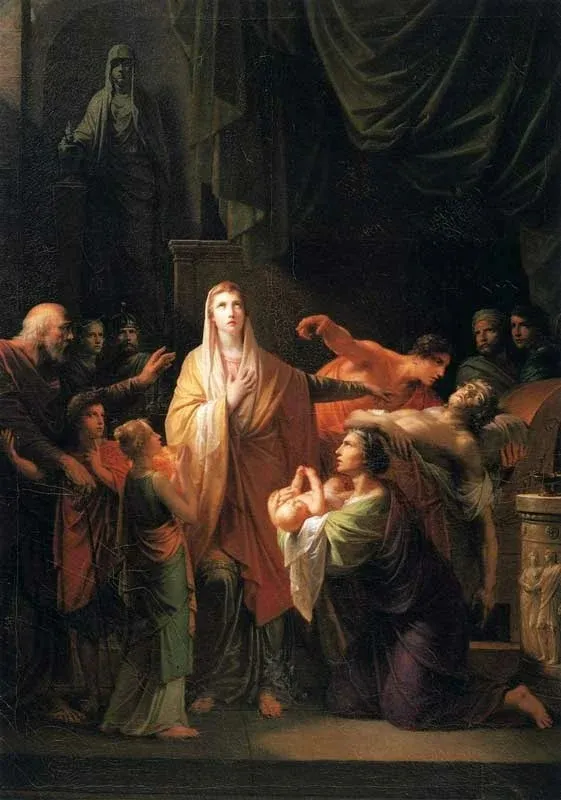
This whole scene is extremely overloaded with emotions. In some places it looks even better than Sophocles‘, but in other places, on the contrary, it is too much, which makes the performance begin to look unrealistic (cf. the stage behavior of 18th- and 19th-century society ladies, with the popular culture of “fainting”). At all times, from antiquity to our time, theorists and practitioners of art say that Euripides was a realist, while Sophocles idealized people, wanting to educate them in new, more “high” qualities. Therefore, Euripides was evaluated a little worse than the same Sophocles. But here even on the example of “Alcestis” we see exactly the same idealization of high and noble qualities of man. It is just that Euripides wished to cultivate somewhat different qualities, less “sublimely stoic” and more sensual-humanistic (we would say “epicurean”). The fact that Euripides was later considered a “lowly” poet is probably due to a perverse association with a number of false dichotomies (reason/feeling, good/evil, older/younger, male/female, white/black, virtue/dissoluteness, Romans/Greeks, Stoics/Epicureans, etc.). If we look at Alcestis, the characters of “exalted” characters are found here even more often than in the idealized works of Sophocles. The only question is the specific forms of this “sublimity”, and it varies.
Returning to the first scene, to the conversation between Apollo and the demon of death, it is worth reminding that Apollo failed to defeat the demon, but in the best traditions of his image, this god gives a prediction. He says that Heracles will appear in the city and will take the girl to the world of the living. And so, after the scene with Alcestis‘ farewell, in the very next act Heracles arrives in the city. I.e. the motif of divine fate and determinism still penetrates Euripides’ work.
Father-child conflict
In the scene of Alcestis‘ funeral, we see another motif that distinguishes Euripides from all the previous plays of Aeschylus and Sophocles. Admetus’ father has come to bid farewell to Alcestis; but the son despises his old father, for the father, who already had little left, was unwilling to sacrifice himself to save his son; or since the role of sacrifice was chosen by Alcestis, the old man could have saved the girl by insisting on a substitute sacrifice. Since the father did not do this even for the sake of his own son, and by doing so he supposedly lost his “virtue”, his presence at the funeral is now perceived by Admetus as an insult to the memory of his wife, and to him personally (it should be understood that Admetus himself could not die, because Apollo arbitrarily decided to rewrite his fate, and someone must necessarily die in his place, but who exactly — it was not precisely prescribed, so there was still room for variation here). Not only the general idea of what is happening on stage, but also the narrative itself changes greatly. Sophocles never, even in moments when the “fathers” were extremely wrong, allowed their “children” such harsh expressions as we see below:
Over the youth you ruined,
Do you now come to weep? Condemned
Before men enough, hardly
You were even my father, old man.
[…]
Your age was so short. What feat of sacrifice
Thou couldst accomplish by thy sacrifice,
What glory.
Here
Thou hast experienced all the happiness of man:
Thou hast been king from the youngest nails,
Thou hast had an heir. Behind thee
All things would not have fallen to ruin. Thou darest not
Thou darest say, surely, that I have insulted thy old age.
I have insulted thy old age, that I have not been
honorable. Oh, for my cares
You and your mother have paid me handsomely.
Please hurry up and have more children.
More children, old man, or else who will be there
to feed you, and if at last
You die, who’ll clean up your corpse, who’ll carry it out?
Who’s gonna take care of your corpse? Not me, not Admet.
Of course, the society of “elders” from the choir, and the father himself, strongly object to such an impertinent tone. It could not have been otherwise:
But what a tone, my son! Did you buy yourself a Lydian
Or did you buy a Phrygian slave?
I advise you to remember: a Thessalian,
The free son of a free father.
before thee. But your childish words
cannot hurt me. I bore you
I brought you up to give you your father’s house.
To give thee, not that I should give thee,
To buy you back from death with my life.
The father’s argumentation is simple, the son cannot reproach him for his cowardice before death, because he himself is cowardly and allowed his wife to die in his place (a strong argument, but not really, if Admetus really had no choice because of Apollo, though the father does not know about it). Further reasoning in the dialog concerns whose life is more precious, the old man’s or the young man’s. And the question of “life-love” as such is raised separately here:
You love life yourself, it seems. In your father
Why don’t you want to recognize the same love?
[…]
And you have the spirit to reproach others
to reproach what you yourself are guilty of.
Silence, child, we are all of us life-loving.
I will answer to your scolding with sternness.
The ideological motive of this dispute is obvious; it is all the more interesting because here the “old man” — the very one who is supposed to embody Sophocles’ “stoic” ideals — rationally justifies his vitality, even when his son demands that he be conventionally virtuous. Euripides generally agrees with the elder, since his son could not challenge any of his assertions, and began simply to press the old morality, the images of valiant death.
(Admetus) But death will not bring you glory.
(Feretus) No glory reaches the dead.
By design, in the eyes of the theater’s conservative audience, the elder is supposed to be “downright” wrong, which in itself is a break in the pattern. And what is more, the chorus of elders chants that the young man should not argue with his father (which is generally “right” in the eyes of the audience); but this formal deference to the elders actually justifies a “lowly” attitude to notions of honor. Even in the very arrangement of roles there is a considerable irony over the “high” poetry of Euripides’ contemporaries. As for Euripides’ own position, it is ambiguous and will eventually lean to the “right”. He cannot dispute the arguments of the elder, but he does not want to fully sign under them either. For Euripides himself, the theme of “glorious death” is of great importance, and he will still try to justify this theme in his later works. Perhaps here, too, he sides with Admetus, but for some reason has made his father’s argument stronger. In that case, it’s a failure.
Manifesto of Hedonism
No sooner does the viewer recover from the violation of the “logic of virtue” that he has seen, than we are immediately shown Heracles feasting and visiting Admetus. And again strange things: everyone around knows about the mourning in the house of Admetus, massively dressed in black clothes, but Heracles does not prevent him from feasting! Why does everyone wear mourning? Sure, he even tried to leave, and yes, Admetus himself made his friend stay, out of hospitality, but does that justify such carelessness? Hercules in the story did not know that Alcestis was exactly dead (though he knew, or guessed, that she was near death!), and on this is built the attempt to justify him. But with or without justification, further events do not fit into any picture of the traditional hero’s appearance.
Even the slave of Admetus (!) grieves, considering Heracles’ behavior inappropriate. And we remind you once again that Heracles in the plays of the previous authors, as well as in the Greek logic of myths in general, is an extremely “stoic” character, the embodiment of warrior virtue. Here, however, he is initially painted in rather negative colors, even against the background of a slave. And so, when Heracles finds that the slave serves him with obvious discontent; what does the hero decide to say about it? Does he try to find out what the cause is? No! “The embodiment of the virtues” Heracles lays out a little manifesto of hedonism to the slave!
You! Why lookest thou sullenly, why art thou.
What cares thee, slave? When thou hast served thy guests,
Thou shalt not make them uncomfortable with a sad face,
Be cheerful. Thou hast before thee a companion
and thou hast puffed up thy face,
and you frown, for the trouble of others…
Come here, learn, you’ll be smarter:
Do you know what our life is?
Come,
Don’t you know, slave? No one knows,
If he’ll be alive in the morning. Our destiny
No science can tell us the way,
nor cunning can buy its secrets.
Think it over and have fun. Behind the cup
A day is yours, but tomorrow, someone else’s tomorrow?
Thou of the gods art almost special, friend,
The sweetest of mortal gods, Cypris.
And all other things aside! My
If I seem right to you, follow my words.
If I seem right.
Come with me,
(clapping him on the shoulder)
And we’ll adorn ourselves with wreaths
From your gloomy thoughts the cheerful splash of wine.
On your goblet, believe me, you’ll sail away.
But to the pompous and gloomy, if thou take my judgment.
Thou wilt accept my judgment, not life but torment.
Is this not another insult to the whole “virtuous” public? But to somehow smooth things over for the further plot, we are reminded that Heracles did not know about Alcesta’s death; he himself is fiercely indignant when he learns about it from a slave, and even realizes that his behavior was improper. But has his position — «of the gods almost especially, friend, the sweetest to a mortal, Cypris”- ceased to be his position? Certainly not. The image of Hercules is greatly altered here.
A love story
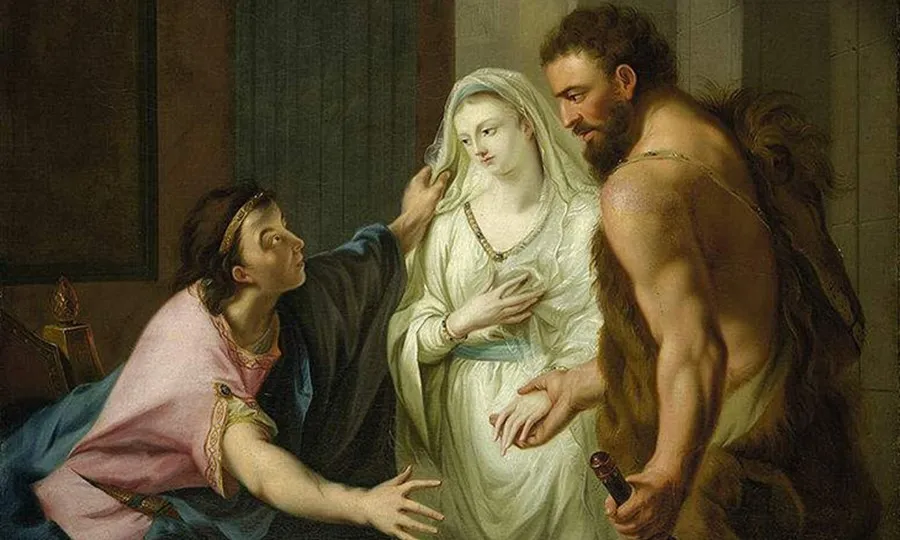
Despite the fact that “deception is bad,” Hercules is not angry at his friend, and decides to help. In many ways, he does so because of the same principle of hospitality. Admetus, even in mourning, did not want to reject his friend and burden him with his troubles, and perhaps he was wrong here; but the guest was well received, and so must, as it were… repay the good reception. So Heracles goes to Hades, where he defeats the demon of death in battle (thus fulfilling Apollo’s prophecy from the beginning of the play), takes Alcestis, and places her in the hands of his friend.
With heavy right hand struck
He did not deprive me of my feast,
He honored in me so noble a guest.
In Thessaly, in all Hellas.
Who can compare with him in hospitality?
Euripides talks a lot about fate in these last scenes, as if trying to further justify the deed of Admetus (that he gave his wife instead of himself, did not prevent her), and shows us an amusing scene of exactly how Heracles hands Alcestis back. He doesn’t reveal her name first (!), as if playing a game with Admetus. He does this so that in front of his wife he can reaffirm his loyalty to her, and after that she would reveal her identity to him. Everything goes according to plan and we get a happy ending. The gods did not punish Admetus for his impertinent words towards his father; and Heracles did not lose his valor, even though he was clearly nihilistic. On the whole, everyone should be satisfied (Happy End), but Euripides still left quite a few ideological barbs in the direction of the “mainstream” of his time.
What is separately striking is that we get very atypical characters and an atypical plot. The main characters are idealized lovers. Their tragedy is built on their personal, inner feelings, on their love. To make such a plot the central theme, and even so that no one died, is highly unusual for the theater of that time. So there is also an atypical image for the father, an atypical image of Hercules and an atypical image of Apollo! If we try to describe the main innovations of this play, they are as follows:
- more expression and feeling than ever before;
- innovations with the presentation of material (silent tearful scenes and musical intermissions between acts, flashbacks and hallucinatory images);
- paying attention to characters’ feelings and less “high” pathos;
- deconstructing old characters and trolling the aristocratic notions to which Sophocles and Aeschylus clung.
- The image of the “noble slave” emerges, a man of high spirits, highly sympathetic to his masters.
Another important difference between Euripides and Sophocles (even the early ones) was the development of an intrinsic motivation for suicide for their characters. In Sophocles, suicide is most often committed out of shame for some transgression, or out of fear of punishment; this emphasizes how terrible the transgression was, that it is even unbearable to live afterwards. In Euripides it is the opposite, the motivation is explained by his own desire and good motives, the desire to make a sacrifice to save someone, and by this to show how great was the love.
But the central theme of the play, if not in substance, then in form, is of course the importance of hospitality. Even in parting, Heracles reminds Admetus once again: “And you yourself, always be just and honor your guest.” This is, literally, the “moral of the fable.” But if we were to reveal the plot of the play through the theme of hospitality, then all other moments would have to be relegated to the background. And this theme is essentially irrelevant. We can only note that the behavior of the characters, built around the notions of etiquette — quite traditional and patriarchal, and by making this theme the main theme, Euripides brings to the forefront the notion of moral duty of Heracles. Without this point, it might seem that Euripides is quite the “sophist” and has strayed far from the morals of his contemporaries. Of course, this is not true, but he took the place of “dramatic philosopher” for a reason, so that the “sophistic” elements in his work are significant, and more significant than in any other famous tragedian.